Showing posts with label Marvel. Show all posts

Wednesday's New Things: Fantastic


1. This is the second Fantastic Four reboot in as many years. That's not a good or bad thing, necessarily, but I liked the direction that Matt Fraction was moving, even though the individual plots weren't always quite coherent. It's a shame that he gave up on the First Family to focus on Inhumanity, a project that is no longer his. Here we are, anyway, with James Robinson and Leonard Robinson taking the series up; Robinson's pencils, take a peak here, don't have a line out of place, and they stake a nice spot between photorealism and stylization. He's well respected from his work on that Captain Britain series he did with Paul Cornell five or six years ago; from the preview, it doesn't seem that there's anything particularly exciting about it, but it certainly gets the job done. As to Robinson, well, Starman is one of the most fondly remembered series of the nineties. That's not a high bar, but it is really good stuff, and it holds up. He hasn't been quite as good since, but I've heard intriguing things about the Earth 2 series he was doing for DC, and my understanding is that he's been generally solid. Obviously, he'll have to do something wild to step out from Jonathan Hickman's shadow here; starting with a story called "The Fall of the Fantastic Four" is certainly one place to start. I'm always suspicious of stories that give away the conclusion in the title, but there's certainly room for something interesting in this new phase of the world's greatest comic magazine. 

Wednesdays New Things: Iron Man, Once A Year


1) Undertow just seems like a good comic. I don't know either writer Steve Orlando or artist Artyom Trakhanov, but there's something about the preview that just pulls me in. Steampunk adventure at sea? What could be bad? Except the white lettering, which is hopefully going to be clearer/changed in print. 


2) I'll probably trade wait this one, just because it's a mini, but the premise is Winter Soldier-as-gangster, which is at least nominally intriguing. Also the art is great; think Chris Bachalo working in black and white. 


3) Marvel's Iron Man Annual #1 (I remember buying an Iron Man Annual #1 in 2010, but its time I accept that comic book numbering is meaningless instead of letting it drive me crazy) is a weird, weird comic book. It costs five dollars, and its an epilogue to one of the Marvel Infinity Digital comics. It is written by Kieron Gillen, but it doesn't seem to be connected to the mainline Iron Man book at all, except, of course, that the solicitation is very vague. Who knows? Could be relevant. I don't think I have a fiver that cares, though. Similarly, who is this new New Warriors series for?

Coming Soon to A Spinner Rack Near You: Ms. Marvel


The new Ms. Marvel series, coming out in February, is to be written by G. Willow Wilson and drawn by Adrian Alphona and will feature a new character, a shape shifting Muslim-American teenager named Kamala Khan. Today's announcement came by way of a New York Times article
The creative team is braced for all possible reactions. “I do expect some negativity,” Ms. Amanat said, “not only from people who are anti-Muslim, but people who are Muslim and might want the character portrayed in a particular light.” 
But “this is not evangelism,” Ms. Wilson said. “It was really important for me to portray Kamala as someone who is struggling with her faith.” The series, Ms. Wilson said, would deal with how familial and religious edicts mesh with super-heroics, which can require rules to be broken.
I've read Wilson's work before, and remember particularly liking her graphic novel, Cairo. I have every confidence that this book will be very good. That Times article goes a little too far out of its way to pat Marvel on the back, though, and it is important to remember that comics' diversity problem is not going to be solved by little, well publicized displays here and there. This is definitely a step in the right direction, moreso than Mighty Avengers was, and it will be interesting to see the reaction, both inside the comics community and outside of it, as we move closer to seeing this new Ms. Marvel in print. 

Coming Soon To A Spinner Rack Near You: Gillen and Kubert's Wolverine Origins II


Kieron Gillen, on what's inside (via CBR): 
This story is set right before World War I. It takes place right around the time the German Schlieffen plan for winning that war was was made up. So we're on the cusp of what will be frankly a horrific century and what will civilization mean, then? An earlier draft of the story featured characters like Sigmund Freud and the Futurist movement. That was my original focus. All that stuff is sort of gone, and now I'm really focusing on the characters and what's important there, but in terms of themes, the idea of civilization and how violent it can be is a big part of this story... 
The X-Ray was originally called that because they had no idea what it was. An "Unknown" or X-Ray was pretty much the short hand for that, and this story is only a few years after that. So it makes sense that if they found a new form of human living in the woods, they'd call him an X-Man. That's all kind of built into the period detail. Ideas like Eugenics were prevalent around this time in this world that was on the brink of war.


Wednesday's New Thing

Uncanny X-Men #1. More on this soon. 

Thor: The Mighty Avenger and The Aesthetics of Scale

Over at his newly reinvigorated blog, Chris Samnee has posted a sketch of Thor and the Warriors Three.


Samnee hardly needs a good reason to sketch, although I imagine that he might be a little bummed out these days. It turns out, though, that he picked these particular characters in honor of Marvel's upcoming reissue of Thor: The Mighty Avenger. TTMA is one of the great unsung comics of this century, an all ages, absolutely free from the shackles of continuity Thor story, the real main character of which is Jane Foster, here an academic working at a museum. Roger Langridge wrote with a nice combination of for-the-neophyte and for-the-obsessive, totally reworking the character's history, but also nodding along to the tune of its contemporaries by setting it in Oklahoma, although in Bergen rather than Broxton. Rereading the first issue now, it seems pretty clear to me that whoever wrote the script for the Thor movie used this comic for part of the inspiration and they couldn't have made a better choice. 

The book was also the first extended encounter I had with Samnee's work, which I've since come to adore. Although the look is very typical for the artist, simple and bold, I think it might be his best work: the line is thinner than the one I usually associate with him and the compositions are less crowded, giving the book a gorgeous, spacious quality. Matt Wilson's not-quite-flat colors also need their due, as they detail the compositions while complicating them only slightly, joining Samnee's art with a consistent visual tone. 

For whatever reason, TTMA didn't sell well, and it only lasted eight issues. I suspect its unfortunate demise had to do with a misunderstanding about what could be expected, sales-wise, out of an all-ages title; as the mainstream newsmedia never fails to remind us, comics aren't just aren't really for kids anymore. A few neat looking all-ages comics boutiques not withstanding, the children's market is probably not as robust as any of the big companies would like. So when Marvel eventually collected TTMA, they doubled down, publishing it in a scaled-down digest format, presumably because little books fit better in little hands. Insofar as this cramped the book's style, turning the spacious into the claustrophobic, it was a small tragedy. 

Last weekend, I wrote about comics' unique ability to suggest through variation of panel size, and now I can't help but wonder if there's a minimum threshold for that. On the other hand, Archie and other books are published in small magazines all the time, but those stories are designed for that size. So it seems more likely that the nature of TTMA changed, that it got less good despite no actual change in content, not because of the size of the book itself but instead because it wasn't designed to be so small. I also wonder if the same thing is true about the scale up--  I've never read one of those neat IDW artists editions or any of those massive Marvel omnibuses, so I don't know for sure. But I get the feeling that they might be weird, or certainly awkward, reading experiences; nobody is big enough to read a thousand page collection the same way they read a single issue. 

The nice thing about this particular reissue of TTMA is that they've scaled it back up to original size, so that you can, in reading it, get a much better idea of why the book is so great. Surely, for Chris Samnee, the Warriors Four, and the rest of us, that's a good reason to celebrate. 


The Best Way To Promote A Comic?

Earlier this evening, Marvel released a trailer for the upcoming Age of Ultron event, written by Brian Bendis and penciled by Bryan Hitch. Rich Johnston has, very kindly, made it embeddable:


In the past, Jon has fantasized about a future in which comics, and not just the movies based on them, are promoted on billboards in prominent locales, but, save that Fables spot that Vertigo ran on the BBC a few years ago, I'm not sure I've ever seen something quite like this. It's interesting for a few reasons, not least of which is that I hadn't realized that Marvel was releasing Age of Ultron at such a fast clip. Three issues a month seems onerous, and I wonder if it might affect the sales of either the crossover or of some the company's other books. I know that, in terms of my own purchasing, it's a lot easier to take an extra $3.99 out of my wallet once in a given month without thinking about it than it will be for me to do it three times in the same span, so I think I'm going to pass. On the other hand, one of my major complaints about crossovers, Marvel's in particular, is that they last so damn long; even shipping twice monthly, waiting for AvX to conclude was numbing. With AU lasting just three months and change, I can return, blissfully, to stories I actually care about much sooner than before.

To return to the trailer itself: I wonder if this is the best way to advertise comics. It is certainly one way of doing it, but it fails to achieve what's really great about the movie preview, which is that it can give a real sense of the thing that it promotes, while also divulging just enough plot detail to hook an audience. Now, there a few ways to nitpick this particular trailer-- it relies mostly on already revealed covers rather than delivering much in the way of the new, the narration is reminiscent of those old commercials for Power Rangers video tapes, it utilizes animation in a way that is even more insipid than most motion comics and, most egregiously, it doesn't do a good job of explaining who the creators are-- but I wonder if even one that was more well made woud be a good way of giving a sense of what a comic would be like.

Part of the reason that I suspect it can't be is that video and comics work on similar, but fundamentally different, visual principles. Each is a kind of window, yes, but, when you watch a film or a tv show, the size of that window, in this case some kind of screen, tends to be the same when you start the thing as when you end it. This seems likes it would be true with comics-- page sizes tend to be internally consistent-- but the base unit of the comic isn't the page; it's the panel. This is not to say that panel sizes can't be consistent, just that they aren't always, and, specifically, that Bryan Hitch doesn't make his that way. Hitch's "widescreen" art style is neat because it gives comics, very small in physical size, a wonderful sort of scale up, making some of his scenes seem grandiose in a way that is much more common in film. That said, the style only really works when there are also many smaller, less grandiose scenes, which is why no one constructs comics out of splash pages alone, and why they didn't even when the widescreen style was in vogue. The AU trailer, which generalizes panel size by mediating panels, not pages, through both editing techniques like the Ken Burns effect and the consistent size of the YouTube screen-within-a-screen, totally robs Hitch's art of what makes it work. Watching the trailer, it is possible to see that some the art takes the wide view and that some of it does not, but seeing that isn’t really the same as understanding it, isn’t the same as being convinced of it. That comics can make meaning through the way that the size of its building blocks relate to each other is one of the things that makes the form unique, one of the things that makes it great.

That the trailer can’t communicate why I might be interested in AU as a piece of art rather than as a particular story is why it fails. I know it might not be for me--it's too general to be coded for people who are already readers of comics-- but the hook isn’t such a great one that a potential reader would be sold on the book on plot alone. If Marvel really wants to bring new people into the fold, shouldn't they emphasizing what makes their product interesting? And if they want people like me to take a risk on a book that we're not otherwise inclined to buy, particularly if they’re going to ask us to shell out $11.97 a month to follow it, I can't help but wonder if there's some way to give us some of what we love.


Review: Uncanny Avengers #3

I'm beginning to worry a little about Rick Remender. The difference in quality between the first two issues of Captain America and this most recent one is bizarre, with the first two bordering on excellence and that other one, well, dithering around the saccharine muck of what I imagine Remender thinks is inspirational.* Then, there's Uncanny Avengers, the first two issues of which were basically unreadable and but were followed up, with this third issue, by utter, if problematic, brilliance. Maybe Remender can only contribute to one good book a month? If Uncanny Avengers and Captain America have to enter a cage match to the death for his attention, which one wins?

Frankly, I suspect Captain America is Remender's for the long haul, while I'd be surprised if Uncanny Avengers lasts through 2013. Alex Summers (whose not even the other Summers brother!) leading an Avengers team just seems so purposeless, particularly since whoever cooked up this half-cocked idea for a series apparently couldn't decide if what they wanted was to appeal to nostalgia ("hey, it's an Avengers team with Cap, Thor and Scarlet Witch!") or novelty ("hey, that's two former Evil Mutants, one of whom was formerly very dead, and one guy who they actually had to send into space to get rid of on an Avengers team with Cap, Wolverine and Thor!"). If Remender can't figure out how to consistently write Captain-America-as-Avenger and also stop avoiding some of the melodrama that's plagued the series so far, I'm not sure I can keep with it, no matter how much John Cassaday begins to draw like his old self (more on Cassaday in a minute). It doesn't help, either, that the mutants-as-hunted-minority thing isn't exactly new, and that the specific metaphor Remender wants to draw about the possibility of madness in crowds isn't either. I suspect he's trying to add a little bit of ambiguity to what's been a paint-by-numbers plot at Marvel since the mid-Sixties, but, in inverting a very traditional superhero origin story ("a bad guy murdered my family and now I dress in a uniform... FOR JUSTICE") he doesn't make the the Red Skull's S-Men flunkies sympathetic so much as he makes the comic regressive, seeming to justify the brutality of the whole episode and therefore excusing its violence.**

Still credit where it's due: Remender finally manages to squeeze some genuine menace out of the new Red Skull, who is, for this issue at least, truly and persistently terrifying. There is some kind of mad pulp genius in getting a racial ideologue to bind himself to that which he hates, that is, in bringing that particular spent trope about expressive racism into camp, and doing it with a goofy scifi beat--brain grafting--that's probably been a cliche for half a century. Even so, this particular iteration of Captain America's archenemy just hasn't been convincingly villainous, instead seeming more like a poorly timed joke. Now, though, Remender's got the Red Skull really hamming it up, monologuing, "YES! Rise Up! STAND AND BE COUNTED!," as a mob of brainwashed Manhattanites led by his S-Men wander around destroying Manhattan, brutally killing mutants, all the while holding a glass so his manservant can pour him a tipple.*** It's, somehow, both chilling and delightfully ridiculous.

To the extent that the comic isn't problematic or exasperatingly overwrought, though, it's a lot of fun and Remender's relatively good day has a lot to do with that. Perhaps more importantly: John Cassaday's gotten his groove back. I know that he's gone after the next issue (he's a very slow artist and I'm not sure why Marvel thought they were going to be able to get their new flagship monthly out on time with him at the board), but the Drummer really outdoes himself here; his hallmark has always been the way he ties his figure design to distance, and, two issues in, he finally has the right ratio going. When he's close up, he works in an almost photorealistic mode, but, as he positions himself further away, everything becomes increasingly stylized, not-quite-cartoony, as if his understanding of the panel developed such that each one is only able to hold a certain amount of information before it loses something, and so he came up with this kind of relative style to maximize the effect of each. On the page, this translates into a very particular type of dynamism, and it makes his work, at its best, ultra-legible despite its incredible complexity. I want to stress the importance of that, so I'll rephrase: comprehending John Cassaday's artwork simply isn't very hard, even though his compositions have many things to say, by themselves and to each other. If Rick Remender can manage to figure out a similar trick for his writing, or if he can at least untangle himself, Uncanny Avengers might be a breakout book yet, even as its artist, back at the top of his game, steps aside.

---------------------------------------
*I know, I know, I'll write about it sooner or later.
**This is itself actually an inversion of one of the tropes of superhero deconstruction, the crucial distinction between justice and revenge, but, since Remender doesn't appear to be interested in pursuing this theme, I'm not sure that it was intentional.
***That man servant, by the way, is named Honest John The Living Propaganda, and he feels like the natural conclusion of some of the stuff that comes out in Ed Brubaker's Captain America work. I think that the character is more than a little brilliant, and I hope he sticks around for awhile.

Chatter: Dan Slott 1/10/2o13

Dan Slott's interview with The Village Voice makes the cover!
In speakng about his recently released intense turn of events for poor, beleagured Peter Parker in "the Amazing Spider-Man" writer Dan Slott said wonderful things during his interview in The Village Voice. Here's my second favorite excerpt:

"
"We're a crazy medium where people put on skintight costumes, climb up walls, fly, and shoot things out of their eyes," Slott says. "If there's any part of you that goes, 'You can't do a brain swap!' then you should go read Great Expectations." He rattles off a list of other fantastic story lines from his run on Amazing: "If you say, 'You can't give everyone in Manhattan superpowers!' or 'You can't create a doorway that takes you 24 hours into a future where Manhattan is destroyed!' remember, this is the Marvel Universe. We have mutant children raised by talking cows. We have teleporting dogs. It's fun."
"
~@DanSlott

And it's all true.

P.S. ~ Did you get a load of the issue's awesome cover? [See it up top?] Even more importantly, do you appreciate that the current Spider-Man comic-book storyline and the Spider-Man fanbase's reaction is the subject of the cover story for The Village Voice? It's not about the movies (hardly, anyway) or about the Broadway musical (not really, anyway) or about the rumors surrounding the lovelife of an actor palying Spidey, it is an interview with Slott about his current and ongoing work with the original main 616 Peter Parker character. In other words, it's about SEQUENTIAL ART. Genre fiction sequential art no less.

P.P.S. ~ My favorite excerpt of writing from this interview is more just a great joke about fandoms in general. "Game of Thrones" die-hards are apparently a little crazy.

And, NOW!: Iron Man #1

And, NOW! is a series of posts about Marvel NOW!


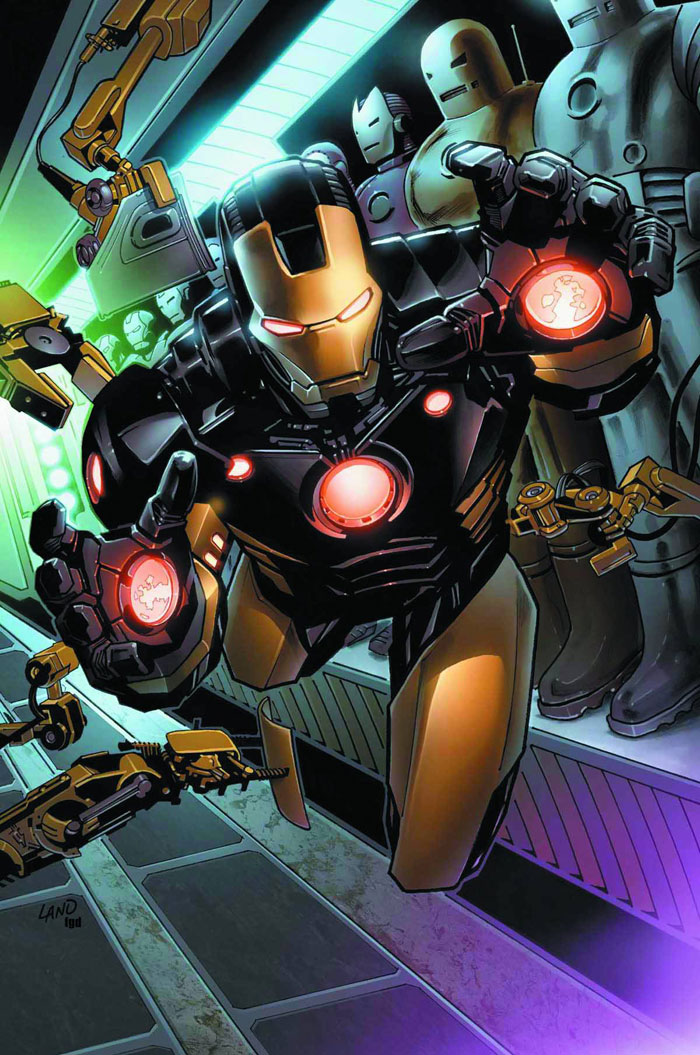
Let's get one thing straight: Greg Land is not a bad artist. He's not a good artist, either, but I think I've been hyperbolic about his work in the past and I just wanted to clear this up. Although I'm not attracted to his artificial style, which is a stiff and lightboxed parody of photorealism, I am willing to admit that his lines are solid and that his characters have a certain boldness, a kind of magnetic density that draws the eye towards them and away from the rest of his compositions, which, themselves, merely suggest scene dressing.

Part of the problem with that kind of composition, though, is that individual panels often closely resemble one another. To avoid a repetitive page, then, Land is forced to pull the reader a great distance in between panels, effectively slowing any natural movement from one to the next by forcing the reader to close more space than he or she should have to. Since the relaunch of Uncanny X-Men, a year ago, though, he's been doing a few things that ease the reading experience, like varying compositions in interesting ways and, most importantly, allowing panels to interact with each other through the gutter. In the sequence below, for example, the cell phone flies out of one panel, up and over the gutter, and into the next one. The move between individual compositions is kind of awkward, the first indicates movement and while the second is still, but the airborne phone suggests, very deftly, how the character in the white shirt moves while the reader is in the space between.

All of this to say that I'll defend Greg Land, yes, but only up to a certain point-- his human characters all have exaggerated soap opera facial expressions that leave much to be desired. Like Sal Larroca before him, though, his style lends itself to the drawing of machines, so that his version of the Iron Man armor is dynamic in the same way that his drawings of people are stilted, at least in terms of the individual panels. This seems to make him a perfect choice for Iron Man and he may indeed prove to be, but only if Kieron Gillen does his damnedest to keep Tony Stark in the suit rather than leave him out of it.

Basically, its up to Gillen to write for his artist's strengths, in a way that Matt Fraction didn't always manage to do when he was writing for Larroca. Reading this first issue, it seems likely that this will be the case, since Gillen is eschewing Fraction's fascinating corporate espionage angle in favor of a more traditional man-of-action faces down terrorists kind of plot, one that will require Greg Land to draw more than one kind of armor. For his part, the writer does a pretty good job, even managing to relatively concisely explain a piece of information from an old Iron Man arc, even as he's placing it at the center of his own story. It's a masterful example of how good shared universe writers can relay enough information to keep new readers in the loop while still managing to keep old ones interested. Gillen has experience with this particular kind of counterterrorism story, often pulling it out during his Uncanny X-Men work, but much of that stuff was sort of out there and I expect that he's going to play Iron Man much more traditionally.

I think Fraction and Larocca's work with Tony Stark is probably definitive for the next little while, but if Gillen can keep it up, and if Land can behave, then we may very well have another classic on our hands. 

Marvel, Then: Intro


I'm hunkered down in my apartment*, waiting for Hurricane Sandy to pass me by. Happily, this means that I am catching up on months worth of reading I have piled up next to my mattress, but I also figured that it was a good time to quickly intro something I'm going to be doing over the next few months, in conjunction with the House of Ideas' Marvel NOW! yearly culling of established ongoing series in order for the company to replace them with new number ones in an attempt to temporarily raise sales relaunch, namely, the consideration, first, of the books whose era has just ended (Matt Fraction and Salvador Larroca on Iron Man, Ed Brubaker on Captain America, Jonathan Hickman on the Fantastic Four, and so on) and then of the books that are replacing them.

In some ways, this series started last week, with my review of the initiative's not very good flagship title, Uncanny Avengers #1. That was sort of a false start, though, since the first few posts, which I've not very cleverly titled "Marvel, Then," are going to focus on what's ending, rather than what's new. Because of the staggered roll out of new titles, though, some of those posts will run concurrent with the posts, titled, again very cleverly, "Marvel When?" that deal with what's new NOW! that an era that's a decade old has come to a close.

That time frame, of course, is the same one in which Brian Bendis has been writing The Avengers. His work on that franchise over that span, while hardly the greatest superhero comics produced in the period, made possible the existence of some much better work. If he hadn't brought Luke Cage to the forefront of the Marvel universe through sheer force of will, for example, it seems unlikely that Immortal Iron Fist would have happened. I have a feeling, too, that his use of the Thing in New Avengers is partially responsible for the success of Jonathan Hickman's Fantastic Four. Bendis's move to other projects, which would have presaged a monumental change even if Marvel hadn't cloaked it in a line wide changing of the guard, presents by far the most important questions of this new era, at least when we think about Marvel as a business: can he replicate his Avengers success with All-New X-Men? Will his high word count writing style, the superhero board room approach, translate well to a much different kind of series? How about Guardians of the Galaxy? Is it going to be any good? Given that it mostly exists to gin up excitement for the movie adaptation, could it possibly be any good?

While Bendis's contributions are important, and while his arrival at Marvel marks the beginning of a renaissance for the publisher, I don't want to minimize how important, maybe even how much more important, I think Hickman, Fraction and Brubaker are to the company's artistic success over the last decade. Before them, too, were people like J. Michael Straczynski and beyond those three there are people like Kieron Gillen, each of whom helped to make Marvel's recent production stronger than anything from the Big Two comics companies in quite a long time. So, for the next few months, besides posts on the new Iron Man, Thor and Captain America series, you can expect commentary on the old ones, as well as whatever else piques my interest during this most fascinating moment in the history of the House of Ideas.

----------
*Although this is posting Tuesday, I wrote it on Monday after I was sent home from work.

Process: Paolo Rivera

I know I posted some process from Paolo not very long ago, but I want to highlight his last post, which deals with his work on Mythos: Captain America, because, in it, Paolo goes beyond the art itself, beyond comics, really, and deals with its afterlife.

Of Mythos as a whole, that is, of the comics themselves, Paolo writes:
The series did less than amazing in terms of sales, but Marvel still followed through with the project until we had enough issues to collect into a beautiful hardcover. If nothing else, it proved to be a fantastic platform for jumpstarting my career — aside from being paired with a top-tier writer, I got to illustrate the cream of the crop in terms of Marvel characters. And all that while I was still a rookie: when they gave me the job, I had painted just 34 pages for them.
In the pantheon of creator origins, Rivera's story is kind of extraordinary. Although he was one of the few comics artists in the last few decades to immediately jump to the big leagues, I'm not sure he has ever been introduced with that overused "superstar artist" epithet, despite the fact that the quality of his work is often much higher than those artists that are. Instead, he began his career by working for the House of Ideas, and, perhaps more interestingly, he has only produced a couple of dozen books for the company over the ten years he was signed to an exclusive contract with themWhile I'm cynical about the ability of mainstream comics companies to see and recruit truly talented artists, its not hard to see why Marvel kept Rivera around for so long-- look at these pages, both from Captain America's Mythos issue: 


Although the one on the left is unequivocally beautiful, the one the right is fascinating, formally: check out the way the Rivera suggests differences of time in the top three panels, although all three frame the same space. Obviously, this is exceptional work, but anyone who suggests that nothing interesting happens in mainstream superhero comics isn't paying close enough attention. 

But Rivera doesn't just pull these images out of thin air. His process, which he very generously describes in more or less detail on a regular basis, is one of the most intensive I've ever read about. Rather than bluffing his way through the parts of a page he thinks people are unlikely to notice, Rivera takes every detail into account. He sketches everything from multiple angles. He takes reference photographs and, when he can't, he sculpts a reference out of clay. Take a look:


Of this technique, he writes:
One of the things I love most about Marvel heroes is that they don't always look the part. In fact, Captain America was the first in the entire Mythos series who had the classic heroic look (despite the fact that he doesn't start out that way). Creating that square jaw from scratch ensured that I got exactly the look I was going for, panel after panel. This was the largest of the maquettes I've made — the head's about 2 inches tall — and I still use it as a general reference for all types of heroes. 
I think he probably builds whole pages, both in reality and in his head, that we'll never see, things that are just as good as what he has published. It's hard to escape the sense that Rivera would have found success as a fine artist, had he not decided that what he really wanted to pursue was a career in comics.

Of course, the fact that his production is extraordinary neither makes him immune to market forces nor excuses him from paying the rent. In fact, I imagine it was something of a detriment: he's admitted that he's a slow painter, but, given how much work he does before he even touches the gauche, it would probably be more accurate to describe him as a pure and simple perfectionist. Still, perfection has its price, and I imagine the way it was limited production could be hard. Working on Mythos, however, helped him alleviate some of that stress:
The fact that I was commissioned to work on Marvel's flagship characters so early on was a privilege I recognized from the start, however, the benefits extended to my original art sales, which quickly became a third of my income (a much-welcomed addition since I was such a slow painter). If you're not familiar with the comic book art market, the price paid always comes down to which characters are on the page. Art is a commodity like everything else, and fame always trumps any intrinsic value. Captain America was (and always will be) more famous than me, but he has been kind enough to let me share in the spotlight.
I will tell you that, because I'm a recent college graduate, I never think about the original art market and, accordingly, know nothing about it. I had no idea that value in that world was figured in that way. Although I could imagine a market where value was determined by the relative fame of the artist, since everybody has their own favorite B-List character, this makes much more sense: Captain America will always be more famous than Paolo Rivera, and Batman will always be more famous than Jim Lee. Rivera's honesty about all of this is a thing to behold and, while I imagine that someone who wasn't some kind of fan of Marvel couldn't produce art that celebrates it like Rivera does, it's refreshing to see him admit that one of the perks of getting to draw the company's flagship characters is being able to up his income by a full third. A full third. 

Of course, an admission like that could be dangerous for artists, since its conceivable that they could end up stiffed on pay, with the big companies using that reasoning as an excuse: "Well, yeah, your royalties are tiny, but have you ever thought about original art sales?"

A few weeks ago, I heard Sean Howe describe his recently published history of Marvel as a story about pop culture because its a story of how art met commerce, and Rivera's post is a good reminder that its that confluence that conscientious readers of comics, that any conscientious consumer of culture, really, always need to be thinking about, but particularly when they're making decisions about what to buy and how. While it's tempting, maybe even partially true, to point to Paolo Rivera as story of a big comics corporation getting it right, Rivera's experience is, ultimately, atypical: he was as lucky as he is talented. And its important to remember that.

Review: Uncanny Avengers #1

I desperately want to like Uncanny Avengers #1, although mostly for sentimental reasons: I've been reading comics with the word Uncanny in the title since I was a seventh grader, when I started buying them off of a spinner rack near the counter of a Waldenbooks at the mall. Although I look back on those years, Chuck Austen was writing the book, with more than a little disdain, I liked it then because Nightcrawler was leading the team, and I just kind of stuck with it, only stopping for about a year in my senior year of high school and then again in college, for about six months and in protest, during THE SECOND COMING X-crossover.

So, yeah, I'm attached to the adjective, and I want to uncritically love this new use of it as much as I loved the last one. It should have been so easy to do, too, since it has, in Rick Remender, a competent writer and because it is being drawn by John Cassaday, one of the industry's brightest talents, finally returned from an exile in the Desert of the Cover Artists. Alas, it was not to be-- Uncanny Avengers is vulgar and incomprehensible.

It doesn't help, of course, that Marvel's bloated Avengers v. X-Men event, out of which this new series springs, ended as messily as it did, basically returning the Marvel Universe to a status quo ended when Brian Bendis undid all of Grant Morrison's New X-Men work in the pages of House of M (a story that Marvel's characters are, sort of inexplicably, now referencing every few pages).* Mutants, all of the sudden, are back, and they're popping up all over the place, in Beijing, in Cyclops's cellblock, everywhere. The premise of this book is simple: those mutants need help, and Captain America is determined to be there for them. His first order of business is to find them a leader (doesn't anybody at Marvel realize how condescending that is?), and the list of those who are unqualified is quite long. Scott is, obviously, out. Wolverine's past is checkered. Xavier is dead. Magneto used to be a terrorist. Who knows where Hope is. Onto this scene, from the pages of X-Factor, waltzes Alex Summers, first to admonish his brother, at this point a matter of course for a Marvel good guy, and then into the company of Steve Rogers and the mighty Thor who tell him, without prompting, that he is the leader that his people need. Cue the requisite hemming and hawing and then...

Cut to a fight scene, in which Captain America, Thor and Havok are on hand, out of nowhere and from across town, to fight a lobotomized Avalanche. This is how this book moves, with little regard for plausibility and continuity; from there, we're shuffled along to a moralizing internal monologue from the Scarlet Witch, kneeling at at the grave of Professor X. Rogue doesn't take kindly to this, and they prepare to fight when, out of nowhere, there's another completely illegible, although much more mysterious, fight scene. All of this is, of course, followed by a big, wacky reveal at the end. At this juncture, I think it's important that you  keep in mind that I'm talking about a story in which a man who dresses up in a flag and throws a round shield at things is teaming up with a Norse god and a man whose "x-gene" gives him the ability to blast things with powers he gets from exposure to sunlight to fight someone who, in the first page of the comic, has his frontal lobe removed and replaced with a computer and can cause earthquakes-- and it's the mode and mechanics of the storytelling that I'm finding implausible.

This is particularly hard to take, since the book has a lot of other things going for it. Remender, for his part, just stuffs it with interesting ideas, from the suggestion, at the beginning, that Havok might be the one to step up as a leader for mutantkind to the reveal, at the end, of a returned Red Skull, who needs Professor X's brain for some nefarious scheme for the destruction of that same people. Look, this could have been very good stuff, like a Matt Fraction story with a legacy villain and an occult twist. Rather than aping the slowburning plotter of Invincible Iron Man, though, Remender has picked up on the hyperactive tendencies of certain parts of The Mighty Thor, introducing too many big ideas to bring any of them to a satisfying resolution, at least on the level of this individual issue.

Remender's inability to pick one subject and stick with it is particularly galling because it wastes John Cassaday's considerable talents. Cassaday, who hasn't published any narrative work since the release of Planetary #27 in 2009, really does deserve better than this because, while Uncanny Avengers isn't the best thing he's ever drawn, it is an excellent reminder of why he's one of the few artists I follow faithfully, wherever he may go. His style, because it seamlessly transitions from photorealistic to cartoony and back, often in the same panel, feels natural, almost real. More than any other artist, I'm struck by how easy Cassaday makes it for a reader to suspend disbelief. This only works, however, if the narrative that he is drawing is, itself, natural, that is, if it flows comprehensibly. Uncanny Avengers does not.

Some of this, certainly, could be forgiven; Cassaday's art is good, and it's nice to see a writer as excited about his own ideas as Remender. Unfortunately, the book's dialogue is too often either reheated sermonizing from the end of AvX or stilted and manufactured, much like the conflict between Rogue and the Scarlet Witch, and that's just too much to take. If Marvel wants this to be a successful series, and since it's the flagship in a new era for the company, I'm going to assume they want it to sell well, they would do well to do some actual, honest-to-goodness editing here, if only to pin the writer down. There's too much good stuff here to let it get away like this again.

------------------------
*I think there's probably something to be said for the fact that Marvel is starting its NOW! era with a recursive move-- the company's stories are stagnant even when it makes an explicit attempt at moving them forward. At least the idea is a good one, one that should never have been abrogated in the first place.

Assembling To Protect A World That Loves and Hates Them


Next month, the Marvel universe is starting over, or, at least, parts of it are. There's a whole slew of new #1's, from an Avengers one pictured above, to new Captain America, Thor, and Iron Man volumes, some of it really interesting sounding and some of it, well, less so. What's going on, though, is not a hard reboot, like the kind DC did a little over a year ago with The New 52. It's not really even a soft reboot, either, since no continuity is being reset; instead, many of Marvel's characters are simply entering new phases of their ongoing stories, with new creative teams on the books that star them.

One series, though, is conspicuously absent from the books that have been solicited so far. There has not, at least not as of yet, been an announcement of a new Uncanny X-Men. That book, the flagship of America's second most popular superhero family,has been published with only two interruptions since it first emerged in the early Sixties, and, so, this disruption, the second in as many years, is much more interesting than any of the various and sundry renumberings that are going on, since, for example, this must be the seventh or eighth volume of Captain America and the above images represent, I think, the fourth volume of The Avengers, which is less ridiculous than the fact that we're on the third volume of New Avengers, a title that Marvel has been using for only seven years. Of course, the fact that there's no new volume of Uncanny is sort of explained by the new Uncanny Avengers series, written by Rick Remender, which is premised on a post Avengers vs. X-Men alliance between the two groups.

On its own, that seems like a typical big two throw-anything-at-the-wall-and-see-if-it-sticks sales strategy, but by publishing an Uncanny Avengers without publishing an Uncanny X-Men, that is, by shifting the Uncanny moniker away from its classic association and towards a new brand, I wonder if Marvel is tipping its hand. The whole thing sort of suggests a solidification of holdings, both in corporate and story terms, under the newly, massively, fortified Avengers brand. We've known for a while that Remender's book is going to prominently feature characters from both groups (and art from John Cassaday!). I remember reading a mention I can now no longer find of preview art for a Wolverine and the X-Men issue with a heavy Avengers presence in the Jean Grey school. And, oddest of all, in the interlocking covers for the first three issues of Jonathan Hickman's new Avengers series, Cannonball and Sunspot, two of the New Mutants, are the only featured characters who are not associated with the team in some prominent, iconic way.

This kind of synergy with the rest of the Marvel universe is sort of new for the X-Men, who were sort of left to do their own thing, particularly since they moved across the country and onto Utopia. The cynic in me says its about weakening a brand that the company doesn't totally control, and thereby strengthening the case for the inclusion of some of these characters in upcoming Avengers spin-offs, Fox be damned. I also suspect that, solely in the terms of the economics of comic books, it will be good for sales, since the two franchises are the best selling in all of American comics, and this sort of permanent crossover builds off of both the premise and success of Avengers v. X-Men. I don't know how wide ranging this effect will be, since I don't know how many New Mutants readers there are who don't already Avengers, but I guess you never know.

In story terms, this new synergy presents some interesting questions-- does the acceptance of mutants into the Avengers on a more general basis than Beast and Wolverine mean that mutants are no longer hated and feared by the society they're sworn to protect? Does that mean Xavier's dream is realized? And is that really only possible because the good professor is now, again, dead?*


All that, of course, sets up some really interesting possibilities having to do with Brian Bendis's All New X-Men series, and my whole theory might fall apart in the pages of that book. If it turns out that All New is Uncanny's replacement within the insular X-Men family, it won't be too surprising. But consider that these characters on the covers are all, excepting Magik and Emma and those two in the background**, iconic X-Men, ones that were used in the nineties cartoon, which is still probably the most recognizable group for much of the comics reading public, and certainly for my generation. They're also, again excepting Magik and the two question marks, characters that have been used in movie versions of the characters, so maybe we're not seeing a solidification so much as a kind of shift, which moves many of the excess X-Men under the Avengers umbrella. This could both strengthen the former brand and broaden the latter one, particularly if Bendis can build on the last few years' good work by Kieron Gillen and Jason Aaron, and if Hickman and Remender can manage the onslaught of characters effectively.

I'm surprised to find myself writing this, but I'm actually pretty excited for what comes now-- rather than feeling forced and random, like the New 52, this seems like almost a natural progression, everything seems to fit together, despite the fact that some of the decisions were probably made for artificial reasons. It's All New, and All Different, and that can't possibly be bad.***

----------------------
*I haven't read Avengers v. X-Men #11 yet, but, when I do, I suspect I'm going to have some very critical things to say about how the book handled the death of Xavier. As an idea moving forward, it's not bad, particularly in the context I'm talking about above, but it doesn't really ring true in terms of the crossover's plot, in part because he shows up absolutely out of nowhere in #10. I don't even think we've seen him since Matt Fraction left Uncanny and his death just doesn't have any gravity, given how unimportant the character's been since Joss Whedon chastised him a few years ago. But maybe they handled it really well. I won't know until I go to my LCS.

**Is that one on the far right Rachel Grey?

***By the way, the powers that be at Marvel, I have a request-- can we get the 616 Nightcrawler back?  Please?

A Note On Ed Brubaker's Move From Marvel

So long, Ed! (source)
I want to take a moment to talk about last week's news that Ed Brubaker is leaving Marvel in January, when he entrusts his Winter Soldier scripting duties to Jason Latour's very capable pen.

Since the announcement of Brubaker's imminent departure from Captain America, I've been been thinking about doing a rather extensive annotation of his run with the character. Such a project would be both massively enjoyable and massively time consuming, and I'm not sure if I have the wherewithal or, more importantly, the knowledge base, to do it properly. Now that I know that Brubaker's time with the House of Ideas is coming to an end, my impulse is to expand the scope of my annotations, which would, of course, mean both more time and more research. Even if I decide not to undertake such a sprawling project, watch this space for a couple of retrospective essays, which will deal with his Captain America work and his writing for and influence on the company in general.

Right now, though, I think its important to talk about what, exactly, is ending when the man who brought back Bucky Barnes walks away from Marvel to concentrate both on his creator owned comics and on ventures in other media. Much more than any other superhero comic book writer in the last fifteen years or so, I think that Brubaker understood that, when he was dealing with Steve Rogers and Bucky Barnes, or even when he was dealing with Iron Fist or Daredevil, he was dealing with the stuff of legend, and so he always approached the material in its own terms, with gravity and without anything resembling irony. Given the generally accepted absurdity of comic book superheroes, it would be very easy to laugh off Brubaker's seriousness as a kind of misreading of the state of mainstream comics, but I think to see him in this way fundamentally misses the point.

Indeed, I've always gotten the sense that Brubaker believes in superhero comics, that he believes in what they're capable of, and that he believes that they can affect the culture at large even if they don't often reach beyond an, unfairly stereotyped, niche market. That he is ambitious in this way is evident, of course, in his politically resonant work on both Captain America and Winter Soldier, but I think it can also be seen in his incredibly well respected Daredevil issues and the Gotham Central series he wrote at DC with Greg Rucka, and in his flawed X-Men work, and in his abortive run on Secret Avengers. His attraction to the big idea, to the conspiracy that takes years to unravel, to the story that takes dozens of issues to unfold, is clear in all of his work, but his ability to use the combination of medium and the genre as a certain kind of more- or less- subtle allegory is what sets him apart from even from the talented writers, writers like Matt Fraction, Jonathan Hickman and Jason Aaron, that are guiding Marvel's bold new direction. What Ed Brubaker gifted to us, more than almost a decade of excellent stories, was a renewed sense that not only could mainstream superhero comics be culturally important, but that they could also be literary, particularly if their readership was willing treat them as such.

Not all of his allegories are played out, yet, and the real shame here is that, for the next few years, even if new writers pull at the threads that Brubaker left behind, the work will probably lack that double ambition, that driving desire to tell stories that matter to everyone and that are also great. Everyone who is going to have to pick up from where Brubaker left off is going to have to deal with this, and I think that, rather than try, most are simply going to give up the gun; Andy Diggle's Daredevil run is the cautionary tale here. There is an obvious exception to this in Winter Soldier, but I wonder if, even with a talented writer like Latour and a movie with that title on the way, the book has any long term prospects without its creator at the pen. On the other hand, Captain America has, in the last year and a half, certainly begun to feel less essential, even as the month-to-month quality of the book hasn't dropped in any significant way, and so I'm not sure that Brubaker is pulling as hard as he used to, not even at his own big ideas. Still, if Rick Remender's high action Steve Rogers as John Carter of Mars new direction for the character is any measure, we're not going to get a chance to see superhero comics done quite as well, or quite as seriously, as Brubaker did them, at least not for a long time.

While this turn is lamentable, it is certainly not disastrous. Its important for those of us in or on the edge of fan communities to remember that nothing lasts forever, and doubly so in this case, since to act like it should, to assume that it would, betrays the high quality and literary aspects of Brubaker's work. Rather than mourn the end of something I love, something I think is important in way that superhero comics tend not to be important, I would much rather celebrate it. There are, after all, volumes of Captain America on my shelf, just waiting to be annotated.

Barton. Clint Barton.

I've been waiting for this book for a long time. Or, more precisely, I've been waiting for the successor to this book for a long time-- four years too long. Those first sixteen issues of The Immortal Iron Fist, those issues that Matt Fraction and Ed Brubaker wrote, those issues that David Aja drew, are certainly among the best superhero comics of our young century, and may very well be the best superhero comics produced in that century's first decade. But then Brubaker, after a little more than a year on the title, went back to concentrating on Steve Rogers for a living. Soon after, Fraction and Aja wrapped up the run, with the writer becoming Marvel's golden boy and Aja retreating, for the most part, back to Spain, doing an issue here and an issue there, dropping a few covers when he could.

I return to The Immortal Iron Fist on a pretty regular basis, out of nostalgia as much as awe, and, last April, it was good to hear that two thirds of the band was coming home for a series featuring the newly famous purple archer. Although Jeremy Renner's Hawkeye was the least developed and least seen presence in Joss Whedon's movie, the character still represented newly fertile ground for a decidedly West Coast Avenger-- if Fraction and Aja could drag Iron Fist back into the spotlight, after Brian Bendis, through sheer force of well, had done the same with Luke Cage, surely they could do the same for the Archering Avenger, right? Even though his last crack at an ongoing series was a massive, relationship ending, flop?*

Well, it turns out, they could. Hawkeye #1 is so close to a perfect 32-pages-with-advertising comic that pointing out its one flaw-- there's a panel that needs to be flipped in order for the characters' movement to make sense--seems like nitpicking. Fraction's writing is a joy, dense and clear, like, but not quite as much of a workout as, the best of his Casanova work. That book is probably the closest analogue to what he's trying to do here, not only because Hawkeye doesn't really resemble anything that either Marvel or DC is putting out right now, reading much more like one of those brilliant new Image books, but also because Fraction is very clearly pointing to the fact that he's going to be writing a certain kind of espionage story. The James Bond nods, one an explicit reference and the other a kind of easter egg, are a dead giveaway, but the subtler clues, the just this side of too clever references to Hawkeye's relative obscurity as a character ("...are you, like, Iron Fist or something?"), the way he passes unnoticed in his neighborhood, despite a conspicuous amount of purple in his wardrobe, suggest that this is a sort of anti-Avengers book, an attempt to figure out the hero that Barton is when no one is watching.

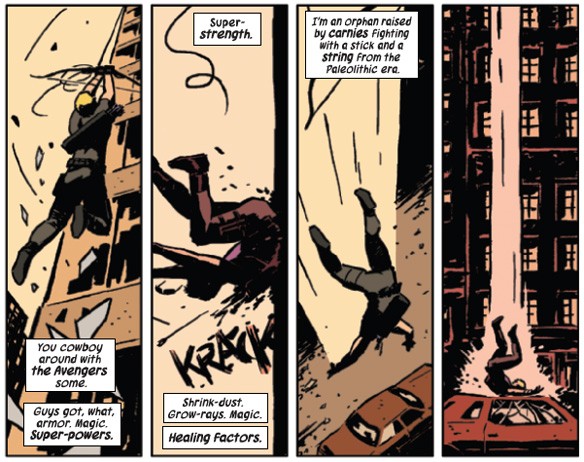
Given that, the closest cousin that Hawkeye does have amongst the current cohort of Marvel or DC series is Ed Brubaker's Winter Soldier, another superb spy project starring a less than well known character. But Brubaker writes a different sort of cloak and dagger than Fraction, more serious and less self aware, straight up espionage, really, while Fraction and Aja are just sort of winking and nodding at its conventions, and not those conventions alone. The duo mix their Ian Fleming references with homages to famous panels and reflections on the absurdity of an archer's presence on a team made up mostly of gods and supermortals, that is, the simple fact that a man who shoots a weapon from the paleolithic period is out of place on a team featuring Thor and a man with a reactor where his heart should be. In emphasizing these things, Fraction and Aja are reaching beyond Clint Barton and trying to say something about superheroes, or, more precisely, superhero comics, in general.


The punchline, it seems to me, goes back to how inconspicuous Fraction makes Barton, the fact that someone only recognizes him once in a while. Partially, that line is clever because it reads as a joke on how many times Hawkeye's costume has changed, but, truthfully, it moves beyond clever and into something resembling scholarly. Consider this: all comics, superhero or otherwise, work because of iconography, and not just obvious Captain America or Batman men-in-tights-with-their-own-homemade-logo iconography. We know that the talking mouse with the cigarette is Art Spiegelman the same way we know that the character with that one Curt Swan curl on his forehead is both Clark Kent and Superman. Icons are what makes comics intelligible, what makes them possible. But they're also what makes superheroes memorable-- this is why such characters found their natural home in the funny books-- and, without his bow, there's absolutely nothing iconographic about Clint Barton; as Fraction has himself has suggested, there's a much more famous character in American popular culture with that nickname:

I'd totally read a Fraction and Aja M*A*S*H comic. 
I would even go so far as to say that Barton's bow isn't iconographic the same way that, say, Spiderman's chest-spider is. The weapon represents Hawkeye, for sure, but it could just as easily represent a character at a rival comics company who is, with the exception of a slightly greener color scheme, essentially the same, or it could present him as an an American Indian stereotype or an Olympian. The bow, as a symbol, simply isn't specific enough to be powerful. Peter Parker's spider symbol, however, only really means one thing-- your friendly neighborhood Spiderman. This is why the Clone Saga, despite its poor execution, could have been terrific: the plot exploited a formal quality as the crux of the story. Fraction and Aja seem to have realized that his lack of significant or interesting iconography is Clint Barton's great flaw, the reason that he's never been successful except as a part of a group of much more immediately recognizable characters, and are making that flaw work for them rather than attempting to overcome it. 

That recognition, perhaps aided by the character's relatively limited presence in The Avengers, is why people, primarily people like me, have responded so well to the first issue of Hawkeye: Fraction is writing Clint Barton as the schmuck he's always been, he's just doing it with the mask off. It just turns out that Barton is much more interesting as himself, when someone is being honest about the fact that he lacks the heavy duty icons necessary for stardom, than he is as the purple archering Avenger.

--------------
*That's not entirely fair-- it just turns out that people were about as interested in Hawkeye and Mockingbird together, again, as they were about either alone.

Quote For the Week

This is Iron Man as adventurer and knight and… oh, let’s just have a quick burst of words. This is hyper-intense bursts of adventure and the future. This is about reclaiming the single issue story in the context of a larger narrative. 
-Kieron Gillen, on his upcoming Iron Man run for MARVEL NOW! If Gillen really can do that, if he can go ahead and carve out a space for single issue stories for one issue comics wholes that are only one order separated from the larger whole of an ongoing series, than it will be a thing of beauty. Of course, he's already managed it on a smaller scale, and I have to believe he'll manage it here, too.

Marvel's New Captain

It's an unfortunate coincidence that Sally Ride, the first American woman to travel outside of our planet's atmosphere, would pass away, at the age of 61, in the wake of Kelly Sue DeConnick's new Captain Marvel series. Instead of celebrating those woman who have managed, despite not only the force of gravity but also a sexism that similarly serves to try to keep them grounded, to touch the sky, we are, instead, mourning one of them. 

Of course, DeConnick got me thinking along those lines even before Ride's death-- Captain Marvel #1 is so good, in part, because its author problematizes stereotypes about gendered work without ever seeming heavy handed. Ride's death, which weirdly mirrors what goes on within these pages, does, however, put a fine point on these critiques; that the comic's first piece of dialogue ("LUCKY ME! IF IT AIN'T CAPTAIN AMERICA'S SECRETARY, MS. MARVEL!) is meant to suggest just how little distance we've come from the days when a journalist asked Ride if she wept if things on the job didn't go quite right. 

To tell you the truth, I don't feel I'm well enough versed in gender studies to properly analyze the book any further along those lines, so, putting it in the only adequate language I can muster, its unfortunately striking just how feminist this book is. When I say its unfortunate, what I mean is that it is unfortunate that it is striking at all; in the best of all possible worlds, every mainstream superhero comic would be as aware as this one is. Sexism is so entrenched in the genre that the two often seem to go hand in hand, but if this book can manage any traction at all, its a good first step towards a more enlightened status quo. 

Which is to say, basically, that Captain Marvel #1 should be very good. And, in fact, it is, if you read it out loud and do your damnedest not to look at the pictures. The unfortunate fact of the matter is that Dexter Soy is a terrible artist, and in particular a terrible partner for DeConnick-- while the writing is alive, almost crackling with energy and ambition, the art is stiff, sludgy, painterly in the worst possible way. At his best, Soy is a low rent Mike Deodato and, at his worst, well, you get zombie Captain America: 

Sorry for the crappy iPhone picture, but you see what I mean.
The cynic in me says that Soy's assignment to the book is Marvel's desperate attempt to get it canned. I can't imagine the book will sell very strongly if it continues to look this dismal, particularly in comparison to both Jamie McKelvie's clean design and to Ed McGuiness's truly excellent cover (which you can see above). There does, however, appear to be hope at the other end of the gutter, since Captain Marvel is shipping twice in October, and both issues are drawn by the far superior Emma Rios and I can only hope that, from that point forward, the book will thrive. We need more books like this; as sad as it is, we seem to need a reminder that it isn't only Tony Stark and Thor who can touch the sky, that there is as much, and probably much more, to admire in Carol Danvers and Sally Ride.

A New Defender: Jamie McKelvie

iFanboy has the second best news involving Matt Fraction that I've read all day:
Today at C2E2 in Chicago, Marvel announced at the Next Big Thing panel that fan favorite artist Jamie McKelvie would be joining Fraction with The Defenders #8 as the regular artist.
 They also have a page:

Isn't that pretty? As sad as I am to see Terry and Rachel Dodson go, I think its awesome that McKelvie gets a monthly gig, and on one of the the most exciting books that Marvel is publishing right now, as opposed to some backwater, like New Mutants or something. The only downside, as near as I can tell, is that it won't be nearly as easy to talk to him at conventions anymore; he and Gillen are regularly my favorite artist's alley conversations and, two years in a row now, I've walked right up to him without having to wait in line, had a quick chat, and bought something from his table. It's hard to be too upset about that loss, though: if you love a comic book artist, you should set them free, right?

Good on Marvel for this one; good for McKelvie, too.

This Is Exciting.

David Aja's covers for his new Hawkeye series, with Matt Fraction.

Even if the strides, in terms of quality, that Marvel has made in the last six months go to shit after Avengers vs. X-Men, at least there's this come August.