Showing posts with label Kieron Gillen. Show all posts

Wednesday's New Things: Lightning Round

To make up for my absence the last couple of weeks, and because this week brings a plethora of exciting new comics, here is a slightly different than usual version of Wednesday's New Things, a lightly annotated list of things worth taking a peak at that come out this week.


Leading the pack is a period piece, set in ancient Greece and written by Kieron Gillen. From the preview, stunningly pencilled by Ryan Kelly and colored by Jordie Bellaire, you can see that it has that typically, frankly, Gillen. Do you think I can just send him my money by airmail? Or do I have to go to a comic book store?


This looks pretty fun. Darrow is a practitioner of a smoother version of the raw, loose style that I mostly associate with Frank Quitely, and which you can also see in the work of Chris Burnham, Simon Roy and Nick Pitarra. When a prose story came out, I think a year ago, featuring this character, I passed because, well, prose. But Darrow's art is great, emphasizing the movement that those artist do so well without any of the attendant squishiness, so I'm likely to pick this up the next time I head to the shop.


 It's nice to see that Vertigo is back in the game in a serious way. After the departure of Karen Berger, the imprint, which had seemed moribund for a while, really looked decrepit. Recently, though, they've published Trillium, FBP: Federal Bureau of Physics (the poorly renamed book formerly known as Collider) and, now, this, which, with established author Caitlin Kitteridge as its writer, seems an awful lot like Vertigo projects of old. I've never heard of either contributor, and the story seems to fit squarely in the gothic horror genre (not that there's anything wrong with that), but the art, by Inaki Miranda, looks great.


I bought the first two issues of this, didn't read them, and then moved. They're in my short box, alternatively laughing at me and looking at me longingly. The pricing on the trade edition of this book's first volume is tempting-- less than $10, for four issues? I suspect the subsequent volumes won't be as cheap, but even so, at $3.50 a pop for individual issues, I save money as long as a four issue collections costs less than $14. Is that enough of a savings, considering I already own the first two issues? As I reconsider my comics purchasing strategy, reorienting myself towards buying trades in the case of books like this, I think it may be. 

'
These lego variants are fun. Not enough fun that I want to own one, but, still, fun.


These Best American Comics anthologies seem like good books for people like me, who don't have the time, energy, or cash to pick through everything that comes out in a year. Although I think I'll wait until the end of the year to pick it up, it's a pretty sure buy.


Hey! New Paul Pope is always exciting. 

Coming Soon To A Spinner Rack Near You: Gillen and Kubert's Wolverine Origins II


Kieron Gillen, on what's inside (via CBR): 
This story is set right before World War I. It takes place right around the time the German Schlieffen plan for winning that war was was made up. So we're on the cusp of what will be frankly a horrific century and what will civilization mean, then? An earlier draft of the story featured characters like Sigmund Freud and the Futurist movement. That was my original focus. All that stuff is sort of gone, and now I'm really focusing on the characters and what's important there, but in terms of themes, the idea of civilization and how violent it can be is a big part of this story... 
The X-Ray was originally called that because they had no idea what it was. An "Unknown" or X-Ray was pretty much the short hand for that, and this story is only a few years after that. So it makes sense that if they found a new form of human living in the woods, they'd call him an X-Man. That's all kind of built into the period detail. Ideas like Eugenics were prevalent around this time in this world that was on the brink of war.


Wednesday's New Thing: Young Avengers

  Out Today: Young Avengers #1 by Kieron Gillen and Jamie McKelvie. 
Variant cover by Bryan Lee O'Malley

Chatter: Kieron Gillen


Ever since our work on Phonogram, Jamie have strove [sic] to make our comics – for want of a better phrase – slash-fic-able. If you’re working in certain heroic fantasy genres, that’s part of the emotional churn. And that part is what loses the sort of person who thinks by Jamie redesigning Ms. Marvel’s costume he’s destroying the “sex-cake.” 
(Oh man. Someone really did say Jamie had removed the icing from the sex-cake. Sometimes all you can do is blink when doing this gig. Blink so hard you hope your eyes open on some kind of better world. I digress.)
-Kieron Gillen, digressing from his introduction of Noh-Varr, the first in a series of such posts that he's doing leading up to the release of Young Avengers #1, which hits two weeks from today.

Glyn Maxwell, Young Avengers, and Art's Present Past


One of the great pleasures of my new life as a postgraduate is the ability to pursue things that I just didn't have the time for when I was a student. My favorite of these pursuits is a foray into a genre, poetry, which has always made me feel vaguely illiterate; because I now work at the school from which I graduated last May, it wasn’t so strenuous to find a way in, and I'm lucky that my job has afforded me both the access and the time to take a class on the subject. (I know that this is not-comics, but bear with me.) We've been focused mostly on the sonnet but, last week, my teacher decided to expand our horizons a little bit and gave us a packet that included the poem above, Glyn Maxwell's "My Grandfather at the Pool." It's really an amazing piece and I suggest that, if you are inclined to do such things, you take the time to read it out loud. In particular, those of you who are interested in how words sound as well as what they mean should do this; I can't quite explain how stanzas like "This photo I know best of him is him/With pals of his about to take a swim" feel as they trip over your lips and spill out into the world, and its something you really should experience for yourself. 

Although I could type your eyes off, counting the ways I love "My Grandfather at the Pool," I'm going to go ahead and break one of the first principles of the appreciation of poetry (Archibald Macleish: "A poem should not mean/But be") as a way into a thought I've been kicking around for awhile, about the nature of stories that people get particularly attached to, that is, the kind of stories that produce fans. In the poem, Maxwell describes an old photo of his grandfather, taken around the start of the First World War: 

This photo I know best of him is him
With pals of his about to take a swim,

Forming a line with four of them, so five
All told one afternoon, about to dive:

Again, you should read this out loud-- it’s nice reading, sure, but poetry is meant to be spoken and to be heard; let it bounce around your ears for a while and see what happens. 

Back to the picture: Maxwell is clearly looking at this photograph in the present tense. The immediacy of “This photo” (as opposed to “That photo,” which would suggest distance) even seems to put it in his hand, and we’re looking at it with him as he narrates: 

Merseysiders, grinning and wire-thin,
Still balanced, not to late to not go in,

Or feint to but then teeter on a whim.
The only one who turned away is him,

About to live in the trenches and survive,
Alone, as luck with have it, of the five. 

Leaving aside the harrowing beauty of that passage, take note of two, or maybe even three, different tenses. Although almost the whole passage is in the grammatical present, it's “not to late to not go in,” after all, “About to live in the trenches and survive,” is suggestive of the future and “The only who who turned away is him,” is ambiguous and possibly in the past. Maxwell gets all of that time, past, present, and future, out of one little photograph.

Reading “My Grandfather at the Pool,” I was struck by the fact that this is true of art as well as of documentation; although Da Vinci painted the Mona Lisa in the early 16th century, she’s been smiling all this time, right now, before now, and she will after now, too. Odysseus is still finding his way home. At the same time, though, he's also landed on Ithaca's shores, met up with his son, and is now slaughtering his wife’s suitors. Similarly, Steve Rogers is still dead and Bucky Barnes is still Captain America, even as Barnes is the Winter Soldier and Rogers has put the flag back on. I only have to look at the painting, or open up Homer, or take the lid off of my longboxes for it to be true. 

The point, here, is that all the stories that have ever been written or painted or photographed, and so on, are happening right now or, if I’m a little more careful, they have the potential to be.* This is because art doesn’t operate the same way that our experience of time in the real world does; my first time reading “My Grandfather at the Pool” is past, but the poem is always present (and this, despite the fact that its writing and its subject are past as well!) Maxwell is always holding the picture of his grandfather, and his grandfather is always turned away. 

This is an important point for fan communities. When a story that you love is moved into a new direction that you don’t like, the original story, the one that you loved so much that you can’t stand this one, can’t be ruined, by definition; it’s still happening, it’s always happening.** Watching Kieron Gillen and Jamie McKelvie respond to Young Avengers fandom after the preview pages for their new YA series hit, I’m reminded of my esteem for those two creators (Gillen actually pointed to a fact of comic book production that might sate some of the criticism when the book actually comes out next month, and McKelvie doesn’t think that the changes are much more than superficial) but I’m also frustrated that we’re having this conversation at all: there are plenty of legitimate reasons to call serial art bad, but insufficient similarity to what came before is never one of them.***  Young Avengers fans are perfectly welcome to dislike what Gillen and McKelvie do with the characters, of course they are!, but they need to be able to evaluate the comic fully and in its own terms before they can make a legitimate judgement about it, or even about its relative merits. Although I don’t want to speak categorically, much of the criticism of the YA preview, certainly all of it that I’ve seen, fails on both counts.  

Maxwell ends “My Grandfather at the Pool” by bringing into the clear the sentiment he has, to that point, implicitly expressed about the nature of the photograph he’s holding in his hand:

And things are stacked ahead of me so vast
I sun myself in the shadows that they cast:

Things I dreamed but never dreamed were there, 
But are and may by now be everywhere,

When you’re what turns the page of looks away,
When I’m what disappears into my day. 


My teacher closed out conversation of the poem by pointing to that second stanza, in particular “But are and may by now be everywhere.” “When’s that now?,” he asked. It’s now. Right now. That photograph documents a particular moment, and it will do so until it and each one of its reproductions is destroyed, and so that moment is always happening, no matter what James Maxwell and his friends wandered into later. Similarly, those first issues of Young Avengers? They’re happening too, right now, in your longbox or between the pages of the hardcover, and they don’t have to be colored by what came next-- art, unlike life, doesn’t work like that. If those are the stories that you want, then you should go to them. That’s why you have them. Cherish them because, inevitably, they won’t be the same as what comes next; that's what exciting about the telling of new ones, after all. 

--------------------
*Let’s save a conversation about the flashback for a different day.

**This obviously isn’t universally true, as George Lucas’s various versions of the first Star Wars trilogy and lost episodes of Dr. Who can attest, but I would say that those are specific examples, one of a creator belatedly editing his own work and the other of shortsighted behavior by a broadcaster, and that they speak to specific circumstances. 

***Similarly, insufficient faith to the source text is also not a very particularly valid critique when we’re talking about adaptation, but I’ll have to find another poem if I want to talk about that. 

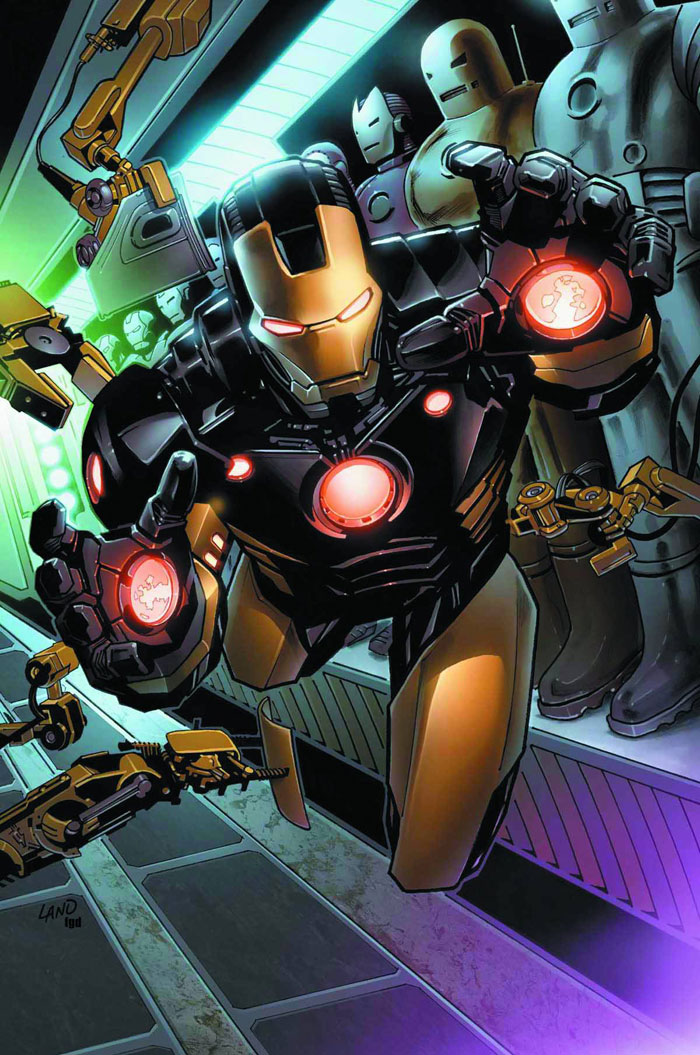
And, NOW!: Iron Man #1

And, NOW! is a series of posts about Marvel NOW!


Let's get one thing straight: Greg Land is not a bad artist. He's not a good artist, either, but I think I've been hyperbolic about his work in the past and I just wanted to clear this up. Although I'm not attracted to his artificial style, which is a stiff and lightboxed parody of photorealism, I am willing to admit that his lines are solid and that his characters have a certain boldness, a kind of magnetic density that draws the eye towards them and away from the rest of his compositions, which, themselves, merely suggest scene dressing.

Part of the problem with that kind of composition, though, is that individual panels often closely resemble one another. To avoid a repetitive page, then, Land is forced to pull the reader a great distance in between panels, effectively slowing any natural movement from one to the next by forcing the reader to close more space than he or she should have to. Since the relaunch of Uncanny X-Men, a year ago, though, he's been doing a few things that ease the reading experience, like varying compositions in interesting ways and, most importantly, allowing panels to interact with each other through the gutter. In the sequence below, for example, the cell phone flies out of one panel, up and over the gutter, and into the next one. The move between individual compositions is kind of awkward, the first indicates movement and while the second is still, but the airborne phone suggests, very deftly, how the character in the white shirt moves while the reader is in the space between.

All of this to say that I'll defend Greg Land, yes, but only up to a certain point-- his human characters all have exaggerated soap opera facial expressions that leave much to be desired. Like Sal Larroca before him, though, his style lends itself to the drawing of machines, so that his version of the Iron Man armor is dynamic in the same way that his drawings of people are stilted, at least in terms of the individual panels. This seems to make him a perfect choice for Iron Man and he may indeed prove to be, but only if Kieron Gillen does his damnedest to keep Tony Stark in the suit rather than leave him out of it.

Basically, its up to Gillen to write for his artist's strengths, in a way that Matt Fraction didn't always manage to do when he was writing for Larroca. Reading this first issue, it seems likely that this will be the case, since Gillen is eschewing Fraction's fascinating corporate espionage angle in favor of a more traditional man-of-action faces down terrorists kind of plot, one that will require Greg Land to draw more than one kind of armor. For his part, the writer does a pretty good job, even managing to relatively concisely explain a piece of information from an old Iron Man arc, even as he's placing it at the center of his own story. It's a masterful example of how good shared universe writers can relay enough information to keep new readers in the loop while still managing to keep old ones interested. Gillen has experience with this particular kind of counterterrorism story, often pulling it out during his Uncanny X-Men work, but much of that stuff was sort of out there and I expect that he's going to play Iron Man much more traditionally.

I think Fraction and Larocca's work with Tony Stark is probably definitive for the next little while, but if Gillen can keep it up, and if Land can behave, then we may very well have another classic on our hands. 

Quote For the Week

This is Iron Man as adventurer and knight and… oh, let’s just have a quick burst of words. This is hyper-intense bursts of adventure and the future. This is about reclaiming the single issue story in the context of a larger narrative. 
-Kieron Gillen, on his upcoming Iron Man run for MARVEL NOW! If Gillen really can do that, if he can go ahead and carve out a space for single issue stories for one issue comics wholes that are only one order separated from the larger whole of an ongoing series, than it will be a thing of beauty. Of course, he's already managed it on a smaller scale, and I have to believe he'll manage it here, too.

Quote for the Week: On Phonetic Accents

Kieron Gillen:
When I’m working on a pre-existing character who’s always been written with semi-phonetic flourishes, I follow suit. Normally in a relatively minimal fashion, but enough to recognise that I’m playing in the tradition. The second is when I’m explicitly trying to turn someone into the Other, which is really about critiquing that (She in Phonogram 2.7 speaks in a complete mass of gibberish. But she’s just a voice in Marc’s head, and the story is about the way he viewed her, etc.) And thirdly… oh, there’s ways when someone really is completely and utterly unintelligible. I don’t think I’ve written one, but Arseface in Preacher would be a good example of that particular type. 
But being a guy with his face shot off is a completely different thing than someone being Glaswegian. 

All-New, All-Different

I've been reading X-Men comics for a long time. Not as long as some people, of course: I'm barely as old as that massive selling #1 written by Claremont and drawn by Lee, but I've been reading X-Men comics a long time. Long enough that, when I started almost a decade ago, a mediocre writer given to melodrama, Chuck Austen, was writing Uncanny, a certain mad Scot named Morrison was writing New X-Men, and Chris Claremont, a man whose name is probably more closely tied to the group than any other, was writing a book titled (horrifically) X-Treme X-Men. It was, for sure, an odd time for Xavier's merry mutants: the three mainline books were vastly different from one another in not only tone and style, but also in quality. Although I've learned to love Morrison's take above all others from the period, in the moment I loved Austen's Uncanny the best: it had my favorite characters. Now I understand the book to be basically incomprehensible but, when I was thirteen, Austen had me. I loved the melodrama; I loved Angel's angst, I loved that Juggernaut was on the team, I even loved that storyline where Nightcrawler joins the priesthood, only to discover that he was ordained by a bunch of anti-mutant psychos.

All of this is to say, basically, that I'm pretty invested in the X-Men. Except for a two year period during high school, I've been buying and reading X comics pretty consistently for the last nine years; certainly, behind Captain America, they are the major superhero franchise I care about the most and, although I've come close a few times, I've never quite managed to quit them, although I did narrow my purchases from three books to just Uncanny. The last few years have been trying, to say the least, because the writing (from the two writers I hold above all others as the paragons of quality in mainstream superhero comics, Brubaker and Fraction) has been uneven at best and because I was forced to endure the art of Greg Land for a full half of the issues (of course, that the Dodsons did the other half was one of the reasons I hung on for as long as I did). Then, Kieron Gillen took over the book from Fraction and things started to change a little bit. There wasn't a major uptick in quality, at least not immediately, but the books certainly felt different.

And then Schism, a mini with two brilliant ideas and an editorially mandated ending that went on two issues too long, hit.

All the sudden Jason Aaron, he of one of the great crime comics of all time, Scalped, and a Ghost Rider series that is supposed to be very good, despite have been read been read by precisely no one, was writing a book called Wolverine and the X-Men and Gillen was writing a renumbered Uncanny. Despite my distaste for the renumbering, and my ultimate dismissal of the status quo setting mini as utter crap, I have never been more excited to be reading the X-Men.

Let me be very clear about why: both books are hilobrow pop art at their best. This is most obviously true of Aaron's Wolverine and the X-Men: Chris Bachalo's art is, of course, the key here. Bachalo's art is highly stylized, and there's no one in the industry who draws anything like it. The figures are reduced to their necessary components; there are no lines out of place, no extraneous muscles. Visually, the book is to the point, yet, it is, because it uses only those distractions (like the occasional benday dots) that add to the books overall style, incredibly detailed. In terms of story telling, Bachalo uses what we might call functional form; when things are calm, so are the layouts. When things get a little more madcap, the panels go a little crazy. He gets points, too, for his colors, which are understated without being drab; it would have been an easy out to go garish, but instead the book has a dreamy, almost water colored look. Finally, and perhaps most importantly, his designs are fantastic. Although no one receives a serious overhaul, everybody looks just a little bit different, and brilliantly so. In particular, what he's done with Quentin Quire and Beast stands out: the choice to go full throttle on Quire's punk streak is welcome, as is the t-shirt with the red exclamation point, the one he wears underneath his school uniform. As for Beast, well, I don't think I've ever seen such a compact vision of the character, bristling with kinetic energy.

If it sounds like there's a lot going on, there is: in contrast to the slow, melodramatic pacing he's employing on Incredible Hulk, Aaron just sort of throws everything out on the table here and, somewhat miraculously, everything works. There are a hundred ideas going a thousand miles an hour inside Wolverine and the X-Men, and each one is better than the last. The characterizations of Quire and Beast stand out here, too, and I suspect that they're the two to watch the most closely. The additions of an arrogant Shi'ar prince, a mutant born of the Brood and some miniature Nightcrawler-looking things to the cast add just the right amount of mysterious and intriguing to make the whole thing feel worth the energy it takes to read. This is a mad book, which takes its cues from Grant Morrison's time with the extended mutant family; it is, in this way, the inheritor of the best X-Men run of the last twenty years, and maybe of all time. If Aaron can sustain both the energy and the coherence of his first issue over his whole run, he might give Morrison his only proper challenge.

That said, Uncanny is the most exciting its been in a really long time. Kieron Gillen really kicks it into gear with the title's first #1 since the sixties: where Aaron's book is wild, though, this one is reigned in. Although some writers would take the opportunity, when writing a team book with a team that's half ex-supervillains, to do something utterly incomprehensible or suffocatingly moralistic, Gillen makes Cyclops' vision for his team just Machiavellian enough for the enterprise to make sense; it helps that his characterization of Cyclops as the military leader of a sovereign state, inherited from Fraction but perfected since then, is spot on. The rest of the team feels right, too: Magneto, Namor and Emma are, perhaps rightfully, arrogant; Storm's humble power is striking; Colossus and Magik are convincingly tortured. Dr. Nemesis and Danger, two characters who sometimes get short-shrift because they have gone relatively undeveloped except as plot devices, get some of the book's best moments. This is a team book at its best, controlled, except the one place it shouldn't be, that is, the villain, and Mr. Sinister here is a perfect counterpoint to Cyclops and his Extinction team.

Although I've been really impressed with Carlos Pacheco's art in the past, here, despite its few flaws, there's something stopping it from transcending from mere high-quality into a kind of brilliance. There's nothing wrong with it, per se, but I do sense that Pacheco is holding back a little bit, perhaps mirroring the control of the writer. I wish he would let loose a little bit; it's a good time to be reading the X-Men, in part because there's nothing conservative about either of the line's new books. If Pacheco begins to take the same chances that Gillen, Aaron and Bachalo have, we could have another brilliant new book on our hands.

So This Happened...

I'm pretty sure he played Pull Shapes.

Weekly Process Roundup 7/8/11

The weekly process roundup is a collection of sketches, pencils, inks, thumbnails, everything other than finished product, really, from The Long and Shortbox of It's favorite artists and illustrators, hitting every Friday.


Quote For The Week 1/17/11

The one-line to take away from this interview: If MIGHTY THOR is AVENGERS then JOURNEY INTO MYSTERY is SECRET AVENGERS. MIGHTY THOR storms the gates of Hell. JOURNEY INTO MYSTERY sneaks in the back door and ends the threat with a single strike. MIGHTY THOR doesn't know that JOURNEY INTO MYSTERY exists, despite Thor being in it. It's a mythological black-ops comic, with a rotating team organized by the most Machiavellian figure in the whole Norse pantheon.

-Kieron Gillen, in this interview with Marvel.com on the newly announced Journey Into Mystery, which he'll be writing with Doug Braithwaite on art. The new title (well, actually the old title- Thor reverts to its old title with #622) will coincide with Matt Fraction's new book The Mighty Thor, which will have Olivier Coipel on art duties. I'll be sorry to see Pasqual Ferry go- his work with Fraction may have been the best comic of 2010- but, given that I get three of my favorite creators in return, I'll take the trade.

Update: It looks like we're not going to lose Ferry after all- Rich Johnston says that he'll be doing the art for the Fear Itself crossover, and then returning to The Mighty Thor when the crossover is finished. Sweet.

Uncanny!

Well, this is pretty cool.

Kieron Gillen, who finished up his run on Thor a couple of weeks ago and who will begin a new X-Men series entitled Generation Hope in a month or so will be joining Matt Fraction on the writing team for Uncanny X-Men starting with issue #531.

Remember that when Fraction joined Ed Brubaker on the title two and a half years ago with #500, he replaced Brubaker soon thereafter. Does this mean something of a changing of the guard for the X-Men? Is Gillen going to replace Fraction at some point in the near future?

I don't know, but what I do know is this: if you're going to put together a brilliant writing team like Fraction and Gillen, why the hell would you put Greg Land on the art?

Uncanny #531 comes out in December.

This Sounds Awesome:

From Kieron Gillen's X-Position interview with CBR:

2) Can we expect to see Spider-Woman in any issues of "S.W.O.R.D.," as she was made an agent in the first issue of her new series?

She turns up in issue #2 for a brief cameo. I'm using "cameo" in its true technical meaning of "banging someone's head into the pavement".

If that's not reason enough to check out the issue of S.W.O.R.D that comes out tomorrow, I don't know what is. Click here to read the whole thing.

Already Tired of Tuesday- Daytripper #1

So, I've decided to try a new format for Already Tired of Tuesday, and that format is this- I'm going to pick one book each week, talk about why I'm going to pull it in excruciating detail, and then just list everything else I'm going to take a look at. The old format was getting boring, and it was actually pretty difficult to write, which is why I've been kind of lax about this lately. So, we're going to start this new format with....


Gabriel Ba's and Fabio Moon's Daytripper #1, which I'm almost hysterically excited about. Two of the best artists in comics today, artists who have worked with both rising stars like Matt Fraction and industry stalwarts like Mike Mignola, Bá and Moon do work that is distinctive, moody, smooth and, most importantly, consistently awesome. I have no idea what their abilities as writers are, although they certainly seem to be pretty good from the Daytripper previews I've seen, but I think that the concept (the life of Brazilian obit writer Brás de Oliva Domingos, told non-linearly but in a presumably illuminating way) is interesting enough to support the book even if the writing isn't all there. Make no mistake, though- if you're buying this book, you're buying it for that art. I'm hoping to pleasantly surprised by the writing- Vertigo seems pretty high on it, anyway- but I'll be disappointed if the drawing doesn't blow me away. Did I mention it's set in the twins' home country of Brazil? Beautiful Brazil drawn by artists with bountiful brilliance? What could be better?

Other Things Worth A Peek This Week:
S.W.O.R.D #2
Invincible Iron Man #21

When Writers Put Back Their Toys

Because I go to a shop that's sort of far away from the place where I live, and also because I was home last week due to Thanksgiving, I hadn't gotten to read the Giant Size Thor Finale until yesterday, when I went to Millbrook to pick it up from my shop.

As the title of the issue indicates, it is JMS's last issue on the book, which is both a good thing and a bad one. On the one hand, maybe now that Kieron Gillen is writing the title, it'll ship on time. On the other hand, JMS's run was unbelievably fantastic- each time I thought it couldn't get any better, it did. The Giant Size Finale isn't his best issue of the series, but it is still pretty good (the highlight, by the way, is Volstagg being badass, something which will never cease to delight me). Unfortunately, JMS saw fit to end his run in a way that always makes me cringe: he decided to put his toys away before he went home.

When I say that, what I mean is this- JMS decided that, in the last issue of his run, he was going to reintegrate certain parts of the status quo before he started writing the title a few years ago. Now, this is his right, but I don't understand why writers feel the need to do this. By killing one of the most interesting characters he introduced during the course of his run, he prevents us from seeing where another writer would have taken the concept (one that was, by all means, worth developing further). Additionally, I think I wouldn't be quite so pissed about the whole thing if Kieron Gillen hadn't sort of mishandled the fallout (which is in the preview for Thor#604 at the end of the issue)- although I suppose it could still have the dire consequences for the book's villians that I think it should have.

I understand that the above paragraph is nebelous, and it was the less egregious of the two examples anyway- what really makes me wonder why unwriting of this sort is necessary is that JMS gives Donald Blake his limp back.

I know, I know, it doesn't sound like a lot, but it is- he couldn't have just let Donald Blake keep walking normally? Why not? I mean, it's not like it's essential to the character, or anything- if it were, the run wouldn't have been nearly as successful. The whole half-cripped-guy-turns-out-to-have-superpowers thing is pretty played out at this point, so I'm not sure it's actually going to bring anything to the comic that wasn't already there.

The only concievable reason why any writer should unwrite him/herself like that is because they don't trust whoever is coming up next to play with the new status quo very well (or, at least the first writer thinks the second one won't). Quite honestly, it's kind of arrogant, and it brings a run of issues that should have ended with a bang (Volstagg being badass and associated dick joke notwithstanding) out with a little bit of whimper.

I understand that this is, in the end, a very small complaint. The book is a good book, and I certainly recommend reading it if you want to get into Thor, but this sort of writing frustrates me to no end because it nullifies ideas that make comics interesting- something that we're always a little short on.

Already Tired of Tuesday...

Short post today, as I have a paper due in a little over 16 hours:

This week is heavy on the Batman, as both the Brian Azzarello penned Batman/Doc Savage Special and Batman and Robin #6, the conclusion of Phillip Tan's work on the title, are out. Also from DC this week is Fables #90 and, as Witches hits its penultimate chapter, I can't wait to see where we go from here. Out from Marvel this week is Daredevil #502, in which I'm sure things will continue to go to hell for Matt Murdock (it sometimes seems like Daredevil is the comic book equivalent of the Book of Job) as well as the first issue of S.W.O.R.D. which looks unbelievably cool- I'll be pulling it at least through issue three because, well, just look at this cover.

Finally, there's Fred Van Lente's history of the comics medium, Comic Book Comics #4, which comes out this week, although I'll probably pick it up at some other point over the internet.

Now, back to Frederick Douglass and Uncle Tom's Cabin.

What Could It Be

Rich Johnston's hope is that back-up feature in Kieran Gillen's S.W.O.R.D is going to be a Dazzler one- my own hope is that it will be about Lockheed's short stint on Broadway in a production of THE PRYDE OF THE X-MEN.

Seriously, is Lockheed in a top hat too much to ask?