Showing posts with label Captain America. Show all posts

Wednesday's New Things: Lightning Round

To make up for my absence the last couple of weeks, and because this week brings a plethora of exciting new comics, here is a slightly different than usual version of Wednesday's New Things, a lightly annotated list of things worth taking a peak at that come out this week.


Leading the pack is a period piece, set in ancient Greece and written by Kieron Gillen. From the preview, stunningly pencilled by Ryan Kelly and colored by Jordie Bellaire, you can see that it has that typically, frankly, Gillen. Do you think I can just send him my money by airmail? Or do I have to go to a comic book store?


This looks pretty fun. Darrow is a practitioner of a smoother version of the raw, loose style that I mostly associate with Frank Quitely, and which you can also see in the work of Chris Burnham, Simon Roy and Nick Pitarra. When a prose story came out, I think a year ago, featuring this character, I passed because, well, prose. But Darrow's art is great, emphasizing the movement that those artist do so well without any of the attendant squishiness, so I'm likely to pick this up the next time I head to the shop.


 It's nice to see that Vertigo is back in the game in a serious way. After the departure of Karen Berger, the imprint, which had seemed moribund for a while, really looked decrepit. Recently, though, they've published Trillium, FBP: Federal Bureau of Physics (the poorly renamed book formerly known as Collider) and, now, this, which, with established author Caitlin Kitteridge as its writer, seems an awful lot like Vertigo projects of old. I've never heard of either contributor, and the story seems to fit squarely in the gothic horror genre (not that there's anything wrong with that), but the art, by Inaki Miranda, looks great.


I bought the first two issues of this, didn't read them, and then moved. They're in my short box, alternatively laughing at me and looking at me longingly. The pricing on the trade edition of this book's first volume is tempting-- less than $10, for four issues? I suspect the subsequent volumes won't be as cheap, but even so, at $3.50 a pop for individual issues, I save money as long as a four issue collections costs less than $14. Is that enough of a savings, considering I already own the first two issues? As I reconsider my comics purchasing strategy, reorienting myself towards buying trades in the case of books like this, I think it may be. 

'
These lego variants are fun. Not enough fun that I want to own one, but, still, fun.


These Best American Comics anthologies seem like good books for people like me, who don't have the time, energy, or cash to pick through everything that comes out in a year. Although I think I'll wait until the end of the year to pick it up, it's a pretty sure buy.


Hey! New Paul Pope is always exciting. 

A Note On Ed Brubaker's Move From Marvel

So long, Ed! (source)
I want to take a moment to talk about last week's news that Ed Brubaker is leaving Marvel in January, when he entrusts his Winter Soldier scripting duties to Jason Latour's very capable pen.

Since the announcement of Brubaker's imminent departure from Captain America, I've been been thinking about doing a rather extensive annotation of his run with the character. Such a project would be both massively enjoyable and massively time consuming, and I'm not sure if I have the wherewithal or, more importantly, the knowledge base, to do it properly. Now that I know that Brubaker's time with the House of Ideas is coming to an end, my impulse is to expand the scope of my annotations, which would, of course, mean both more time and more research. Even if I decide not to undertake such a sprawling project, watch this space for a couple of retrospective essays, which will deal with his Captain America work and his writing for and influence on the company in general.

Right now, though, I think its important to talk about what, exactly, is ending when the man who brought back Bucky Barnes walks away from Marvel to concentrate both on his creator owned comics and on ventures in other media. Much more than any other superhero comic book writer in the last fifteen years or so, I think that Brubaker understood that, when he was dealing with Steve Rogers and Bucky Barnes, or even when he was dealing with Iron Fist or Daredevil, he was dealing with the stuff of legend, and so he always approached the material in its own terms, with gravity and without anything resembling irony. Given the generally accepted absurdity of comic book superheroes, it would be very easy to laugh off Brubaker's seriousness as a kind of misreading of the state of mainstream comics, but I think to see him in this way fundamentally misses the point.

Indeed, I've always gotten the sense that Brubaker believes in superhero comics, that he believes in what they're capable of, and that he believes that they can affect the culture at large even if they don't often reach beyond an, unfairly stereotyped, niche market. That he is ambitious in this way is evident, of course, in his politically resonant work on both Captain America and Winter Soldier, but I think it can also be seen in his incredibly well respected Daredevil issues and the Gotham Central series he wrote at DC with Greg Rucka, and in his flawed X-Men work, and in his abortive run on Secret Avengers. His attraction to the big idea, to the conspiracy that takes years to unravel, to the story that takes dozens of issues to unfold, is clear in all of his work, but his ability to use the combination of medium and the genre as a certain kind of more- or less- subtle allegory is what sets him apart from even from the talented writers, writers like Matt Fraction, Jonathan Hickman and Jason Aaron, that are guiding Marvel's bold new direction. What Ed Brubaker gifted to us, more than almost a decade of excellent stories, was a renewed sense that not only could mainstream superhero comics be culturally important, but that they could also be literary, particularly if their readership was willing treat them as such.

Not all of his allegories are played out, yet, and the real shame here is that, for the next few years, even if new writers pull at the threads that Brubaker left behind, the work will probably lack that double ambition, that driving desire to tell stories that matter to everyone and that are also great. Everyone who is going to have to pick up from where Brubaker left off is going to have to deal with this, and I think that, rather than try, most are simply going to give up the gun; Andy Diggle's Daredevil run is the cautionary tale here. There is an obvious exception to this in Winter Soldier, but I wonder if, even with a talented writer like Latour and a movie with that title on the way, the book has any long term prospects without its creator at the pen. On the other hand, Captain America has, in the last year and a half, certainly begun to feel less essential, even as the month-to-month quality of the book hasn't dropped in any significant way, and so I'm not sure that Brubaker is pulling as hard as he used to, not even at his own big ideas. Still, if Rick Remender's high action Steve Rogers as John Carter of Mars new direction for the character is any measure, we're not going to get a chance to see superhero comics done quite as well, or quite as seriously, as Brubaker did them, at least not for a long time.

While this turn is lamentable, it is certainly not disastrous. Its important for those of us in or on the edge of fan communities to remember that nothing lasts forever, and doubly so in this case, since to act like it should, to assume that it would, betrays the high quality and literary aspects of Brubaker's work. Rather than mourn the end of something I love, something I think is important in way that superhero comics tend not to be important, I would much rather celebrate it. There are, after all, volumes of Captain America on my shelf, just waiting to be annotated.

Quote for the Week 2/12/12

"We [Joe Simon & Jack Kirby] discussed this idea, about America. This was at a time when everybody was patriotic... and it was ridiculous not to do Captain America because there was an idea that would have been bought by everybody. So Joe and I did that. Our job was to sell comic-books. And we did.

...

[after being asked about a current Captain America storyline:]
I receive the books from most of the companies... That's their prerogative. Whatever they do with Captain America is their prerogative. If you like it, fine... I say that Marvel has every right to put out the kind of book that they like. That's their business, to sell books."
~ Jack Kirby, co-creator of Captain America, on a panel in Troy, Michigan on the 29th of May in 1988.

This month, @DCcomics announced a series of prequels to Alan Moore's "Watchmen". Moore was quoted in an interview that this is: "shameless". The creators attached to the books defended their involvement in multiple ways including pointing out that Moore himself has used characters created by other people both for corporations ("Swamp Thing", "Superman", "Green Lantern") and in his own projects ("League of Extraordinary Gentlemen", "Lost Girls"). He dislikes the project and stands to make no money from it. (I've already covered this story myself here.) This page on ComicsAlliance.com summarizes the reactions.

Then, Ghost Rider creator Gary Friedrich was ordered to proffer to Marvel $17,000 he has made in selling his own Ghost Rider merchandise AND refrain from publicizing himself as the creator of Ghost Rider. Commenters have brought up Friedrich's health and financial problems as well as the fact that many, many professional comics artists supplement their careers with simple commissioned sketches of corporate-controlled characters at conventions or by mail. Some say @Marvel should settle with winning the case (i.e. not owing Friedrich any part of the earnings from the first film from 2oo7 or the new one opening this week) and rescind any request for damages or the somewhat ridiculous demand that Friedrich stop referring to himself as the character's creator.

And on top of all of this, original "The Walking Dead" artist Tony Moore is suing fellow co-creator Robert Kirkman claiming a proper half of proceeds from "The Walking Dead" TV show and merchandise has not been sent his way. The two were reportedly close friends who worked together on multiple projects before Kirkman (@RobertKirkman) became a part of the corporate structure of Image Comics (@ImageComics).

Supposedly
money + agreement = fair use of characters
but which part of that equation is more important? The compensation or the permission? And is there leeway for artistic relevance? Financial or health status? Even friendship?


Where do we draw the lines between business and ethics? Why do we draw lines there at all? Who is in the right: the creator or the copyright owner?

In this sudden rush of news in regard to creator's rights, it's interesting to me to remember that some of the most screwed over were also the most respectful. Superman creators Jerry Siegel and Joe Shuster sued DC several times. Kirby never sued Marvel. Was Kirby a fool or a gentleman?

~ @JonGorga

A Sock In The Jaw

There's a lot to love about this new Captain America #1, but there's an ambivalence here, too. The two issues, however, are entirely unrelated; as an individual comic book, it's brilliant. As an idea, it sort of sucks, but I'll get there in a second. First:

Captain America #1 is why people read comic books or, anyway, why people should. Ed Brubaker, one of the best writers in the business on his worse days, slips into writing this Captain America like Steve Rogers slips back into the flag, with the ease of someone who's worn this suit before, and who missed it just enough. He does here what he does best, reinventing Captain America (for what's really the third time since he took over the character in 2005) by taking Steve Rogers' past and using it to turn the character into something both new and familiar, something both recognizable and, perhaps, radically different.

Starting with a brief summary of who Cap was in WWII, and then two panels of who is he is now, Brubaker begins his story with an ending, with the death of Peggy Carter. Carter was a member of the French resistance, Steve's girlfriend back in the day, and the aunt of Sharon Carter, who is Steve's girlfriend these days (it seems perfectly normal in terms of the the whole "man out of time" conceit of the comics but, man, typing that last sentence out just now, the whole thing just strikes me as really bizarre). Cap, Carter, Nick Fury and Dum Dum Dugan gather for the funeral, and their reunion sets off a string of events that were really put in motion during the twilight hours of the war in Europe. Brubaker tells both that story and this one, letting each inform the other, and this style of storytelling gets at precisely the reason why I think Brubaker does Cap so well: he gets that part of the reason Steve Rogers is a compelling character is because there's a contrast between the Captain America #1 of 1940 and the Captain America #1 of two weeks ago, and part of that contrast has to do with ambiguity of purpose. In that first world there were good guys and there were bad guys; in this brave new world, I suspect the lines between them are a little less clear.

Or maybe not. The blast from the past Bravo may very well be a clear cut villain, himself a man out of time, egged on by a decades old jealousy. There are more questions than answers here, and this suggests that Brubaker has become a master of the serial story. Captain America #1 is a whole whole with a beginning and a middle and an end, a discrete and satisfying unit of entertainment in and of itself but one that will be extended and better understood next month, when a hopefully equally as satisfying issue comes out. This is comics at its best.

Of course, it helps that Steve McNiven is drawing the thing. Brubaker is a fantastic writer, but part of what makes him so great is that he always seems to be matched with artists who have their own share of talent and, aside from Sean Phillips, McNiven may very well be the best of them. His panel design is dynamic and he doesn't get stuck in the six by two grid; the panels move with the characters, they're explosive and, although they often reflect the kinetic confusion of a street fight, they read easy, there's never any question about which panels goes after which other panel. It's quite a feat, and it follows a similar mode of operation to the one that Mike Deodato was using with Brubaker on Secret Avengers. The difference here is that McNiven's art is much less stiff and woody than Deodato's: while the latter's panel design saved him from being guilty of the muscled stillness that dooms comics art by making it too heavy, the former's at its best has a levity to it, one that suggests a sort of trial and error process in the talking heads scenes but is consistently killer when there's even a little bit of movement. Although there are a few close ups that qualify as nearly perfect, McNiven is best when he's working at a little bit of a distance, when he loses some of the detail for a more cartoony look. Certainly some of the credit for this goes to inker Mark Morales and colorist Justin Posnor, just as they get some of the blame for putting the lines in the faces of Dum Dum, Fury and Cap, which occasionally gives the book an almost photorealistic look at odds with what I imagine is the art team's tendency towards a traditional, albeit updated, comics aesthetic. This Sharon Carter should be the model; there are a few panels which are right out of an old romance comic which, in a sort of oblique way, is what this comic is.

Second:

I am ambivalent about the idea in Captain America #1. I hate it because Marvel thinks it needs to renumber books every seventy-five issue or so to stay relevant, I hate it because there are someways in which it represents a retread, a place we've already been, I hate it because I disagree with Tom Brevoort when he says that, y'know, maybe, with a movie on the way, it's not the worst thing in the world that Steve Rogers is back as Captain America.

Actually, I don't really disagree with him; it's not the worst thing in the world.

Clearly, I haven't stopped reading Captain America because Bucky isn't wearing the flag anymore. I'm pissed that he's dead, of course, but with a book called Captain America and Bucky coming out and a pretty serious continuity problem between the mainline Cap book and Fear Itself*, I have a hard time believing he's going to stay dead, although I'm relatively confident he won't be Captain America anymore. That's really a different issue, though, as it takes place about as far away from this Captain America #1 as possible, presumably because Marvel didn't want the book the kids who saw the movie pick up at their LCS or in the drug store caught up in some crazy continuity bullshit. In terms of a giant corporation trying to make money off their comics, this makes complete sense; in terms of long-form, continuity based storytelling, it sort of sucks.

Except that I think that there are times when long-form storytelling needs to take a back seat to mythology, to legend, to archetype and, while I personally don't think this is one of those moments, because I think there were many, many more good Bucky-as-Captain-America stories to be had and because I liked the idea of Steve Rogers super spy, I sympathize with the impulse and if I trust this sort of thing to anyone I trust it to Ed Brubaker. The true genius of it, of course, is Grant Morrison, but Brubaker is almost as close, and much more consistently great.

If I trust anyone, I trust Ed Brubaker. Captain America, after being a good book but not a consistently awesome one in the time since the mess that was Reborn, is back and, as pissed as I am that the storyline that I loved as much as I love anything in pop culture was stopped well short of its logical conclusion, he's got me. Here's to #2.

--------
*Not that I really care that it doesn't make sense, shared universe superhero comics often don't, but I wonder if it's a clue that things aren't quite as they seem at the moment.

Fourth of July Fun

Josh agreed to come along with me on a short research trip to more fully explain this:

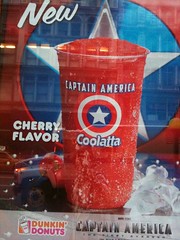
We Live in the Age of the Captain America Coolatta
Okay, there was very little research done. But I was right that it was a good prompt for discussion. See for yourself:


I'm saying comics-adapted movies bring in money.
Josh is saying the two are innately separate.

Both true.

~ @JonGorga

UPDATE:
(thanks thenewbestthing)


Update!

Holy Tabernacle! I was right:

CAPTAIN AMERICA AND BUCKY #620
Written by ED BRUBAKER & MARC ANDREYKO
Penciled by CHRIS SAMNEE
Cover by ED MCGUINNESS
Variant Cover by TBA
Rated T+ …$2.99
ON SALE THIS JULY!
...and it's drawn by Chris Samnee?! And set in the early days of World War II? I'm not happy that Buck's taking off the flag, but if this is what we get in exchange, well-- count me in, for now.

(via CBR)

Bleh.

Given that we are about to have a big Cap film and Cap’s going to be in front of more people and in more folks’ awareness than in any other time in recent memory, well, since we killed him, it would probably not be the worst thing in the world for him to be in the suit and carrying the shield at that point.
- Tom Brevoort, on Steve Rogers putting the flag on again in July.

This is what I hate about mainstream superhero comics. Steve Rogers is going to become Captain America again. OK, I can dig it, people like Steve. I like Steve. But we're really going to abrogate the best stories in superhero comics in maybe a decade because there's a damn movie coming out? And where the hell is Bucky?!

There are two things here; first, I trust Ed Brubaker. If I think anyone can handle what I imagine has to be an editorial mandate like this well, it's Ed. There's a reason he's one of the best at what he does (and what he does is really, really, cool). Second, I haven't been reading Captain America. Oh, I've been buying Captain America, I just never end up reading it these days, which is odd considering it is ostensibly my favorite comic book and it is written by my favorite writer and he is my favorite superhero.

But I'm certainly going to read that new #1 in July. Maybe it isn't the worst thing in the world to have Cap wearing the flag right now?

One other thing to think about: the solicit to Captain America #619 doesn't say "final issue." Maybe we'll get some Bucky comics in whatever that becomes, if it, recent Thor-style, becomes anything.

(Olivier Copiel cover via Bleeding Cool)

I Hate It When This Happens

Solicited by Marvel earlier today:
CAPTAIN AMERICA: THE FIGHTING AVENGER #1
Written by BRIAN CLEVINGER
Pencils by GURIHIRU
Covers by GURIHIRU & BARRY KITSON
Captain America’s Day One!
He’s got the strength. He’s got the training. But has he got what it takes? A ragtag Special Forces unit takes Captain America on his first mission of World War II. Their orders? Don’t get him killed! But when the low-profile assignment draws the attention of Baron Strucker, the future Red Skull and half the Nazi
army, it’ll be a crash course in super heroics for Marvel’s first Avenger!
48 PGS. /One-Shot/Rated A …$3.99
Y'all may or may not remember, but way back during SDCC '10, in July, this was announced as an ongoing, to premiere in January. I wondered where it was, and now I know: it's a one shot, coming out in April. My feeling at the time was that it was going to be a similar quality as the sadly canceled Thor: The Mighty Avenger and my feeling now is that the cancellation of that book probably has something to do with the minimizing of this one. It's too bad, too- I still love Gurihiru's design for Captain America.

The Digital Divide

I have fallen really and truly behind in my Captain America reading. Every month I buy Brubaker's monthly and somehow, some horrible how, I end up with it at the bottom of my pile and it never gets read. This is a great and true travesty- those Captain America comics are surely among the great comics of our time, as they have been since Brubaker took over the title five years ago. To be completely honest, I miss the Captain a great deal, and one of my comics related new years resolutions was to make sure I read as much good Cap stuff as there is, on time and monthly. I want to do this partially so I can review it and consider it critically (I do, after all, have aspirations towards being the world's foremost Captain America scholar), but mostly because I want to read the stuff; although I've mostly moved away from character based purchasing, in the case of Captain America (and sometimes Iron Fist) I just can't help myself from wanting to read all of it, even the bad stuff (and some of it is really bad). Luckily for me, some of the Cap stuff that's coming out appears both great and essential: I'm trade-waiting Mark Waid's "Man Out of Time" mini, although Gorga has had some great things to say about it, and with the upcoming movie and the character's upcoming 70th birthday, there's bound to be more good stuff to come.

Including, of all things, Jason Aaron and Ron Garney's Ultimate Captain America. Aaron has slowly and sneakily become one of my favorite writers: between Scalped and Punishermax he's written some of the best comics of the last couple of years and has even managed to get me interested in characters as lame as Ghost Rider and as ubiquitous as Wolverine (every time I pass a new issue of the current "Mr. Logan Goes To Hell" arc I have to try really hard not to break down and buy all the issues so far. On that day you will know I have failed, for the cries of joy and despair will be spread across the four winds) and I was pumped to see him write my favorite character. Even better? Ultimate Captain America was going digital day and date.

Some of you might already know this, but back in October I cracked the screen of my laptop by falling on top of it (the story is very short and pretty funny, but I'm not going to speak of the incident anyway) and solved my problem by hooking up my laptop to a monitor on my desk and buying an iPad for mobile use. It didn't hurt, of course, that I could buy and read comics on the thing. I'm not sure I could ever give up on physical format comics (I'm twenty, but I still buy vinyl!) and particularly not at the prices their being offered for at the moment, but I'm always up for trying something new and interesting- it helps that comics look great on the thing, without the limitations of printing and absurdly high-res.

In fact, I was so interested in the way comics look on my fancy new toy that it was inevitable, given my interest in the comics consumption problem, that I would also become interested in the differences between the two formats. I proposed to Gorga that we each review the whole of the series in one of the formats, and use it as a springboard to talk about the pros and cons of each format. I was more excited for this series of posts than I was for the comic itself, and so when the release date rolled around on Wednesday, I was pumped. I booted my iPad, logged onto the Marvel comics app and...

I found that Ultimate Captain America was missing.

And then I realized that Jonathan Hickman and Carlos Pacheco's seriously brilliant Ultimate Thor (featuring Ultimate Captain Britain wearing a lab coat and his costume AT THE SAME TIME!), also announced as day and date, hadn't shown up the last week in December, when it came out in physical stores everywhere. That comic has had some distribution problems of its own, so I wasn't that worried about it, but it hasn't appeared since either. I don't want to speculate too much on why this is, but I'm having trouble believing that Marvel is going back on their day and date announcements, particularly in the wake of the recent news about the death of Ultimate Spider Man. It's too bad, too: starting off their same day digital release program with two minis that were likely to be very popular was a smart move for digital readers, although it may have damaged some relations with physical retailers, but promising something that never appears is a good way to turn readership off of digital comics entirely, particularly given what seems to be a wide preference for comics you can read off of paper and prices that are simply too high for a product that only exists digitally.

I hope to see the minis soon- I would like to read them, after all, and am getting tired of waiting. It's a fast moving comics business and I wouldn't want minis that are deserving of attention to fall in the same spot in my stack as my poor ignored Ed Brubaker Captain America comics.

Sometimes, I Think Con Isn't Worth It...

... because they aren't really my thing, I think. There are just too many people, and most of them are there for different reasons than I am. This is not to say my reasons are any more legitimate than theirs- different, perhaps, more academic, certainly, but not better or worse- just that the crush of people cosplaying and shouting and cutting in line to get an autograph isn't really my thing. I'm in for conversation, to talk to people who love the form (as opposed to the characters) as much as I do, and whether those people are creators or fans is irrelevant.

Sometimes, though, even I have my fanboy moments. Like this one:
Just so we're clear, that's me and Joe Simon. That's the man WHO CREATED CAPTAIN AMERICA, with his arm around my shoulder.

I'll have a post (or maybe I'll turn it into an essay- I'm not sure yet) about why the experience of meeting him was a little disheartening, but for now- I'm just basking in the glory of this picture. This man is a legend, one who isn't going to be around a lot longer. And I thanked him, and I shook his hand, and that experience is worth more than all the autographs in the Javits Center.

"We're Going To See Him When He's New to This Whole War Thing"

Today's announcement of pre-continuity Captain America series written by Brian Clevinger and drawn by the Japanese art team (one might even go so far as to call them a dynamic duo)* Gurihiru, entitled Captain America: Fighting Avenger has some potential. The idea of an ongoing series set during the War is a fantastic one and, if it means that we get to see some Captain America war comics on a consistent basis, it's something I'm sure to pick up come January.

Oh, sure, it could be terrible- light reboots like this sometimes are- but looking at the killer costume redesign Gurihiru came up with and reading what Clevinger has to say about the project gives me heart:
"We're approaching Captain America from an angle you never really see. It's that window between getting hepped up on supersoldier serum and becoming, y'know, the mythic Captain America that immediately comes to mind when you talk about him."
This suggests a sort of Captain America: Year One style project (sort of like last week's solid Thor: The Mighty Avenger #1), but without all the grimngritty that's usually found tagging along with a project like that and, in fact, what he goes on to say about his writing style for the work is a further reason to see this project as a potential bright light:
"To put it into die-hard Marvel reader terms: it's not funny like Deadpool, but maybe it's funny like Iron Fist"
Funny like Iron Fist? Surely, Brian Clevinger, you mean funny like The Immortal Iron Fist, my favorite comic book series ever? Sweet.

So we've got a good concept with a writer who has promised that his writing's going to be serious with a little bit of a goofy streak- but, wait. There's more, you say?
"What's great about Steve is that he just wants to do what's right. Actually, it kind of goes beyond that, doesn't it? It doesn't occur to him there's an option. Even more than Spider-Man, I've felt that Steve is the embodiment of, 'With great power comes great responsibility.' Only, in Steve's case, I think he considers 'citizenship' to be the great power in question. Whereas the power/responsibility mantra is more of a lesson or a reminder to Peter Parker, for Steve it's a fundamental part of reality that's as inevitable as gravity."
I didn't think there was another writer out there who gets Captain America like Ed Brubaker does but maybe, just maybe, we've found that guy. This is a project that has the chance to be absolutely fantastic- perhaps my expectations are a little bit too high, but I simply can't wait.

The ball is in your court, Brian Clevinger. Please don't disappoint.

----------------------------------------------------
*Alright, fine- I'd never heard of Gurihiru until reading the announcement today- but, seriously, is that costume just killer or what? The helmet is a stroke of genius.

Friday Double Feature Comics Show: Superspy Edition


Welcome to the first of a new feature here at The Long And Shortbox Of It- The Friday Double Feature! As a tribute to one of the greatest methods of consuming the grittiest, grimiest, pulpiest fiction ever conceived, we're going to bring to you- every Friday!- two reviews of comics that we, for whatever reason, see as heirs to that legacy. As a result, you're more likely to see Criminal here than Avengers, but anything that smells of pulp has a shot of making it into the column. These reviews won't always be exclusive to stuff that came out the previous new comic book day (although I'm certainly going to try to write about as many new comics as possible), but this week we had a killer first issue two-fer: Steve Rogers: Super Soldier #1 and Casanova #1.

It's fitting that we're starting out with Ed Brubaker and Matt Fraction, since the two of them are responsible for what I think is the greatest superhero pulp in recent memory- the much missed (around these parts, anyway) Immortal Iron Fist. These comics, though they share the same sort of narrative aesthetic, belong to a much different genre than that kung-fu masterpiece*. Indeed, Casanova and Super-Soldier both feature characters equally as concerned with focus and tradition, but in a much different sort of way. What we have here are two spy comics- and they're both brilliant.

Let's start with the superhero formerly known as Captain America: ever since his return in the pages of Reborn, what Steve Rogers' precise role was to be in the Marvel universe has been a little unclear. We knew he was the country's top cop. Or maybe Secretary of Superheroes- whatever his official title is, it's clear he's running the show these days. What hasn't been clear is what role he's going to play in the places where he does appear- what kind of figure is Steve going to cut out in the field? Although I'm sure that Brian Bendis would love to write a comic called Steve Rogers: Secretary of State, Ed Brubaker had a much more interesting idea: turn the original Super Soldier into 007. This new role has come through with varying degrees of success in his Secret Avengers title (and, for the record, I think Brubaker may have gone too big too fast on that one, but we'll see what happens), but is clear as day in Super Soldier.

In fact, it's the structure of the book that makes this work, because Brubaker isn't trying to be too fancy with anything inside. While it's true that the issue's narrative is a pretty traditional one, I think that's the key to understanding exactly how Steve sees himself these days- and how we're supposed to see him. Way back when, we never would have caught this man out of uniform (that's part of what makes Captain America so powerful) but here he looks right at home shmoozing around a cocktail party in a tuxedo, to the point where it's not so hard to see Daniel Craig playing this version of Steve in a movie, ordering a drink that's shaken, not stirred.

Dale Eaglesham's art here has exactly the right feel, too: while there are some moments when it feels a little too stiff, most of the action sequences are incredibly fluid and he makes the spy scenes feel just right. It's hard to explain, but Eaglesham's Steve Rogers is dashing, suave and, most importantly, subtle. It was a hard trick to pull off, I'm sure, but the penciller does a killer job here.

Speaking of killer jobs, let's talk about the coloring on Casanova #1. Some of us were more fond of the idea than others when the news broke that Matt Fraction's inter-temporal super spy Casanova Quinn (originally published by Image in a two color, sixteen page format) was going to reappear in full color and, for the record, I like the original slim two-colored versions too (to the point where I'm on something of a mad quest to track down issue #4 so I can complete my collection and read the damn thing all the way through). With that said, though, this new coloring job is killer. I wish I had a scanner so I could show you why, but when you hit the page of Cass falling through the space time continuum, believe me you'll know exactly what I mean.

I'm not sure what I can add about the comic itself that hasn't already been said (it is basically a reprint, after all), but I can tell you that the new material in the back (drawn by Fabio Moon) is brilliant as well as being enlightening and confusing- it sheds some light on stuff we already knew, while making everything just a little bit more confusing too. Whatever it is that's going on (and this is true for both comics- Super Soldier had some really killer twists too) I can't wait for more and that, more than anything else, is the mark of a good, pulpy piece of serial fiction.

------------------------

*Incidentally, this demonstrates precisely what I mean when I say "pulp"- sure it's true that all comics are descended from the pulps, but the Avengers or the X-Men are, on their own, too shiny to be considered true inheritors of the pulp tradition. At the same time, I'm not going to shut out comics simply because they feature superheroes, or because they don't belong to a more specific kind of genre. This week we're talking about spies. Next week, maybe crime comics. Or westerns. Or war comics. We'll just have to see what I find.

Holy Comic Strips, Cap!

I love Captain America.

Long time readers know this to be true, but it bears repeating- there's no character in comics I like as much as I like Captain America, Steve or Bucky. Imagine my joy, then, in finding out that there was not one new Captain America comic this week, but indeed two! And that second one, far from being a poorly written one-shot or needless mini-series was something... well, a little different.

Karl Kesel's Captain America: The 1940's Newspaper Strip#1 is certainly fun (it's a collection of a faux in-period daily strips that Kesel did for Marvel Digital Comics unlimited) and it's pretty funny, too. Kesel's artwork is expressive and cartoon-y and, even if his writing sometimes falls flat, his characterization is pretty good. All the characters sound and feel appropriately cheesy and there were just enough interesting twists and turns to keep me engaged.

Mostly, I'm interested in two things, here- can this concept (which is serviceable, if not precisely mind blowing) sustain itself without getting obnoxious, first of all, and, secondly, how can comics fans use this book to their advantage?

That's sort of an odd question, I know, but consider this- Peanuts and Captain America are, essentially, the same medium- they're in different formats and run in different mediums, for sure, but they work on the same principles, much like the difference between a novel and a prose serial. Tell someone you like COMICS, though, and I imagine they're more likely to think of the latter rather than the former, as if the two are completely different. I don't know why this is, although I certainly have my suspicions, but books like this are important (even if they're just fun comics, rather than good comics) because they have the opportunity to bridge that gap and, in so doing, close the difference between a comics fan's understanding of the medium and everybody else's.

That Kesel is using the "strip" here is fascinating and, although sometimes it works better than others, I hope to see more like it, or even an anthology of strips like this that comes out once a month, just for something a little different. There's a lot of potential for fun comics here, and there's no need for something like this to be high art: it's great just the way it is.

In Which I Discuss Captain America Comics Again.

I have a confession to make. I haven't read an issue of Captain America in months. I bought all the issues, and I'm sure that, some day, I'll go back and read them but, upon their purchase, I wasn't all that interested.

I'm not quite sure why. It was after that big Captain America tea-partier blow up back in February, so that may have had something to do with it. Maybe I was just a little tired- I've been living with these comics for a long time now. I've read them, re-read them, parsed them, wrote about them; I'm sort of surprised that I didn't burn out a long time ago. This week's issue #606, however, was the start of a brand new story line, featuring the return of Baron Zemo to the pages of Captain America, as well as the beginning of a new art era for the book (with Butch Guice taking over pencils from Luke Ross), and so I decided that it was, perhaps, time to return to the pages of my favorite comic book.

I was not disappointed.

Cap's had a little bit of a rough patch since the mess that was Reborn started, but I'm glad to see it's over- everything about this comic is pitch-perfect and spot on. Ed Brubaker is writing this book brilliantly again. That Brubaker has managed to seamlessly integrate Steve into the book as a supporting character is a feat on its own- he used to be the star of this book, remember. He plays Falcon off of Steve and both of them off of Bucky in a way that almost makes me wish that Ed had given us a whole issue of the three of them sitting around talking in a bar- this is how superheroes should interact with each other, out of costume. This is how superhero comic books should be written.

Brubaker's return to form was not very much of a surprise- he's done nothing but write brilliant comics for years, so a misstep or two was to be expected, sooner or later. What is something of a surprise is Butch Guice's art. My only previous experience with Guice was his inks on Reborn, and to say that they left something to be desired would be a significant understatement: Bryan Hitch's art was bad, and the inking didn't do it any favors.

Here, though, Guice proves that he knows his Captain America- at its best moments, the art references both Cap co-creator Jack Kirby and the artist responsible for perhaps the most famous Captain America page ever, Jim Steranko. This art is cartoony, kinetic, yet also impossibly realistic, which is the Kirby influence (I think there's even some Kirby Krackle in there!) and the design and surrealist elements are full-dose Steranko. Butch Guice does for Captain America's art what Ed Brubaker did for his writing- he is reexamining Cap's history, radically retelling it, in order that we may understand his present, his future. I'm in love with the technique in both art and writing- this is a hell of a book, if you like great comic art.

There's only one page that's kind of silly, and that's the oddly placed Steranko-style page near the beginning; it's not that the art's bad, it just doesn't make very much sense.

If you're looking to get into Captain America, now's a good time. If you're looking for something new? This is a good choice for that, too. This is a damn good comic book- I wish they were all this good.

AVENGERS ASSEMBLE!

The Heroic Age is here.

How do we know? Well, the first issue of The Avengers (that's right, without a modifier) is here and on the third page Steve Rogers (you know, the most heroic of them all) says that what the world needs is heroes.

But not just any heroes... the world needs the Avengers. This is a moment that I've been waiting for, a moment that I've been dying for, a moment where our heroes get to be heroes again. By no means do I intend to criticize superhero deconstruction; it has its place and for good reason. In many ways, it got people to start taking comics seriously, because it proved that comics, just like any other medium, could blur the lines and convince readers to cheer for flawed people, just like they cheered for perfect ones. This is all well and, as I said, extremely important to the history of comics, but it lost the track when it forgot that we like to pretend that we can be our heroes, because we aren't perfect and we aren't brave and we aren't strong. But we would like to be.

It feels damn good to remember that.

Brian Michael Bendis and John Romita Jr. hit every note here. I've ragged on Bendis in the past for being too wordy and at the same time saying too little. I've derided his comics as often actionless dialogue-fests where nothing happens and all the bright and colorful superheroes are, well, boring. It is important, therefore, for me to just come out and say that this comic is not those comics. Every word has its place, there are great character moments (like Wonderman's refusal to join the Avengers or Thor not knowing who Bucky Cap is), there's a ton of action and, unlike Siege, the book feels fulfilling- this is great comics writing. Not ground-breaking. Not necessarily literary. But damn good. Bendis' script only hits one sour note, and that's at the end- I won't spoil it for you, but I'll suffice it to say that if you read any of Mark Millar's Fantastic Four, you've seen this reveal before. It feels so tired that it must have been used before, too.

Despite that, Bendis spins a great story and JRJR is nothing but a help. His panel design is brilliant and easy to understand, he fluctuates between drawing action and static scenes with incredible ease and damn does this man draw the Avengers well. Not a single costumed character is off-model and my biggest complaint is that Steve's hair is probably too long.

If that's my only quibble, this man should win an Eisner.

If you were on the fence about this issue? Pick it up. Don't bother with the backmatter (prose really needs to stay out of comic books), but even without it it's worth the extra dollar. This is a damn good comic book and, hopefully, it'll remain this easy to remember why my heroes are my heroes.

Chicago's Favored Son Makes Triumphant Return


Our very own Josh Kopin will be presenting on an academic panel at C2E2 this weekend!

Check him out if you're going!


5:45 ROOM E266 COMICS STUDIES CONFERENCE SESSION #9: Superheroes—Josh Kopin (Bard College) examines how the death of Captain America in Ed Brubaker’s run on the character serves as a lens for examining the American nation and the meaning of Cap’s triumphs and tragedies.


I know it's good because he is giving an updated version of his talk from last year's Annual Bard Comics Symposium!

Why I Trade Wait (Sometimes)

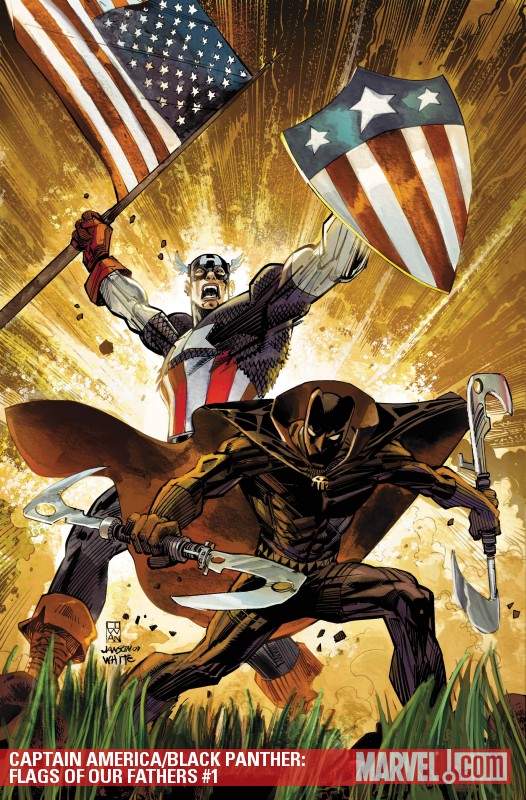
This looks AWESOME.

I dig the title (Flags of our Fathers), I like the writing in the preview, I like the Denys Cowan art in the preview, and I'm a sucker for World War II stories... particularly those featuring Captain America and The Howling Commandos.

This is a comic book that I want.

But... 22 pages of story for $3.99 is a tough sell and this is why some people, myself included, have a tendency to trade wait for books like this.

The series is four issues long, so that's sixteen dollars for 88 pages (which, ratios being what they are, is the same 5.5 page/dollar ratio as the book). Now, it's possible that they'll release it as an even more expensive hardcover first, but if I'm waiting I can wait for the trade and here's why:

If I wait for the trade, the most it'll cost me is $15 dollars- and, because the page count is so low, I expect it will be less, even cheaper if I track it down on Amazon. The ratio continues to get lower and lower if I'm willing to wait a couple of months.

This is why people trade wait- because comics are expensive, and trades are, quite simply, a lot cheaper. Contra Jon's objections (and, for the most part, I agree with them, which is why I buy most of my books on a monthly basis), trades allow for comic book readers to consume many more panels for a much, much lower price. This is also true of most $3 dollar books, like the first volume of Chew, for instance (which includes the series' first five issues and costs $9.99, which is hella savings), or, as is more common, like the first volume of Thor ($14.99 for six issues, and much cheaper on Amazon). Even in the latter case, waiting for the trade is the price of a comic book. If I'm willing to wait for some series I want to read (Chew, for instance) I save myself several books worth of money. If the move to $4 books continues, I think I'm going to trade wait more and more.

Again, this is not to say I disagree with Jon; in fact I think most of the comic-buying audience continues to prefer the single-issues, except in cases when they come to a series, writer or artist late in the game (which, I suspect, was the original purpose of the collections). This is, I suspect, because there's something compelling about a pamphlet, something beautiful and something worth keeping. There's a tension, though, because saving money (and, in particular saving money in such a way that it helps me buy more comics) is also compelling. The future of the comics industry is going to be in finding the balance, if we haven't already found it.

Marvel Announces New $1 Reprint Throwback Line

In what is obviously meant to be a compliment/counter to DC's "After Watchmen" program of last year, Marvel announced their "World's Greatest Comics" line on their corporate site back in December here and have made a second recent small statement here.


DC's "After Watchmen... What's Next?" program can be read about at AfterWatchmen.com, a sub-site of DC's website [which appears to have been taken down - DEAD LINK - 9/15/2o12]. It was just narrowly an even better program than this new initiative from Marvel, because it also included a free catalog that explained why they felt X, Y, and Z project they did was similar to "Watchmen" and why you should go buy them all.

This seems like an excellent idea to me. Comics, as a medium, is great. Individual comic-books are great. Superheroes are great. Trade-paperbacks are great. Marvel is great. DC is great. These programs essentially promote all of these things at once.

Already out is "Invincible Iron Man" v3 #1 reprint for FREE no less!
"Captain America" v5 #1
"Thor" v3 #1
"The Wonderful Wizard of OZ" #1
and
"The Punisher MAX" #1
are to follow over the course of March for a mere $1 each.

Putting out the first issues of the modern interpretations of the BIG THREE (Thor, Captain America, Iron Man) just before they are presumably going to be re-united by the currently ongoing "Siege" crossover 'event' storyline in cheap, cheap reprints is a stroke of genius! No question about it.

"Marvel's Greatest Comics" was the title of a reprint anthology series Marvel produced from 1968 to 1981, which was a re-titling of "Marvel Collectors' Item Classics" started in 1965. The bombastically promotional nature of the title is Stan Lee all the way. So there's a throw-back element here as well: the idea of presenting old comics material again at a lower price has been around for a LONG time.

"Marvel Tales Annual" #1 was Marvel's first and was printed back in 1964! It reprinted the origin stories of each of Marvel's biggest hit characters from the previous three years. In a way, this is EXACTLY what the new "Marvel's Greatest Comics" line is doing. I have fond memories of some reprint titles, as they were the only way to cheaply catch-up on old Spider-Man stories in those days before the internet!

Reprints may not be worth as much as the original, they may entirely miss the cache of that 'THIS WAS THE OBJECT, THIS WAS THE TIME' feeling, but reprints are a good thing.

In fact, the first comic-books were reprints. "How the fuck is that possible?" you ask. "How could there be a reprint if there were no comics to reprint!" you think, smug in your excellently logical thought process.

Well Mr. Smug, the first comic-books and comics trade-paperbacks were reprints of comic-strips. "The Funnies" #1 from January 1929 was essentially a newspaper comic-strip section without the newspaper. "Famous Funnies: A Carnival of Comics", published in 1933, was the first comic-book one-shot. "Famous Funnies" #1 kicked-off the first ongoing comic-book series way back in 1934.

They are all firsts, but they are also made-up mostly or entirely of comic-strips reprinted one on-top of another page after page, reformatted to the new form of the comic-BOOK.

________________________________________
To learn yourself more about this stuff:

Arthur's Marvel Comics Reprints Website is a catalog of Marvel reprint titles.
Marvel Masterworks.com is a very detail-oriented examination of the Marvel Masterworks hardcover and trade-paperback reprint line.
The Collected Comics Library is a strange but thorough site which reports on collected reprint editions.
and
TheComicBooks.com has a detailed history of the invention of the comic-book format in the section titled "Newsstand Period 1922-1955".


UPDATE: 3/12/2oo9
Not only are these many first issues being made available in super-cheap reprints, but the second issues will be available for free as a part of Marvel Digital Comics Unlimited on their website.

Brilliant.

Comic Symposium Assemble!

Those of you who attend Bard College with Clare and myself know that, on April 10th, we will be conducting the 10th Annual Bard College Comic Symposium with guest of honor Chris Claremont (who, as it happens, is a Bard alumnus). The deadline for submissions is TOMORROW, and in honor of that fact I thought I might share the posters I made up seeking submissions.

It's gonna be a great event, and we already have some great submissions- but we need a few more. If you're interested, send an academic or artistic abstract to jk448@bard.edu by midnight tomorrow!

A History of "Marvelous Color"

"Marvelous Color" is the name of a wonderful small exhibit on display now at the Gallery of the Caribbean Cultural Center African Diaspora Institute (or CCCADI) near Columbus Circle, here in New York City. Perfect for Black History Month.

The basics about this exhibit with some wonderful photos (better than mine!) can be found at: MarvelousColor.com

The focus of the exhibit is the history and art of Marvel Comics' most popular African/African-American characters and it presents us that history and artistry with simple but bold curatorial strokes. The journey starts downstairs at the curatorial statement to be found on the wall at the bottom of the stairwell that leads to the gallery. After entering the gallery itself on the second floor, you start on the far wall to the left at the two huge faux-comic-cover posters created for the exhibit. One is a presentation of these six characters as they were in an earlier period of their history and the second, their modern incarnation. Both are wonderfully drawn by Eric Battle. The exhibit is organized clock-wise so that if you start at the double posters and walk to the right through the single room of the exhibit you'll have met each character in the rough chronological order they were first created and published.

Muralist David Medina composed a larger-than-life image of each of the colorful (pun intended!) characters directly upon the walls:

(1) The Black Panther, T'Challa, regal African prince of the fictional country of Wakanda. Both the character and his country were introduced in the same Fantastic Four story in 1966. It was while looking at the Black Panther art (some which is by the immensely popular John Romita Jr. and the one pictured below was, I think, by Billy Graham) that my friend Dev Crasta (from whom I had the luck of learnin' me about the existence of the exhibit) pointed out that a story in which the BLACK Panther is depicted fighting Captain AMERICA has a certain weight that you wouldn't find in another 'superhero misunderstanding fight' and this got me thinking that the absurdity of that weight falling so squarely on a single character's shoulders is emblematic of the problem minority figures, both fictional and political, face every day.

Doubly-so for T'Challa. He is both. Nelson Mandela with superpowers. [Click on the image, scroll to the upper left, while trying to ignore the murky reflection of me in the glass entirely through no fault of my own... You'll see a much clearer reflection of what we were talking about.]

(2) Storm, Ororo Munroe, goddess of weather itself and member of the second "All-New All-Different" X-Men team of 1975, and T'Challa's queen since 2oo6. Another character who's a leader, this time in several positions: X-Men team leader, goddess of a small tribe, Queen of the nation of Wakanda. Although her parentage is much more complicated: born of an American man and an African woman, raised in Harlem but soon orphaned while on vacation back in the continent of her mother's origin. She lived on her own, first in Egypt then in the countries of the Serengeti. (Thank you Wikipedia!) She too is a very strong presence and a popular character, which is of course what made she and T'Challa naturally attracted to each other (and a naturally attractive pair to marry for Marvel's editors). A Michelle Obama kind of woman, if you will. Commanding the cultural storms of a country with style. [It is difficult to see from my separate photos, but the Black Panther mural and the Storm mural were positioned side-by-side and their arms are gently reaching out for one another! You can just see Ororo's intricately designed cape (for which we get to see the original design drawing) in the upper left corner of T'Challa's mural. Just try putting them together in your mind.]

(3) Luke Cage, streetwise Hero for Hire and former convict who escaped his prison sentence in a violent Southern jail for a bogus drug-dealing charge in his first appearance in 1972. A Harlem boy, born and raised. (The famous New York City neighborhood isn't too far away from Columbus Circle!) Luke is in so many ways the complete opposite of T'Challa, inspired by Shaft and 'blaxploitation film' instead of being a political Sidney Poitier-type, yet he too has grown into a major leadership role over the past several years, under the loving care of writer Brian Michael Bendis, as the defacto leader of the Avengers team (comprised of Spider-Man and Wolverine, possibly Marvel's two most popular characters) that has been underground since the "Civil War" ended in 2oo7. And who got a fantastic origin-retelling 1920s-transplanted solo mini-series written by Mike Benson and Adam Glass with art by Shawn Martinbrough recently, as well. The collected edition of "Luke Cage Noir" is out this week. It is as smooth and cool as can be. This is a man who has come from the lowest of points and legal indignities to become 'the Greatest', a steel-skinned Muhammad Ali.

I believe a lot of this material about Cage ended up coming from the research that was done by Martinbrough [whose wonderful art was on display as you can see, at left] for an exhibit at the Studio Museum Harlem that never came to be, as I mentioned in this post reviewing the last issue of "Luke Cage Noir".

(4) Blade, the Daywalker, a half-vampire hunter of vampires created in 1973 who was so surprisingly popular upon being brought to the big screen back in 1998. We've moved now from an African country (fictional or not) or Harlem with a quick detour to the American South, to south London where Blade was born to a prostitute who was bitten by the vampire Deacon Frost while in labor. (Another thank you to Wikipedia, the blogger's friend!) Blade is second only to Cage in having been altered from a bit of a 70s joke to a popular bad-ass superhero. Imagine Michael Jordan if he had been called to a nomadic life hunting the undead, instead of slam dunks followed by a baseball stint, followed by more basketball, followed by a brilliant corporate career. (Okay, that's a really loose one. But they are both smart, resourceful, athletic masters of their domain who maintained their position for a long time.)

(5) The Falcon, Sam Wilson, former sidekick to Captain America himself seems on the surface to be a degrading African-American figure, a subordinate to the white Captain AMERICA. But although Sam has never had his own ongoing series the "Captain America" series was re-titled "Captain America and The Falcon" for a number of years and Sam has shown himself to be his own man, most notably when he quit the Avengers (the premiere superhero team of the Marvel Universe) citing his stated degrading 'token' status. Back to Harlem we must go for Sam's origins: raised by a minister father, he was actually the first African-AMERICAN superhero from Marvel as he debuted in "Captain America" in 1969, four years after the Black Panther and T'Challa was after all African, but not American. Like the character we will meet next, Sam took over his white friend's superhero identity when he was unable to. Which means that Captain America was black... twice. He didn't actually have wings of any kind before he was gifted with a technological flying harness by T'Challa. Making him in some ways a pretty remarkable character of mixed linage: born in America, pro-America (to the point of temporarily embodying it), yet a beneficiary of his forbears in Africa; willing to stand as a subordinate, yet refusing to stay in a position where he is taken for granted. A high-flying risk-taker. The first African-American superhero. I do believe we have our Barack Obama.

(6) War Machine, James Rhodes, a former marine who has recently been seen on the big screen in the highly successful "Iron Man" and is to be seen again in this year's "Iron Man 2", this time gearing up in his own suit of armor as War Machine! A Philadelphia boy, 'Rhodey', as he's affectionately called, became Tony Stark's personal pilot after assisting him in the escape from captivity that figured so heavily in his origin story (as seen in flashback in a 1979 story). Suddenly forced to don the Iron Man in an emergency (partially caused by Tony Stark's inebriation) Rhodes became Iron Man for various periods of time on three separate occasions and eventually received his own suit of armor and identity from Stark. Rhodey stepped up to the part of Iron Man in place of Tony when he fell and he eventually became a hero in his own right. A career military man, Rhodes is intelligent, (generally) cool-headed, and a man of integrity. Colin Powell in a suit of armor.

(This writer hopes you will take his African and African-American character/real-world figure comparisons for what they are: loose comparisons with the intention of illuminating the importance of these fictional characters in our culture and tying the exhibit, and this post, more fully into the context of Black History Month. No specific political comment or endorsement is intended beyond equality for all people of all races. Minor discrepancies or outright contradictions can be found by anyone with a more thorough understanding of these characters or these figures, I am sure.)

The CCCADI is at 408 West 58th Street, between 9th and 10th Avenues in Manhattan, New York. That's just about a block west of Columbus Circle, one of the major transit hubs on the island. Suggested donation is a mere $5. The same as the Museum of Comics and Cartoon Art downtown. The exhibit will run through February 26, 2010 and when I met-up with the exhibit's curator Edgardo Miranda-Rodriguez I was informed that awesome events to spotlight the different characters and their creators were still yet to come! The gallery is holding a 'Meet the Artists' event on Wednesday the 24th at 6:30 PM at the CCCADI Gallery at which you could hear the great Gene Colan and the young Dennis Calero and Shawn Martinbrough.

I highly recommend going to this if you are in New York City and even going to the website and signing up for the mailing list to learn about any other events lined up for the end of the month!