Showing posts with label indie. Show all posts

The Grass is Always Greener on the Other Side...

So. I wrote up a review recently of "Flashpoint" #1, written by Geoff Johns (@geoffjohns).

Note the specificity in that sentence. A REVIEW of FLASHPOINT NUMERO UNO. I didn't review the whole "Flashpoint" event (after all, it's not over yet) and I didn't review Geoff Johns' entire career (it's not ending anytime soon either) and I didn't review every comic in the fictional DC Universe. And I reviewed the issue in question fairly negatively.

But I just read "The Flash" #12, the last issue of the current series and the end of a four-part story titled "The Road to Flashpoint", and goddammit if it doesn't give the story more emotional weight for our central hero Barry Allen! The truth is the story is stronger for being in a few parts. Spread over several examples of what writer Tom DeFalco once called "a complete unit of entertainment" (MARVEL Podcast, "The Amazing Spider-Girl", 4/28/2oo7), i.e. one comic-book, not two or three.

In this separate comic-book (also written by Johns), Barry mentions that the birthday of his long-gone mother is the next day and asks his wife Iris to "just give me tomorrow", for "one more day" (I know, very weird considering what Spider-Man's been through for the past few years) to think his life through, all quite wonderfully drawn by Francis Manapul (@FrancisManapul), and well, just look...
...

In the comic I reviewed, Barry wakes up on his mother's birthday, everything is different, she's alive, he's not the Flash, some of his allies are enemies to the world at large, and Iris is in love with someone else. OUCH. Not the "tomorrow" Barry Allen expected he'd be waking up to.

Johns set us up in the end of "The Flash" #12 and knocked us down in "Flashpoint" #1. IF you read both. (Mind you, "FP" #1 also has a huge amount of very obvious set-up for more to come.) Could it all have fit into one comic, one "unit of entertainment"? Probably. But if it was, it definitely wouldn't have had the space for all the other characters' story-lines, most of which I made it clear I found uninteresting. But something dramatic with a splash of traumatic has happened to Barry Allen and this particular thread is a wonderful surprise! The weirdest part? Neither are excellent comic-books. But they are excellent together.

This is what I love about American superhero comics, really. This is why I fell in love with comics in the first place. I was given a copy of "Spider-Man" #35 in 1993 or '94, read it lying down on the couch in my parent's living room, and I realized that because it was labeled "Maximum Carnage" Part 4 of 14, something came before it and something came after it. I HAD to know what. (There's a page devoted to the issue on The Amazing Spider-Man Gallery that gives you a good feeling for the flow of continuity.)

Et voila:
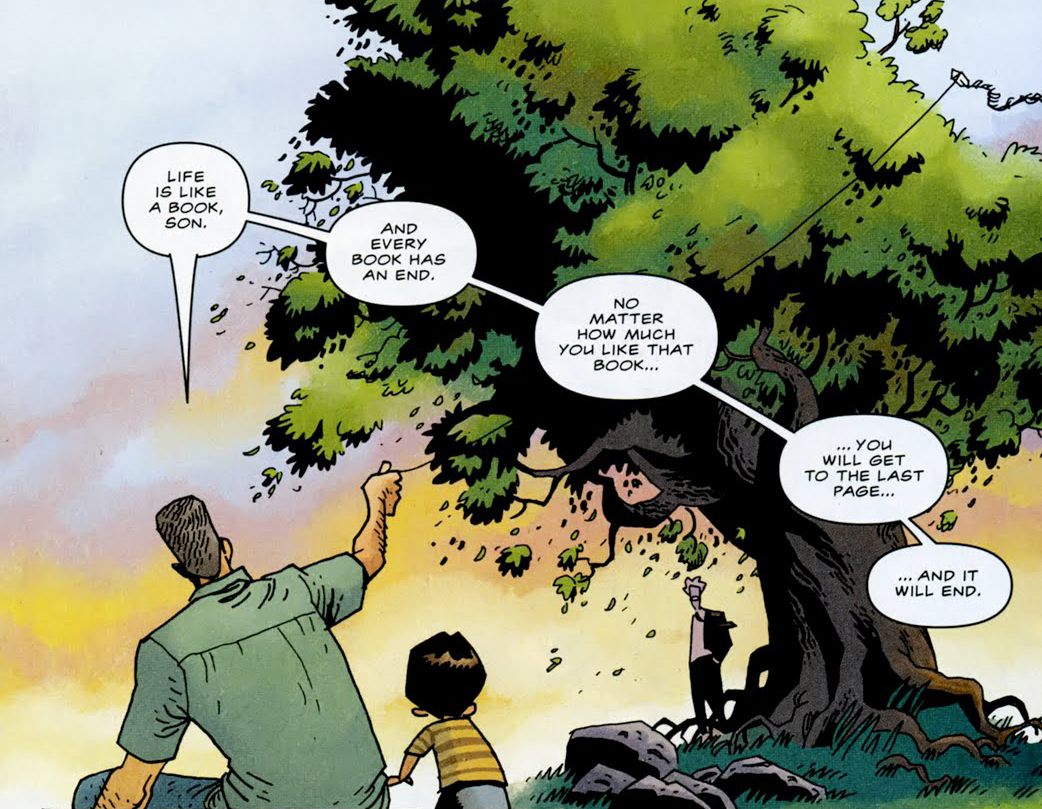
Shared universe ongoing stories. It doesn't end. As Adrian Veidt says "Nothing never ends." Something came before and something comes after. Like... life.

But it's problematic. Most people's brains don't seem to work like mine does apparently. "This is only part of a story? I'm not going to buy this. It's not complete."

So what's a mainstream American superhero comics publisher to do? For that matter, what's a review of mainstream American superhero comics to do? Can you see the dilemma here? You, the consumer, should not have to buy multiple items to get a complete story. I stand by that. But I know stories can become richer, fuller, and more life-like when expanded over multiple items. Several 'units of entertainment'. I stand by that.

I guess a quick and dirty solution is to do just what I did. I wrote a review of "Flashpoint" #1 with a side note alerting all of you, my readers, to consider that ramifications affecting perception of the story might be sitting in recent issues of "The Flash" and/or upcoming issues of "Flashpoint". As part of a larger, shared-universe, semi-mythological, 80-year story something did come before it and something will come after it.

Continuity flows:

*Superman was alive, then dead, then alive. Then "Dead Again", I believe. Since? Alive again.

*Spider-Man was single, then he got married, then he was a widower, then he was married again, then he was magically never married at all.

*Batman was alive, then his spine was broken, then he got better, then he was dead, then suddenly he was just trapped in a repeating pattern through time itself. Now he is back.

*Then there's Brás de Oliva Domingos, main character of the brilliant "Daytripper" by Fabio Moon and Gabriel Bá. In just about each of the ten issues of the series he's alive and then suddenly and tragically he's dead. Slowly, a picture of a life emerges across those ten comic-books.

But each issue stands alone, a cohesive unit. Of entertainment-- or art depending on the eye of the beholder.

Writer Grant Morrison once said at New York Comic-Con, that it occurred to him one day: When you pick up any issue of Superman, what you're looking at is a piece of a life. And what if some god was doing that with his life or my life right now? Picking up and reading it, a slice at a time.

This is actually the exact structure of the late Harvey Pekar's ongoing autobiographical stories. The first series "American Splendor" combined with the mini-series that followed and various graphic novels along the way, the latest of which was published quite recently: "Huntington, West Virginia 'On the Fly' ". And it's not the last. "Harvey Pekar's Cleveland" is yet to come out. Harvey's been gone for over a year and the output of stories still isn't quite over yet. All of them together tell the story of his life. I'm far from the first to point this out. He's made us all like gods who can peer into the memory of his imagination.

I wrote in my recent review "I don't believe we should encourage this one-comic-is-needed-to-understand-another storytelling structure" but you know what? I also really do. That's what first made me fall in love with comics and it's STILL a big part of what I love about comics. Barry Allen, Spider-Man, Brás, and Harvey included. A multitude of short incomplete stories that add up to more than merely the sum of the parts.

Part x of

And so the monkey has swallowed its own tale, this linear-publishing model of life becomes a circle of death and resurrection, and I am back where I started all those years ago on my parent's living room couch. It's exciting. It's about life and death and the tension inherent in moving forward.

So I'll continue to review these units by themselves, while taking into account the traditions and ongoing stories as ever-expanding structures, of which each each comic is a single brick.

Long live the serial narrative.

~ @JonGorga

Xeric Foundation Announces Grants for Comics Will End Next Year

Since 1992 Peter Laird, co-creator of "Teenage Mutant Ninja Turtles", has awarded through his small organization called the Xeric Foundation an astronomical amount of money to various charitable groups but also to aspiring comics creators who could produce work of high quality that was ready to be published.

(As I understand it, a comicsmith or creative-team had only to show their completed work, argue its merit, and lay-out a budget/plan for publication to be eligible for the Xeric Award, a one-time grant that simply paid out that planned publishing cost-budget.)

I can imagine few more beautiful things.

Ryan Alexander-Tanner (@ohyesverynice) was a winner of the Xeric for his short piece "Television" #1 back in 2oo7. He created with education reformer Bill Ayers (@BillAyers) a graphic novel about teaching I reviewed last July. Brendan C. Leach (@iknowashortcut) also won just this past year for his "Pterodactyl Hunters in the Gilded City". We spoke together at great length about it back in October. Both works were named by me among the best of the best last year. You can see the full list of grant recipients including Megan Kelso, Jason Lutes, Adrian Tomine, James Sturm, Jason Little (@beecomix), Danijel Zezelj, Josh Neufeld (@joshneufeld), Ryan Dunlavey (@RyanDunlavey) and Fred van Lente (@fredvanlente), Nathan Schreiber (@nathanschreiber), and Jeff Lemire (@JeffLemire), on Xeric's website here.

Unfortunately, according to this announcement on Xeric's website, they will cease the annual giving of the Xeric Award in 2o12.

[via The Center for Cartoon Studies' Facebook wall]

In Laird's own words:
"Roughly twenty years ago, I started something called the Xeric Foundation. It came about because, with the success of the "Teenage Mutant Ninja Turtles" property that Kevin Eastman and I had created back in 1983, there were a lot of people asking for money. Many of these requests were legitimate and came from real need, and I wanted to find a way to deal with them in a fair and organized fashion.

I also wanted to help out struggling comic book creators. Having started TMNT with Kevin as a self-published venture, I knew very well how critical even a relatively small amount of money could be for success at that nascent stage.

...

The advent of essentially free web publishing has forever altered the way aspiring comic book creators can get their work out into the public eye. With this in mind, I have decided that it makes sense that the Xeric Foundation will no longer provide grants to self-publishing comic book creators, and instead devote all of its available grants funds to charitable organizations."

Yeah. That last part is a little weird. But logical.

On the other hand, are we really to believe that this has nothing to do with the current economic recession?

This truth is the Xeric has come to stand as a mark of quality, an indicator of who might be expected to produce remarkable work in the coming years, as well as a piece of concrete proof that the American comics industry is a small community in which the large figures interact with the small ones and really GIVE BACK.

Taking that away from the world is a sad thing.

~ @JonGorga

P.S. ~ Of course... more money being donated to charity. Who's going to argue with that? Not this guy.

Last Weekend's MoCCA Festival Got The Voice

If you happen to be a comics creator and a comics journalist you probably got the same weird experience I did from reading the latest issue of The Village Voice, "The Comics Issue". The main article is about how underpaid comicsmiths really are. The article is quite good from a journalistic point-of-view: honest and comprehensive. But tremendously depressing from an artistic one. The article is well worth checking out if for no other reason than to hear in first-hand quotes how hard it is for even fairly well-established comics creators to make some money.

On a lighter note, just try and tell me that cover isn't hilarious! Wonder Woman as if drawn by Lynda Barry! Charlie Brown as if drawn by Jack Kirby! The Thing as if drawn by the SpongBob SquarePants... guys. Dilbert as if drawn by Dan Clowes! Dagwood as if drawn by Chris Ware! Archie as if drawn by Peter Bagge staring at the ass of an Olive Oyl as if drawn by R. Crumb!

I love it. It's wrong and disgusting and clever and true all at the same time.

MoCCA Festival 2o11 - The Floor
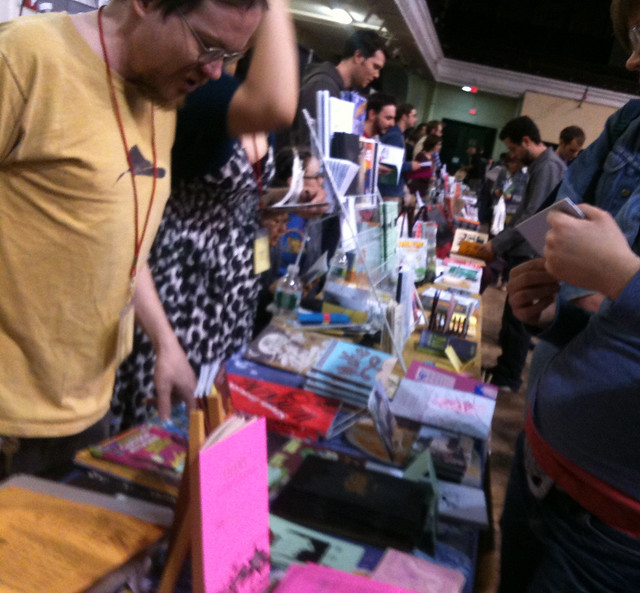
On a MUCH more positive note, this year's MoCCA Festival was great! The Voice issue was obviously timed to coincide with the Festival and they were smart to do so as the The Museum of Comic and Cartoon Art's (@MoCCAnyc) annual fund-raiser has grown to be the premier event of the New York City indie comics year. It also drives in loads of alternative/indie/hipster/zinester/curious types who may have never picked up a comic in years. And this makes me feel good about the health of the industry in general, and the print and independent elements in specific. Jon Lewis, creator of some very cool comics, [pictured at the left below] and I talked about that specifically. Underground people making comics intended to be PRINT comics, as I wrote about for the blog here.

I met, re-met, bumped into, and passed by more people than I can remember.

Jason Little (@beecomix) was there, as was Josh Neufeld (@joshneufeld). Comicsmiths Danny Lewis (@dannydoodar) and Jen Overstreet (@streetoverjen) shared a table. I met Melvin Ylagan, who was once an assistant to Joe Quesada, former EiC of Marvel Comics. Near him was a very talented artist and new friend to me in comics, Miguel Guerra (@SamuraiElf). Steve Seck and Sara Lindo rocked me with their mini-comics making knowledge as usual. They tabled with Lance Hansen of Kettle Drummer Books this time around. Morgan Pielli (@UltraMorgnus) was in the back, holding the fort with his awesome comics [he's one of the fuzzy heads in the phtoto below!] The very talented Mike Cavallaro and Dean Haspiel (@deanhaspiel) were in attendance representing the ACT-I-VATE folk! Plus the always lovely Gabrielle Bell (@luckygab) was selling her minis near the Pizza Island Collective (@Pizza_Island) booth.

The two most exciting moments for me (other than actually working behind a table a little bit for the first time!) were: A sighting of the true gentlemen of comics, Jerry Robinson. And meeting Julia Wertz (@Julia_Wertz) creator of the wonderful autobiographical series "The Fart Party" and graphic novel "Drinking at the Movies", which feels very much like what it is to be in your twenties, living in New York City in a recession, making comics but no money. (I know from experience.)

I wrote some shout-outs right after leaving the convention on the @LongandShortbox Twitter account! Check them out.

MoCCA Festival 2o11 - Jon Lewis Tabling
I also picked up a SLEW of comics, some of which I will review over the next few weeks here on The Long and Shortbox Of It.

~ @JonGorga

Talk Over Balloons: comicsmith Ben Katchor

Ben Katchor is among the most honored creators of sequential art alive today. The first comicsmith to be awarded a MacArthur Fellowship as well as a Guggenheim Fellowship, he is a standing associate professor of illustration at Parsons-The New School and, perhaps most importantly, was declared by Michael Chabon to be "the creator of the last great American comic strip".

The strip in question is "Julius Knipl, Real Estate Photographer", a unique creation of poetic verbiage and expository narration; urban culture sprinkled with imaginative speculation; truly American in nature but with European roots. The work is stylistically experimental yet the content is so quotidian as to be almost boring. And boring it would be if not for Ben's good humour and sharp powers of observation. His work has been collected in "Cheap Novelties", "Stories", "The Beauty Supply District" (all three "Julius Knipl" collections), "The Jew of New York", and most recently as of this month: "The Cardboard Valise".

The Long and Shortbox Of It asked Ben a few questions about his thinking and his work. He has generously supplied us with answers. Here is the L&S interview with Ben Katchor (@benkatchor):

Jon Gorga: Your stories often take place in a highly dynamic and multi-cultural version of the American urban-center. Different eras' architectures and different ethnicities' traditions mix in a true melting-pot. Do you yourself make daily notice of the patch-work elements of urban life like Mr. Julius Knipl, the specialized real estate photographer of the strip's title?

Ben Katchor: Sure, the great energy and ingenuity of first-generation immigrant neighborhoods and business are always exciting -- a transplanted piece of an Asian or Latin culture, designed according to an individual's sometimes eccentric vision and catering to the tastes of fellow countrymen. The strip of Indo-Pakistani businesses on Lexington Ave., the Dominican businesses on the upper west side, the cheap import/export district around 28th and Broadway make living in Manhattan bearable -- otherwise, it's become a corporate strip-mall.

JG: The only place I've experienced that felt to me like what you portray in strips like "Julius Knipl" is Manhattan's Nolita. North Of Little Italy. Chinatown mixes into it liberally. It's home to the Puck Building (former host to the Museum of Comics and Cartoon Art Festival) among other unique buildings. You're a New York City local, are you familiar with the neighborhood? Would you consider it emblematic of a mix you try to represent?

BK: Once a neighborhood in NYC is given a name invented by real-estate agents, it's usually into a social and economic upswing that ruins its character. The business districts I described in Knipl were on their way down. The city invented in Knipl was filled with light industry and lower-middle class families. While the buildings are still intact, the social and economic makeup of that area above Little Italy has changed into something much less interesting over the past 20 or 30 years.

JG: Your work has a poetic storytelling quality to it that I enjoy very much. Ideas flow free-form. I particularly like the simple, but revealing, strips where the last panel alludes to or directly connects with the first, creating a nice 'routine of daily life'-cycle. Like "The First Wife" for example. Is that something you have always done intentionally?

BK: The stories that involve an ongoing situation can usually be evoked with a circular structure. I'm very interested in the kind of free-associative connections that make up the texture of a city -- the distribution of business on a given block or a given floor of a small-office building. If these structures arise through a kind of dreaming, their actual construction on paper is very intentional.

JG: I also enjoy that your work can shift without warning into dream-like speculative territories. I've heard you state publicly at R. Sikoryak's Carousel night that your work is not speculative fiction. How do you reconcile the occasional introduction of a 'novum' (science-fiction's 'the new thing') in your work, with this stance?

BK: I may have said that because I don't like fiction that's concerned with examining ideas at the expense of describing the texture of experience. I want my readers to become highly aware of the invented and improvised quality of the manmade world and, hopefully, become inspired to reinvent it for themselves in some way.

JG: A college professor of mine said that all art's value exists half with the creator and half with the audience. Tell us about the new book "The Cardboard Valise"? Like the Julius Knipl books before it, it's a collection of previously published strips, correct?

BK: It's an absurdist novel in the form of a collection of weekly picture-stories about travel, national identity and print culture. The stories appear in the order they were originally published in weekly newspapers, but have been annotated, or expanded upon, with some new pages.


JG: Does it include the piece you projected on the wall and read aloud at the Carousel night in April about the man who moves house over and over to continue enjoying the most advanced living accommodations possible? That is an example of your work that, to my mind, is both entirely quotidian and yet introduces a few small technologies or concepts not seen in reality. I really enjoyed it.

BK: No, that was from my series in Metropolis magazine.

JG: Ah, I see, they are separate strips. Moving into more formal territory, what do you think of the word 'cartoonist'? Or for that, matter of 'comics'? I noticed you avoid their use in all your bios. As someone whose work is quite far from cartoony or comic-al, and whose primary occupation is in higher education, do you feel the terms apply to you and your work at all? Is there a single word that captures, to your mind, what you do as a creator of "picture-stories"?

BK: Those words seem to have outlived their usefulness in describing the kind of text/image storytelling we're seeing today. Most of the work I like exists outside of, or in opposition to, the comic-strip and comic-book traditions of the recent past. Probably a better description would be autographic writing -- that is, writing concerned with handwriting of words and images.

JG: Interesting. Will Eisner always stressed that he was a writer in pictures and the evidence of the gesture of the hand brings so much both to his artwork, and yours. Now, even "The Jew of New York" was a weekly strip, correct? Any future plans to produce a full-length original graphic novel? And, if not, what's next for you in sequential art? What would you like our readers to know about?

BK: Yes. Almost all of my work has lived in the short serial form. I like the concision demanded by a single page. The novel built only of words needed many pages to evoke a palpable world -- I just need a few drawings. I'm working with Mark Mulcahy on a new music-theater production set in the NYPL on 42nd Street. It will premiere in Oct. 2011.

JG: Exciting! Thank you, Ben, for making the time to answer some questions for us here at The Long and Shortbox Of It!

__________________________________
Ben Katchor's narrative art can be seen monthly in Metropolis magazine and selected strips are available for viewing on their website here.

More information about Ben Katchor's collaborative stage projects (and more sequential art!) can be found at Katchor.com and Ben's elegant WordPress blog. Ben's work is well-worth checking out and he will be speaking with another unique comics-creator, Jerry Moriarty, at the Powerhouse Arena at 37 Main St in Brooklyn, NY at 7 PM TONIGHT. I know I am going to be there.

~@JonGorga

2o1o in a Shortbox: The Best of the Year

The Oscars were last night, so here's the best comics I read last year. Pretty simple.

The deal is: To qualify, a work must be comics and must have become publicly available in its entirety, in English, and for the first time, either in print or on the web, between 1/1/1o and 12/31/1o. The selections are presented by category, but not in any ascending or descending order.

BEST GRAPHIC NOVELS
"Superman: Earth One"
written by J. Michael Straczynski(@straczynski); drawn by Shane Davis
Like a Hollywood action movie, the first of the "Earth One" graphic novels delivered on action, excitement, and most importantly: gravitas. A 'superhero in the real-world' story for the first half and a classic, smart, grandiose superhero/supervillain battle for the second half with strong character work throughout.

"To Teach: The Journey, in Comics"
drawn by Ryan Alexander-Tanner (@ohyesverynice); adapted from a prose-book by Bill Ayers(@BillAyers)
A documentary-comic, Alexander-Tanner deftly cartoon-ed his way through Ayers' theories about education to clear, informative, humorous, and, occasionally, thrilling effect! Truly it is a work that any aspiring teacher should read. Quite a few healthy life lessons in general are spelled out on its pages.

"Ghostopolis"
written and drawn by Doug TenNapel (@TenNapel)
If "Earth One" is the 'action flick' and "To Teach" the 'documentary,' this is the 'animated movie'. A fully-realized world of familiar archetypal Halloween characters used and combined in unexpected ways, portrayed with fine cartooning and lush coloring. Some pages are laugh-out-loud funny (although some jokes are childish 'potty' humor), while other pages are truly moving. The words AND the pictures are moving, both in concert and separately. (I don't play the numbers game, I list no 'number 1' graphic novel here, but if I did...)


BEST GRAPHIC NOVELLAS (under 100 pages)
"Serenity: The Shepherd's Tale"
written by Zack Whedon(@ZDubDub); drawn by Chris Samnee(@ChrisSamnee)
Truly beautiful and truly unique is this 'life flashing before his eyes' sketch of the television/film/comics character Shepherd Book. The overlapping phrases and motifs that run through the life of the main character serve as bullet-points by which the reader is allowed to drop into further and further back stages of Derrial Book's life.

"Pterodactyl Hunters in the Gilded City"
written and drawn by Brendan Leach (@iknowashortcut)
Sharp drawing and even sharper writing makes this strange comic an exciting and engrossing reading experience. Brotherhood and the passing from one era into another are its themes, the ink-lines combined with ink-washes make for a glowing, bleary, period-accurate feeling. Not to be over-looked is the awesome faux-newspaper-front-page that makes the comic's cover.

"Falling for Lionheart"
written and drawn by Ilias Kyriazis (@IliasKyriazis)
The 'indie- film' comic for the year. (Okay, that analogy's done with now, I promise) Emotional, but with action, sex, and humor; alternative lifestyles are presented as well as mainstream ones; comics is depicted as a medium capable of expressing emotion within the narrative, "Falling for Lionheart" is among the finest graphic novellas I have ever read. And furthermore, it uses different visual art styles to VERY smart narrative effect.

"Portrait of the Cartoonist as a Woman" on NarrativeMagazine.com
written and drawn by Liza Donnelly (@lizadonnelly)
Human and honest, like the best memoir comics are, these 32 pages speak volumes about childhood, womanhood, body issues, sexism, motherhood, and creative energy. The inherent sweetness of the small moments ("I was launched as a cartoonist. ... And most importantly, I made my mother laugh.") support a sense of life and narrative.


BEST MINI-SERIES
"Bullseye: Perfect Game" #1 and #2
written by Charlie Huston(@CharlieHuston); drawn by Shawn Martinbrough
This clever short series tells of murder on the baseball diamond. A certain supervillain-assassin masquerading as a home-town baseball player to carry out a hit. A big baseball fan solves the murder and narrates the story to the reader while walking around an apartment. Only at the last page, does the POV shift and we see that the baseball fan has been talking to a certain superhero.

"Phantom: Unmasked" #1 and #2
written by Martin Powell; drawn by Hannibal King
Again, this series' strength lay in a unique POV: the sultry, intelligent, hard-as-nails, lady private investigator Laughton Brice hired to find The Phantom, through which we see 'The Ghost Who Walks' anew! (The character of The Phantom has been around since 1936.) The Ghost Who Walks never even makes a clear physical appearance until more than halfway through the first issue, only shadows and stories. And, to boot, the courageous choice a character makes in the second issue tops it off nicely.

Seriously, these are both worth checking out and only two issues-long. Ask your retailer for where you might find them. I have little doubt most American retailers didn't sell many of these two series AT ALL.


(LATE ADDITION)
BEST STORY-ARC IN AN ONGOING SERIES
"Metal" from "Northlanders" #30, #31, #32, #33, and #34
written by Brian Wood(@brianwood); drawn by Riccardo Burchielli
One of the best stories of any medium was told last year in Brian Wood's series "Northlanders". Cross-cultural viking-era action/romance. Unique, smart, and cool.


BEST INDIVIDUAL ISSUES (either from a mini or ongoing series)
"41" from "Daytripper" #4
written and drawn by Fabio Moon(@fabiomoon) and Gabriel Bá(@Gabriel_Ba)
A tremendously emotionally affecting chapter in the haunting life of Bras, the main character of the series by those talented brother comicsmiths: Moon and Bá. The loss of a father, the birth of a son, and the moment in life at which a precarious level of security-like adulthood is attained... then swept away like all the others.

"M.I.A." Parts 1, 2, and 4 from "DMZ" #51, #52, and #54
written by Brian Wood(@brianwood); drawn by Riccardo Burchielli
Matty Roth, the main character of Wood's long-running futuristic love-letter to NYC, makes some achingly hard decisions to regain his lost honor. LOOK at that cover on the last issue of the arc!

"Collective Punishment" one of five: "five hours under fire" from "DMZ" #55
written by Brian Wood(@brianwood); drawn by Andrea Mutti
A shocking, smart, compact story about the horrors of war, both the ones perpetrated on human bodies and those perpetrated on human minds.

"Collective Punishment" four of five: "A Decade on the Wall" from "DMZ" #58
written by Brian Wood(@brianwood); drawn by Danijel Zezelj
A harrowing and beautiful issue narrated by the first "DMZ" character I ever encountered: the graffiti artist known as Decade Later. After imprisonment, during which he wasn't allowed to draw, this man creates a graffiti autobiography in the ruins of a New York City art gallery. Incredible.

"Electric Ant" #1 and #3
adapted from a Philip K. Dick prose novel by David Mack(@davidmackkabuki); drawn by Pascal Alixe
Crazy mind-altering sex between a self-aware organic-robot and a human... or is she? Visually stunning color and shape choices are made to represent Dick's psychedelic verbiage. Very cool.

"The Sixth Gun" #1, #2, #3, and #6
written by Cullen Bunn(@cullenbunn); drawn by Brian Hurtt
Fun, striking, exciting, funny, and unique all describe this new ongoing series. The most wonderful sound effects melt into the artwork in wonderful ways. The scope is huge, while the human-scale dangers never feel lost. The first arc's conclusion in issue #6 is perhaps the best: mostly double-page spread layouts.

"Never Say Die" from "The Shield" #10
written by Eric S. Trautmann(@mercuryeric); drawn by Marco Rudy
The surprise delight of my year. I received this issue in a pile of free comics. The superhero concept at the core of this series (American soldier is gifted with abilities by the government to better serve) is a very, very old one to which nothing new is brought here, but the characterization seems more genuine than most. The winning element is Rudy's storytelling panel layouts, which are the best I have seen since those of the supremely talented Steve Rude or J. H. Williams III.

"the brave and the bold." from "Superman/Batman" #76
written by Judd Winick; drawn by Marco Rudy
In fact, I shouldn't have been surprised by Rudy's skills as he had already shown me what he can do. More wonderful page compositions here. Judd Winick brings emotional gravitas to Superman's reaction to Bruce Wayne's death. It was also a wonderful compliment to this Batman issue...

"Batman's Last Case" from "Batman" #702
written by Grant Morrison; drawn by Tony Daniel
Despite the fact that this issue makes no sense without the context of a mini-series from two years ago ("Final Crisis") it does an excellent job of gifting that mini-series retroactively with more sense. Most specifically and remarkably it explains Batman's actions and makes them emotionally powerful: "I survived an encounter with something bigger than me".

"Grounded" Part One from "Superman" #701
written by J. Michael Straczynski(@straczynski); drawn by Eddy Barrows
Any story in which Superman is put into realistic morally complicated situations is usually interesting. Stories in which Superman is put into realistic morally complicated situations and finds a way to triumph are usually going to get me. A single issue that does that over-and-over again was guaranteed to win me over.

"Night Gods" from "The Brave and the Bold" #32
written by J. Michael Straczynski(@straczynski); drawn by Jesus Saiz
This Cthulu-inspired, genuinely scary comic, stars Etrigon the Demon and... Aquaman. Aquaman does a series of bad-ass things and Straczynski put in the effort to write all of Etrigon's dialogue in rhyming verse. All good things.

"Ladies' Night" from "The Brave and the Bold" #33
written by J. Michael Straczynski(@straczynski); drawn by Cliff Chiang(@cliffchiang)
A return to the moment-in-time just before a young heroine's defining tragedy laid out in sharp relief. Just beautiful.

"A Batman's Work is Never Done!" from "Batman: The Brave and the Bold" #17
credited as written by Sholly Fisch; drawn by Robert W. Pope
Kids' comic: Batman has a busy week. Calls his friends. Hijinks ensue.


BEST SHORTS (under 22 pages)
"Comic-Converts" on Jillian Tamaki's Sketch Blog
written and drawn by Jillian Tamaki (@dirtbagg)
It's a diary entry, a comics news report, a food review, a showcasing of friendly faces, and an ethnographic statement all at once. The mix of geek/indie, human/inhuman, private/public elements in this comic about SDCC really shows how much a comics convention can be and how much a comic can show.

reportage and photography by Seth Kushner (@sethkushner)
The way Kushner laid-out photographs here to bring the reader through a narrative while maintaining the beauty of the photographs themselves is nothing short of remarkable.

written and drawn by Nathan Bulmer (@natemorebikes)
A fun, trippy little mini-comic. Reality melts into a world of cartoony horror for one acid-tripping punk rocker. The first chunk can be read here.


BEST STRIPS (one page each)
"Angel" in OVERFLOW Magazine #6, Summer 2o1o; and on ACT-I-VATE .com here!
written and drawn by Dean Haspiel
Hapiel's work always feels RIGHT to me, but rarely so much as when the main figure of this double-page comic falls-- no SLAMS-- into the ground and the textbox reads: "I'll miss you." A pseudo-Kirby, action-representation of emotion in line and color, this may be his best work to date. (Again, I don't make this a numbers game. But if I did...)

"Flying Restrictions 1" and "Flying Restrictions 3" (The Adventures of The Man Who Can Only Fly When He's Sad) on cowbirdsinlove.com
written and drawn by Sanjay Kulkarni (@cowbirdsinlove)
I especially like 3 because it is positive and beautiful in its resolution, but 1 serves as excellent set-up. 2 left me cold by comparison. Doesn't really need to be there.

"The Tell-Tale Beat" on XKCD.com
written and drawn by Randall Munroe
A hilarious piece that reminds us that yes Randall Munroe can, in fact, draw.

"Porn For Women" on XKCD.com
written and drawn by Randall Munroe
Honesty = excellence. And, in this case, hilarity.

"Spirit" on XKCD.com
written and drawn by Randall Munroe
Oh god! I can imagine few things as simultaneously funny and horrifyingly sad. Except maybe the next webcomic:

"SuperMutant Magic Academy: Wufflefluff" on Jillian Tamaki's Sketch Blog
written and drawn by Jillian Tamaki (@dirtbagg)
Creepy, sad, but so true.

"SuperMutant Magic Academy: Pickles" on Jillian Tamaki's Sketch Blog
written and drawn by Jillian Tamaki (@dirtbagg)
Funny but also sort of sad, and feels right to me somehow.

"Domestic Men of Mystery" on JillianTamaki.com
written and drawn by Jillian Tamaki (@dirtbagg)
Father's Day, indie-webcomics style. This one is really beautiful and sad and happy and I can imagine few better ways to go out for 2o1o.

~ @JonGorga

P.S. ~
Comics that very well might have made it had I bought/read them in entirety:

"The Playwright"
"Smile"
"Stigmata" (in translation)
"Artichoke Tales"
(Truly, this one is in need of more attention. Amazing.)
"Market Day"

The market for graphic novels either swung wide, wide open this past year, or I just never noticed the volume already coming out. They also take a lot longer to read...

Quote for the Week 2/13/11

"Mainstream American super hero comics and manga are the same medium--they're comics. ... I think we could actually take manga out of the equation and ask why women and girls make up a significantly larger percentage of the comic-reading audience than the Big Two comic-reading reading audience--and unfortunately, I don't think there's a pithy answer. Probably the biggest hurdles to new readership, period--gender aside--are continuity and current distribution models. Take a potential new reader of either gender into a comic shop and watch their eyes glaze over. It's impossible not to be overwhelmed. Where do you even start? Say you have an interest in a particular character--okay, but there are four, maybe five titles that feature that character and current issues on display are number, what? 603, 24, 12, and 3 (of 5). Huh? New readers literally need a guide.

Conversely, point them in the direction of the manga or graphic novel section at their already-familiar local bookstore and neatly arranged in rows are books with already-familiar series descriptions printed on the back covers. You find a title that sounds interesting, read the cover and, if you like it, buy volume one. Easy peasy. Overcoming the fact that manga titles read backwards is actually easier than overcoming 50 years of character history and comics culture."
~ Kelly Sue DeConnick (@kellysue), from her "Woman of Marvel" campaign interview, appeared in Marvel Comics issues dated 6/2o1o

@JonGorga

The Transmogrification of The Indie Comic-Book into The Indie Graphic Novel (Series)

Jason Lutes' "Berlin" has been coming out since 1996 in a slim 30-page saddle-stitched format (that's just fancy talk for: it's a comic-book). But things have changed since 1996. Are "Berlin" and Adrian Tomine's "Optic Nerve" the last of the great indie comic-books?

Chris Ware's "Acme Novelty Library" became a hardcover graphic novel series when Ware began self-publishing the title at issue #16. Los Bros Hernandez' "Love and Rockets" became an annual paperback graphic novel with restarted numbering under the title "New Stories" in 2oo8. Finally, Seth's "Palookaville" jumped ship this year: with "Palookaville" issue #20, the series is now 'hardcover graphic novel volume' #20.

"Acme Novelty Library" changed formats like most people change their clothes but "Palookaville" now exists as nineteen comic-books and one graphic novel-ish thing. Seth is to be congratulated in at least one way: "Palookaville" Vol. 20 is a pretty gorgeous book object but doubts linger in the forefront of my mind.
"The expansion into hardcover from pamphlet is a parallel that illustrates Seth's growth ... into a book designer, hobbyist, editor, essayist, and installation artist."
~ "Palookaville" #20 (marketing writing on the book-band)
A slightly different tune from Seth himself (a slog of text yes, but worth it):

"It's not like I wasn't aware that the comic book format was coming to an end. A shift had occurred (this last decade) in the sales of comic books and people simply weren't buying 'alternative' comic books any longer-- they were waiting for the book collections instead. Books were the current 'healthy business model.' ... I was torn. I have a deep and abiding love of the old pamphlet form of comics. I grew up with them, and it is the most simple, austere and unpretentious format you could invent. ...

all the great alternative comics were gone ... Hate, Yummy Fur, Eightball, Yahoo, Dirty Plotte, Peepshow, Jim/Frank... they'd all vanished. Even Love and Rockets had turned into a large squarebound book. Only Optic Nerve seemed to be strongly carrying on. I hadn't truly realized how much of a dying breed we were. Was I leaving now too? It seemed a minor betrayal of something to quit the format. ...

It's difficult to do a long story all at once and putting it out a bit at a time was a method that worked for me. There was an era when the comics reader was more willing to go along with this approach ... Then they'd buy the book collection as well. I appreciated that too. I guess that day is done. ...

In fact, the less constrained page count would actually allow me to present larger chunks of the long story as well. ... I suspect that this format change itself will influence how my next long story is told. ... So, goodbye, comic book format. It was good to know you. I leave you with no regrets."
~ Seth from "Palookaville" #20: Introduction

So where does the 'comic-book' end and the 'graphic novel' begin? Well, somewhere in the middle of the 'graphic novella' I guess? At over 100 pages? Other than that I'll be damned if I know anymore.

Alan Moore and Melinda Gebbie's "Lost Girls" was an indie comic-book slowly released over several years. The series was canceled and eventually finished when published as a bound book set and then a single volume "graphic novel". If the only way to get the entire story is to buy the trade, does that lend credence to the concept of a serialized graphic novel?

"I suspect that this format change itself will influence how my next long story is told." Of course it will. If I gave anyone alive one page a day to write something, the writing would be different than if I gave them 100 pages at once. Artists, like all humans, are adaptable. They expand or truncate to fit the space they're given. This affects the way these stories are told and if ALL indie creators switch over like this I fear we will begin to see an English-language paper-marketplace with very similar comics. I am working on a review of "Berlin" #17. Will my review of "Berlin" #18 (in 2o13 or whenever) be of a hardcover book? In which case, webcomics-in-print may become the new go-to source for a variety for voices who wish to do something in short formats without a superhero in it (not that there's anything wrong if there is) at a comics shop or box chain bookstore. Truth is: webcomics already rival the indie comics in that regard. Turn on your computer, type "recommended webcomics" into Google and you may be amazed at what you find.

But should not the talented creators of limited financial means be also given credit for surmountting the problem Seth clearly stated: "It's difficult to do a long story all at once"? As a creator of limited financial means (who believes himself to be talented) I myself know that to be true. Time, food, money. These are troubling obstacles to sitting at a computer/typewriter/drawing board/lightbox all day long. I believe those who do so, indie or otherwise, without immediate recompense and publish their hard-fought work all at once, are creators who deserve the term graphic novel.

In the end, I have little doubt that just as digital comics will take off, people will find a use for paper comics; so too, as the ongoing graphic novel series becomes more common, people will find a use (most likely an entirely original and unexpected one) for the comic-book.

Here's looking forward to whatever that may be.

~@JonGorga

Festive Curated Conventioneering

I love 'comic-cons'. From stories of Phil Seuling's New York Comic Art Conventions of the 1970s to the current annual monster known as San Diego Comic-Con or attending the wonderful annual Museum of Comic and Cartoon Art Festival in Manhattan, events to celebrate the comics medium have, and still do, vary in surprising ways. Gail Simone (@GailSimone) just wrote on Twitter about a new convention in LA specifically to celebrate LGBT comics creators and fans called Bent-Con[be warned, some stuff on their site is sexually explicit].

At the Brooklyn Comics and Graphics Festival!The concept of the comics convention is evolving into some interesting avenues, and a new example of what it can be was put-up for the public this past weekend: The Brooklyn Comics and Graphics Festival. Entirely supported by Brooklyn, NY comics shop Desert Island Comics and publisher PictureBox, who together sent out requests for participation only to the creators, collectives, and publishers whose work they most enjoy. This allowed the event to be small, curated, and best of all FREE for all to attend since no fee was exacted from the exhibitors or artists to hold a table!

Why? In the words of the organizers themselves:
"It’s good to try new approaches to old models! We like this approach better than your standard free-for-all, and it makes a better experience for the random spectator, which is good for comics in general. It’s less like a typical small-press fair and more like an art fair or edited comic anthology. It’s frankly an expression of our own interests, which is intended as a positive contribution to the larger comic and art world." (from the festival website)
But if the Brooklyn Comics and Graphics Festival is an experiment, it appears to be a highly successful one as this is the event's second year and everyone I communicated with had a great time. That's, both, on the exhibitor floor and on Facebook and Twitter after the fact.

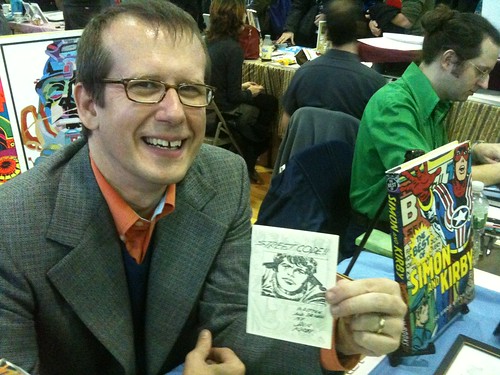
One of the many pleasant shocks of the Brooklyn Comics and Graphics Festival for me was the discovery that the Jack Kirby Museum offers, as a reward for membership sign-up, a mini-comic version of the singular example of the famous Jack Kirby making comics without editorial interference: "Street Code". It's about Jack growing up in New York City in the 1920s and it had never before been printed as a stand-alone comic. This is the guy who co-created characters like The Hulk, Captain America, and Darkseid bringing his fantastic design sense to the gang violence within, and the architecture of, the ghettos he grew-up in.

This is the museum's Rand Hoppe holding the comic in question:
Rand Hoppe of the Jack Kirby Museum holding a very important comic: "Street Code"!

I also saw the excellent comicsmith Jason Little (@beecomix) [who's in the above photo to the right] and spoke with him about publishing in print after publishing on the web, and bought his brand new mini-comic "Gimmick Illustrated" #1! And I saw and bought comics from the fine folk of Sparkplug Comic Books and the people who work together on the Sundays Anthology.

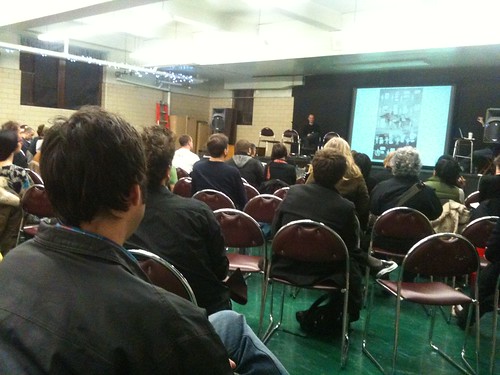
Bill Kartalopoulos (@bkny) ran SIX creator discussion panels from about 1 PM till just 40 minutes before the show's close at 9 PM. All the panels were held in the basement in which was built an impromptu stage and a screen with a small projector.

One of them was an introduction (for me) to the work of comicsmith Anders Nilsen. Guy creates some smart comics. He recently released "Big Questions" #15. (Nilsen maintains a website here.) This is Bill and Anders talking while the screen displays a page from a previous issue of "Big Questions":
Folk listening to Bill Kartalopoulos ask questions of Anders Nilsen (comicsmith of "Big Questions")!

Another of the panels was on the concept of editing comics. Who better to get than Francoise Mouly, the woman who edited her husband's famous comic "Maus". And another on hyper-detailed or hyper-textured art and whether or not it disturbs the flow of the reading experience in the comics medium. The answer-like thing we got was: No matter what the art looks like, the eye must be somehow guided though the images or the comic will fail to be readable. Which makes sense and is damn key to understanding comics!

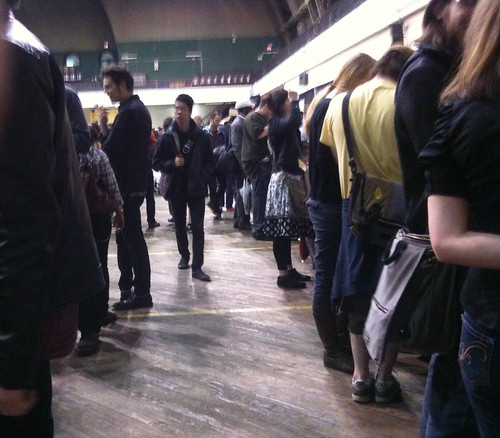
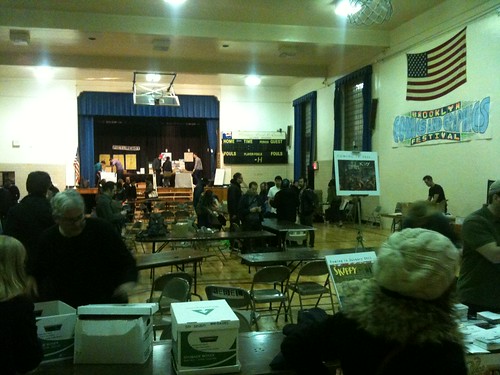
The exhibitor hall (well technically it was a basketball court but who's counting?) was closing down as I was leaving and I took this photo on my way out the door:
Closing time for the Brooklyn Comics and Graphics Festival

I had a damn good time!

As I've said many times before, the fact that there are different kinds of comics is healthy and keeping that variety will depend largely on people being interested in them.

As such?

Events like this are important and I'm glad this one was packed.

~ @JonGorga


P.S.

The day afterward there was a nice festival tie-in event around the corner at The Knitting Factory:
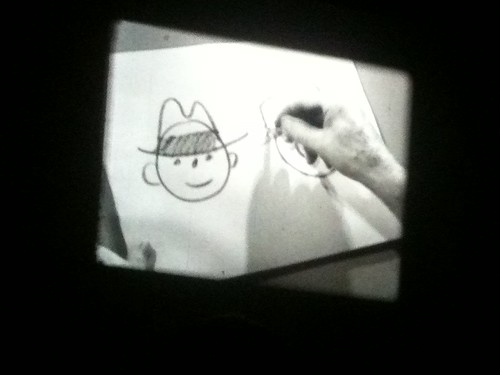
Mark Newgarden's 35mm reels "Cartoonists and Comics On Camera: 1916-1965"
[12/9/2o1o EDIT: Make that 16mm!]
35mm Cartooning 101 (2)
This was in "How to Draw Cartoons #3 - Expression" with Fred G. Cooper from 1944.

Very... edu-taining.

This Is A Good News/Bad News Kind Of Situation..

The bad news first: Danny Lewis, friend of the Long and Shortbox of it, has put his wonderful webcomic No One Believes In Monsters on hiatus.

The good news is that, in its place, Danny is posting a preview from a graphic novel he's working on called Raven Steals the Sun. The first page went up early this morning, and I want to be the first to say that it's absolutely gorgeous.

You can check out Danny's work here and if you like it you should check out his etsy store.

Bee in My Bonnet!

"bee in... The Ramble" from MySpace/Dark Horse

There was a unique and unusual pleasure to be had in hearing the comicsmith, Jason Little, read this comic out loud with accompanying music and a projection of the comic panel-by-panel to a small crowd at one of R. Sikoryak's (@RSikoryak) Carousel nights a few months back. Now the masses can be exposed to it as well since it has been published on "MySpace Dark Horse Presents". The experience of hearing this comic read that night (and then having it divorced from that experience on the web) was particularly surreal for reasons that will become clear over the course of this review.

Right from the start "The Ramble" is a hilarious tale of two friends meeting-up in the Big Apple's world-famous Metropolitan Museum of Art for a... uh... unique tour. Oh man. You've really got to click the link at the top of this post and read it yourself to fully appreciate this. THERE ARE NO WORDS.

Speaking of there 'being no words,' one of the most fun elements of the comic is explored after they leave the MET, occasional pictographs in place of words. An element that starts out playful like this:


and this:


And later, after a few sausage jokes, crescendos into something brilliant, painful, awkward, and hilarious:


And that's the tip of the iceberg.

There's a sequence of photographs inter-spliced with drawings during a tour of statues and another one during a film [above], four panels in silhouette during a discussion about burlesque, and there's a panel in '3-D' color-separation style while talking about 3-D. A character attempts to better read the text in another panel by grabbing the panel borders! The piece does take Bee and friends through the part of Central Park called the Ramble and all over New York City, but really it's a ramble through different art mediums and styles Little finds interesting. (On his blog, Little refers to this as the practice of "putting it all in there". Which says everything.)

Actually, as far as Jason Little's career in comics, the whole piece is just the tip of the iceberg.

I first became aware of Jason Little (@Beecomix) several years ago when I suddenly found myself in possession of a copy of "Jack's Luck Runs Out" from Top Shelf Productions, a marvelous/crazy comic that's like a Tarantino action-movie but with a playing-card visual style set in the world capital of entertainment: Las Vegas. I first became aware of his rotund reoccurring character Bee, a little over a year ago when I discovered "bee in... Motel Art Improvement Service" on Act-I-Vate.com [Unfortunately, that link now only goes to a 10-page excerpt. Fortunately, that means that a collected print edition from Dark Horse is in the works!] a webcomic about sexual discovery and... a whole lot of other crazy things.

I had the pleasure of meeting the man himself a few months ago at the Carousel event at which he read "bee in... The Ramble" and his personal style is as warmly whimsical as his comics. The surreality of the story for me is that after a sequence in which Bee and her friend get thrown out of a silent movie for the above antics, they arrive at a Carousel event where a sequential self-portrait of Little himself reads the first half of the comic we were hearing! Reading this later on the web broke the 'this comic could be now' feeling, but added an exotic feeling of cluing you into this weird gathering of comicsmiths. Add to this, the fact that it's the last comic in the last issue of "MySpace Dark Horse Presents" and that's mighty strange right?

THE LONG AND SHORTBOX OF IT?
The humor in the character interactions can be a bit 'precious' at times and the draftsmanship has a few uneven moments, but in the end the jokes are great, the art is smooth, plus it's colored fantastically, and the play with art medium and art-styles more than makes up for any faults anywhere else.

Really, all of Jason Little's work I've encountered so far is worth reading. Look him up at Beekeeper Cartoon Amusements' website.

~ @JonGorga

Jon Gorga's Precious Little Time!

Last year's "Watchmen" film adaptation came out and there was a huge fan-fare and the trailer was magnificent, advertisements appeared everywhere, the world seemed to scramble to book stores and comic shops to read it and it sold like crazy for a few months, the action figures were gorgeous and, amazingly, in recognition that something was in the air, The New York Times finally created a 'graphic books' best-seller list (only online, however) and all us comics types were very happy.

Whew! Yeah! Awesome!

[Rorschach action figure image at right from DC Direct website.]

But then something happened. The film was a garish, occasionally unintentionally hilarious, extravaganza of superhero violence.

That was my initial reaction anyway. Can you tell I was disappointed? I've calmed down a lot since that day but I stand by my core reaction: in making a Hollywood motion picture out of Alan Moore's and Dave Gibbons' mini-series Zack Snyder took out all the quiet character moments and amped up the violent/sexual ones. The resulting film had a lot of the core spirit of the comics, but none of the beauty or honesty.

I said to everyone beforehand: 'Hey, if the movie is great more people will come out jazzed to read it than there are already. If it sucks, millions of regular, everyday people across the world will say 'It wasn't as good as the comic' and mean it." Still, the resulting film was so self-indulgent and violent I feared that there would be a backlash. That people would say: 'See? In reality all that superhero and comics stuff just comes to violence and sex. No more.' Generally, we didn't get that outside of a few cranks. (Despite the fact that we saw it big time when "Sin City"'s adaptation came out years earlier.) More importantly we didn't, thank god, move backward; but the movie's release slowed the progress we were making. Junot Diaz, awesome novelist and establishment geek, said something that amounted to: 'the Watchmen movie trailer was the best thing to happen to the comics industry in a long time.'

ENTER: Bryan Lee O'Malley's series of graphic novels that began with "Scott Pilgrim's Precious Little Life" and Edgar Wright's upcoming film adaptation "Scott Pilgrim Vs. The World" that opens tonight at midnight. The process that came before the release of "Watchmen" has happened again, but bigger because both the film and the last comic are summer releases! Let's hope the last part of the story doesn't repeat as well.

Clare has informed me that not only is the last comic "Scott Pilgrim's Finest Hour" sold out in the comics store she works at, but that ONI Press itself has run out of copies of the book and has to go back to the printer and thus only the chain bookstores have copies.

That's pretty remarkable. Superhero comic-books sell out of stock. Indie graphic novels do not.

I think it shows that people really are willing to find comics shops (at least Graphic Novel sections) and try something if they've heard good things/they want to be informed about a big cultural phenomenon at the zeitgeist. That's the one solo difference between this moment in time and past big-scale adaption film releases or films based on non-superhero comics: The sixth book just came out. Everyone can be pretty nearly on the ground-floor together and enjoy the latest (and final) comic and the adaptation of the whole series together.

But if it's a bubble ready to burst (not jinxing it, not jinxing it, not jinxing it) I want to enjoy it too, and the window is closing fast. At time of writing I am 35 pages into "Scott Pilgrim Gets It Together", the fourth book in the series. That means just about three graphic novels to go. I am going to finish them by midnight tonight.

So help me god.

Oh and Twitter. So help me Twitter. Because that's where you'll see my updates on this adventure over the next... YIPES! less than twelve hours! I better get back to reading!

~ @JonGorga (<--See if I make it on my Twitter account! Not the LongandShortbox account.)