
"It's got unlimited potential. I mean, any art-form where you can use any word in the dictionary-- all the words Shakespeare used, you know, like, he doesn't have a copyright on 'em, you know? You can use any word you want. You can use a vast variety of illustration styles. They're very comparable to movies. I mean, both of 'em use words and pictures."~ Harvey Pekar, the excellent late underground comics writer, in an interview recorded in 2oo8 for a documentary about Jeff Smith, available on YouTube here.
Showing posts with label Harvey Pekar. Show all posts
Showing posts with label Harvey Pekar. Show all posts
Quote for the Week 12/4/11
The Grass is Always Greener on the Other Side...
So. I wrote up a review recently of "Flashpoint" #1, written by Geoff Johns (@geoffjohns).
Note the specificity in that sentence. A REVIEW of FLASHPOINT NUMERO UNO. I didn't review the whole "Flashpoint" event (after all, it's not over yet) and I didn't review Geoff Johns' entire career (it's not ending anytime soon either) and I didn't review every comic in the fictional DC Universe. And I reviewed the issue in question fairly negatively.
But I just read "The Flash" #12, the last issue of the current series and the end of a four-part story titled "The Road to Flashpoint", and goddammit if it doesn't give the story more emotional weight for our central hero Barry Allen! The truth is the story is stronger for being in a few parts. Spread over several examples of what writer Tom DeFalco once called "a complete unit of entertainment" (MARVEL Podcast, "The Amazing Spider-Girl", 4/28/2oo7), i.e. one comic-book, not two or three.
In this separate comic-book (also written by Johns), Barry mentions that the birthday of his long-gone mother is the next day and asks his wife Iris to "just give me tomorrow", for "one more day" (I know, very weird considering what Spider-Man's been through for the past few years) to think his life through, all quite wonderfully drawn by Francis Manapul (@FrancisManapul), and well, just look...
 ...
In the comic I reviewed, Barry wakes up on his mother's birthday, everything is different, she's alive, he's not the Flash, some of his allies are enemies to the world at large, and Iris is in love with someone else. OUCH. Not the "tomorrow" Barry Allen expected he'd be waking up to.
Johns set us up in the end of "The Flash" #12 and knocked us down in "Flashpoint" #1. IF you read both. (Mind you, "FP" #1 also has a huge amount of very obvious set-up for more to come.) Could it all have fit into one comic, one "unit of entertainment"? Probably. But if it was, it definitely wouldn't have had the space for all the other characters' story-lines, most of which I made it clear I found uninteresting. But something dramatic with a splash of traumatic has happened to Barry Allen and this particular thread is a wonderful surprise! The weirdest part? Neither are excellent comic-books. But they are excellent together.
This is what I love about American superhero comics, really. This is why I fell in love with comics in the first place. I was given a copy of "Spider-Man" #35 in 1993 or '94, read it lying down on the couch in my parent's living room, and I realized that because it was labeled "Maximum Carnage" Part 4 of 14, something came before it and something came after it. I HAD to know what. (There's a page devoted to the issue on The Amazing Spider-Man Gallery that gives you a good feeling for the flow of continuity.)
Et voila:
 Shared universe ongoing stories. It doesn't end. As Adrian Veidt says "Nothing never ends." Something came before and something comes after. Like... life.
But it's problematic. Most people's brains don't seem to work like mine does apparently. "This is only part of a story? I'm not going to buy this. It's not complete."
So what's a mainstream American superhero comics publisher to do? For that matter, what's a review of mainstream American superhero comics to do? Can you see the dilemma here? You, the consumer, should not have to buy multiple items to get a complete story. I stand by that. But I know stories can become richer, fuller, and more life-like when expanded over multiple items. Several 'units of entertainment'. I stand by that.
I guess a quick and dirty solution is to do just what I did. I wrote a review of "Flashpoint" #1 with a side note alerting all of you, my readers, to consider that ramifications affecting perception of the story might be sitting in recent issues of "The Flash" and/or upcoming issues of "Flashpoint". As part of a larger, shared-universe, semi-mythological, 80-year story something did come before it and something will come after it.
Continuity flows:
*Superman was alive, then dead, then alive. Then "Dead Again", I believe. Since? Alive again.
*Spider-Man was single, then he got married, then he was a widower, then he was married again, then he was magically never married at all.
*Batman was alive, then his spine was broken, then he got better, then he was dead, then suddenly he was just trapped in a repeating pattern through time itself. Now he is back.
*Then there's Brás de Oliva Domingos, main character of the brilliant "Daytripper" by Fabio Moon and Gabriel Bá. In just about each of the ten issues of the series he's alive and then suddenly and tragically he's dead. Slowly, a picture of a life emerges across those ten comic-books.
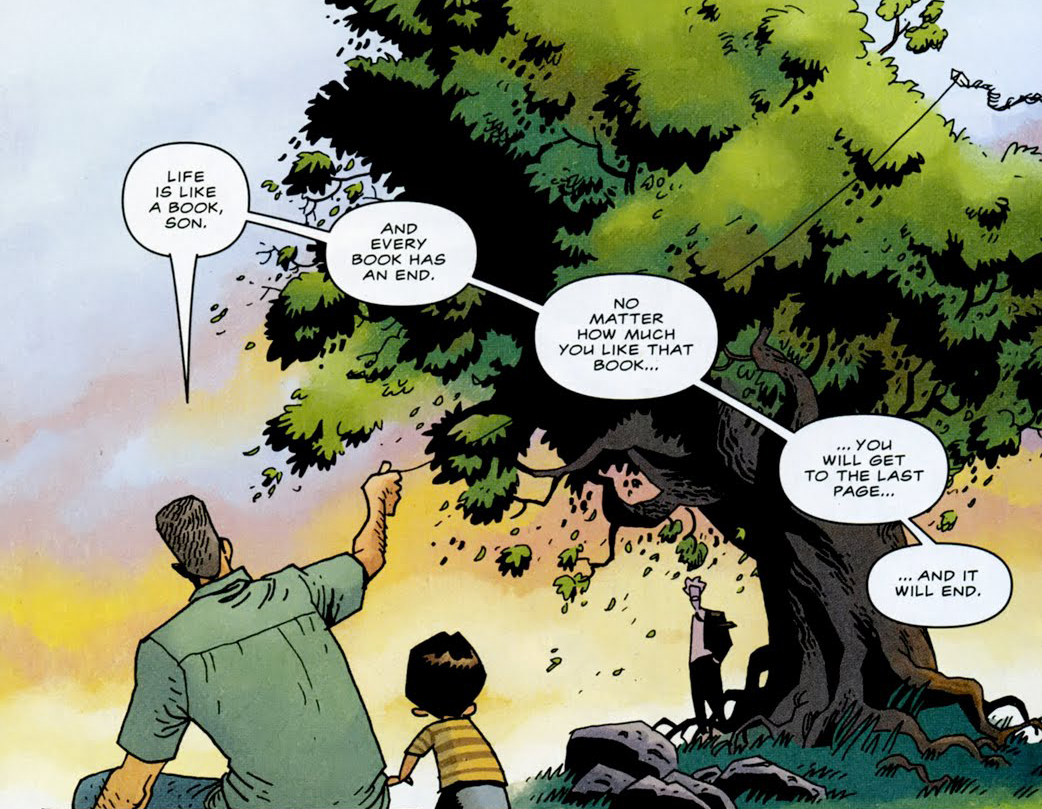
But each issue stands alone, a cohesive unit. Of entertainment-- or art depending on the eye of the beholder.
Writer Grant Morrison once said at New York Comic-Con, that it occurred to him one day: When you pick up any issue of Superman, what you're looking at is a piece of a life. And what if some god was doing that with his life or my life right now? Picking up and reading it, a slice at a time.
This is actually the exact structure of the late Harvey Pekar's ongoing autobiographical stories. The first series "American Splendor" combined with the mini-series that followed and various graphic novels along the way, the latest of which was published quite recently: "Huntington, West Virginia 'On the Fly' ". And it's not the last. "Harvey Pekar's Cleveland" is yet to come out. Harvey's been gone for over a year and the output of stories still isn't quite over yet. All of them together tell the story of his life. I'm far from the first to point this out. He's made us all like gods who can peer into the memory of his imagination.
I wrote in my recent review "I don't believe we should encourage this one-comic-is-needed-to-understand-another storytelling structure" but you know what? I also really do. That's what first made me fall in love with comics and it's STILL a big part of what I love about comics. Barry Allen, Spider-Man, Brás, and Harvey included. A multitude of short incomplete stories that add up to more than merely the sum of the parts.
Part x of ∞
And so the monkey has swallowed its own tale, this linear-publishing model of life becomes a circle of death and resurrection, and I am back where I started all those years ago on my parent's living room couch. It's exciting. It's about life and death and the tension inherent in moving forward.
So I'll continue to review these units by themselves, while taking into account the traditions and ongoing stories as ever-expanding structures, of which each each comic is a single brick.
Long live the serial narrative.
~ @JonGorga
Note the specificity in that sentence. A REVIEW of FLASHPOINT NUMERO UNO. I didn't review the whole "Flashpoint" event (after all, it's not over yet) and I didn't review Geoff Johns' entire career (it's not ending anytime soon either) and I didn't review every comic in the fictional DC Universe. And I reviewed the issue in question fairly negatively.
But I just read "The Flash" #12, the last issue of the current series and the end of a four-part story titled "The Road to Flashpoint", and goddammit if it doesn't give the story more emotional weight for our central hero Barry Allen! The truth is the story is stronger for being in a few parts. Spread over several examples of what writer Tom DeFalco once called "a complete unit of entertainment" (MARVEL Podcast, "The Amazing Spider-Girl", 4/28/2oo7), i.e. one comic-book, not two or three.
In this separate comic-book (also written by Johns), Barry mentions that the birthday of his long-gone mother is the next day and asks his wife Iris to "just give me tomorrow", for "one more day" (I know, very weird considering what Spider-Man's been through for the past few years) to think his life through, all quite wonderfully drawn by Francis Manapul (@FrancisManapul), and well, just look...
...In the comic I reviewed, Barry wakes up on his mother's birthday, everything is different, she's alive, he's not the Flash, some of his allies are enemies to the world at large, and Iris is in love with someone else. OUCH. Not the "tomorrow" Barry Allen expected he'd be waking up to.
Johns set us up in the end of "The Flash" #12 and knocked us down in "Flashpoint" #1. IF you read both. (Mind you, "FP" #1 also has a huge amount of very obvious set-up for more to come.) Could it all have fit into one comic, one "unit of entertainment"? Probably. But if it was, it definitely wouldn't have had the space for all the other characters' story-lines, most of which I made it clear I found uninteresting. But something dramatic with a splash of traumatic has happened to Barry Allen and this particular thread is a wonderful surprise! The weirdest part? Neither are excellent comic-books. But they are excellent together.
This is what I love about American superhero comics, really. This is why I fell in love with comics in the first place. I was given a copy of "Spider-Man" #35 in 1993 or '94, read it lying down on the couch in my parent's living room, and I realized that because it was labeled "Maximum Carnage" Part 4 of 14, something came before it and something came after it. I HAD to know what. (There's a page devoted to the issue on The Amazing Spider-Man Gallery that gives you a good feeling for the flow of continuity.)
Et voila:
 Shared universe ongoing stories. It doesn't end. As Adrian Veidt says "Nothing never ends." Something came before and something comes after. Like... life.
But it's problematic. Most people's brains don't seem to work like mine does apparently. "This is only part of a story? I'm not going to buy this. It's not complete."
So what's a mainstream American superhero comics publisher to do? For that matter, what's a review of mainstream American superhero comics to do? Can you see the dilemma here? You, the consumer, should not have to buy multiple items to get a complete story. I stand by that. But I know stories can become richer, fuller, and more life-like when expanded over multiple items. Several 'units of entertainment'. I stand by that.
I guess a quick and dirty solution is to do just what I did. I wrote a review of "Flashpoint" #1 with a side note alerting all of you, my readers, to consider that ramifications affecting perception of the story might be sitting in recent issues of "The Flash" and/or upcoming issues of "Flashpoint". As part of a larger, shared-universe, semi-mythological, 80-year story something did come before it and something will come after it.
Continuity flows:
*Superman was alive, then dead, then alive. Then "Dead Again", I believe. Since? Alive again.
*Spider-Man was single, then he got married, then he was a widower, then he was married again, then he was magically never married at all.
*Batman was alive, then his spine was broken, then he got better, then he was dead, then suddenly he was just trapped in a repeating pattern through time itself. Now he is back.
*Then there's Brás de Oliva Domingos, main character of the brilliant "Daytripper" by Fabio Moon and Gabriel Bá. In just about each of the ten issues of the series he's alive and then suddenly and tragically he's dead. Slowly, a picture of a life emerges across those ten comic-books.
But each issue stands alone, a cohesive unit. Of entertainment-- or art depending on the eye of the beholder.
Writer Grant Morrison once said at New York Comic-Con, that it occurred to him one day: When you pick up any issue of Superman, what you're looking at is a piece of a life. And what if some god was doing that with his life or my life right now? Picking up and reading it, a slice at a time.
This is actually the exact structure of the late Harvey Pekar's ongoing autobiographical stories. The first series "American Splendor" combined with the mini-series that followed and various graphic novels along the way, the latest of which was published quite recently: "Huntington, West Virginia 'On the Fly' ". And it's not the last. "Harvey Pekar's Cleveland" is yet to come out. Harvey's been gone for over a year and the output of stories still isn't quite over yet. All of them together tell the story of his life. I'm far from the first to point this out. He's made us all like gods who can peer into the memory of his imagination.
I wrote in my recent review "I don't believe we should encourage this one-comic-is-needed-to-understand-another storytelling structure" but you know what? I also really do. That's what first made me fall in love with comics and it's STILL a big part of what I love about comics. Barry Allen, Spider-Man, Brás, and Harvey included. A multitude of short incomplete stories that add up to more than merely the sum of the parts.
Part x of ∞
And so the monkey has swallowed its own tale, this linear-publishing model of life becomes a circle of death and resurrection, and I am back where I started all those years ago on my parent's living room couch. It's exciting. It's about life and death and the tension inherent in moving forward.
So I'll continue to review these units by themselves, while taking into account the traditions and ongoing stories as ever-expanding structures, of which each each comic is a single brick.
Long live the serial narrative.
~ @JonGorga
 2
comments
Shortboxes: American Splendor, Barry Allen, crossover 'events', Daytripper, DC, Editorial, Fabio Moon, Flash, Flashpoint, Francis Manapul, Gabriel Bá, Geoff Johns, Harvey Pekar, indie, Marvel, Spider-Man
May We All Never Forget Where We Came From
My father, Carmine Gorga, turns 75 years old today.
My father's people had comics when most didn't because of things like Michelangelo's Sistine Chapel ceiling and the multiple-walled story-frescos of Giotto. As Paul Levitz is fond of saying: "Comic-book writers and artists are doing the same thing that story-tellers did drawing pictures on the caves at Lascaux, we're using story to create context for life."
First of all: That's amazing.
My father has somehow survived three-quarters of a century (mostly in the horrifying Twentieth Century no less): through the tail end of the Great Depression, World War II, the proliferation of nuclear weaponry, and the M.A.D.ness of the Cold War. After all that I have no doubt that the 9/11 terrorist attacks seemed rather tame. 'Someone else may or may not be trying to kill me and my family? Well, at least it's not the Nazi troops AND the American army AND Mussolini's government at the same time like it was when I was eight-years-old.'
He came to America, paid the bills, found love with an American girl and built a life with her, got married, had a kid, raised his foolish son somehow, and successfully centered his life around a noble cause: economic justice for all.
You know who else turned 75 this year? DC Comics. The company was formed in 1934, but the first comic they published "New Fun" #1 came out in 1935, the same year my dad was born.
Wow, right?
There was yet no Superman. When my dad was born, the superhero genre didn't exist. Comic-books barely existed. Comics were really only in the newspaper (both in America and in Italy) and in other sequential art forms they've always existed as: church ceilings, for example.

 The Sistine Chapel ceiling looks pretty sequential to me.
 The Sistine Chapel ceiling looks pretty sequential to me.
The sequential story art commissioned by powerful people for the internal walls of Catholic churches are essentially huge, complicated comic-strips, make no mistake.
[Images from Wikipedia's "Sistine Chapel ceiling" entry.]
Both Josh and I have been shocked at the low-number of people who turn out to show appreciation to the older comics creators and have said so publicly on this blog and elsewhere. Inspired men who worked in bad conditions for little pay and worked their backs and hands and eyes and brains and don't get the respect they deserve.
People like Superman's creators: Jerry Siegel and Joe Shuster. Jack Kirby. Harvey Kurtzman. Bill Everett. Wally Wood. Al Williamson, Dick Giordano, Mike Esposito, and Harvey Pekar (all four gone this year). People both passed but, especially, those still with us.
People like Joe Simon. Co-creator of Spider-Man: Steve Ditko. John Romita, Sr. Marie Severin. Her brother, John Severin. Murphy Anderson. Gene Colan. Jack Davis. Joe Kubert. Mort Walker. Jim Steranko. Al Feldstein. Trina Robbins. Roy Thomas. Jean 'Moebius' Giraud. Al Jaffee. Kazuo Koike. Ramona Fradon. Albert Uderzo. The creator of the Joker, Alfred, and half of what makes Batman a great character: Jerry Robinson. Russ Heath. Jules Feiffer. And Carmine Infantino.
All those comics creators are just at, or over, three-quarters of a century old and still alive and capable of taking your admiration and appreciation. The Eisner Award Hall of Fame is great, but you should not pass-up a chance to speak with these people, shake their hand, tell them that something they made meant something to you. And the corporations still making money off the fruits of the genius of these ladies and gentlemen could do a little better by them, and their legacies as well.
My point is simple: Respect your elders. They have memories you never will. And hopefully, they've put them to good use.
Happy birthday, Dad.
I love you and I'm lucky to have you in my life.
~ @JonGorga
Scott Pilgrim Is The New Peter Parker
"Peter Parker is the ideal man. He's smart, he's funny, and he always at least TRIES to do the right thing. Plus, thanks to Marvel's publishing schedule, we get to see each other pretty much every week."Alison Lynn, friend of mine and Clare's, said those words the night I met her. Of course, Peter Parker holds a few points over most other guys by simple merit of being fictional. He can do and be lots of things us regular joes can't. Like be in fourteen places at the same time in a given week. Scott Pilgrim is far less reliable by comparison. He only dropped into our lives six times somewhat randomly over the course of six years. Does that make him more special by reason of being scarce? I'm not sure.

What I do know is the two hold a great deal of similarities between them. Think about it: Male, main character. Great responsibility... fucks up a lot. Beautiful girl to fight for. Special abilities that force him into an unusual situation. In the end the only difference between these two lovable losers is secrecy and spandex.
The release of Edgar Wright's adaptation film "Scott Pilgrim vs. The World" has come and gone and the world didn't exactly explode over it. Its box office gross was considered a disappointment by most and although the film was really well-crafted and is already a beloved film among many (including the writers of this blog), it probably isn't going to spawn a billion other indie graphic novel film adaptations.
However another friend of Clare's and mine has been telling me about an ongoing experiment she's conducting with the residents that, as an RA, are under her stewardship. Rachel Altvater shares with The Long and Shortbox Of It a bit about people at her college dipping into comics:
I went to see the movie with two guys from my staff who hadn't read the books, and they both really liked the movie. I encouraged them to read the books, and one of them was skeptical because they were "comics." When I referred to them as "graphic novels," he jumped at the chance to borrow "Precious Little Life."
...
The guy from my staff said that he'd never read a graphic novel before, and he was liking it so far. He said that "Precious Little Life" was "really good...it just kinda sucks you in, and it looks just like the movie so far."
...
The person who came to possess my copy of "Precious Little Life" seems to be a lost cause. I can't even get the book back from him.
Josh's latest post proves this to be even more true as a friend of his picked up a copy of "Scott Pilgrim's Precious Little Life" without prompting of any kind at an unrelated college event.
People love Scott Pilgrim even more than they love Spidey.
Actually, there's also a lot of Charlie Brown in the character as well as Peter Parker. And maybe even some of the late, great Harvey Pekar in there? Could Scott Pilgrim's appeal be essentially that he is a loser with a good and stout heart? And we all see a bit of ourselves in him?
If so, I have never seen such proof that humans like to read about lovable losers because the "Scott Pilgrim" series is currently the most successful graphic novel series in America's history. As Clare said to me: "Bryan Lee O'Malley doesn't need to publish anything else for the rest of his life. And neither does Oni Press." At the very least, THAT makes me giddy as a school-girl because if it's really true, it means that one of America's most inventive comicsmiths and one of America's most varied comics publishers have carte blanche to do what feels right, to take chances, and throw caution to the wind.

Truly, as far as I'm concerned, if even one person discovers a few comics they wouldn't have otherwise I'm glad the adaptation was made. And more money in the bank for creators and publishers during this tough economic time is a good thing. That could be the real legacy of the "Scott Pilgrim" film: the bankroll it brought to a creative comicsmith and a publishing house.
~ @JonGorga
P.S. ~ From bios and other public sources, I understand that Bryan Lee O'Malley (@radiomaru) and Hope Larson (@hopelarson) have been in a committed relationship for some time. So... would it be weird to point out that makes two young creative comicsmiths who both work often with Oni Press (@OniPress) with room to grow and money to burn?
Because this gives me hope for the entire medium, and the future of the American popular graphic novel form.
0
comments
Shortboxes: adaptation, Bryan Lee O'Malley, Charlie Brown, Editorial, Harvey Pekar, independents, Oni, Scott Pilgrim, Spider-Man
A "Splendor"ous Memorium
"Me, Harvey, and Everyone We Know" - Tablet Magazine
Far more appropriate than any pure-text encomium (including my own on this blog) of the man who changed autobiographical comics is an actual autobiographical comic.
Vanessa Davis has crafted a personal goodbye to underground comic-book legend Harvey Pekar that gives us a unique and wonderful thing: the opportunity to see the tiniest bit of Pekar's working process with an artist from her point of view. She writes first about her frustrations in college with "the fine art world" and "artsy auto-bio comics" that would lead her to appreciate the work of down-to-earth creative people like Harvey and then her single collaborative encounter with him. Sometime recently Vanessa Davis was contacted to illustrate a Pekar story herself. Considering the timing, it's possible Davis will be the last artist to illustrate a Harvey Pekar story.
"he wanted me to get the joke and get that he was the butt of it."
Sounds like Honest Harvey.
Pekar passed just four days before this comic was posted. Hardly enough time to truly sit down and draft what was probably an unscheduled two-page comics piece. Davis' art is a bit crude, but using a few choice cribbed panel images and dialogue from stories Harvey wrote himself adds immensely here; and seeing a few of the different styles of the various artists who've penciled Harvey's stories on the page and leaving them in the original black and white is a nice effect.


Or this one, probably originally drawn by Gary Dumm.
Undeniably, we've got Davis' style and not Crumb's or Dumm's or Zabel's or anyone else's on display here, but the slight differences in shading and line-quality shine through if you've read enough "American Splendor".
Most of all, I love the simple and evocative ending of this short piece. It's two pages long. It's not going to take you long.
~ @JonGorga
(Psst- follow the link at the top of the post to read the comic!)
0
comments
Shortboxes: American Splendor, Gary Dumm, Harvey Pekar, Joe Zabel, R. Crumb, Reviews, Tablet, Vanessa Davis, Webcomics
Honest Harvey
To me Harvey Pekar wasn't just an underground comics creator. He was the underground comics creator.
He died this morning at about 1 A.M. 70 years young.
[via @Newsarama & @NBMPUB & @DarkHorseComics & The Cleveland Plain Dealer]
R.I.P. Harvey
~ @JonGorga
I grew up reading superhero comic-books (and I still do), but actually, the truth is I grew up reading Marvel Spider-Man comic-books. Only in high school did I begin to branch out from Spidey and only in college, when a friend named Abbie lent me a collection of stories from "American Splendor" (the title that became Harvey's most used vehicle for telling the story of his life), did I begin to really 'get' underground comics. In fact, I know the exact moment I understood why this girl was raving about this man's work and I first appreciated the beauty of both underground comics and autobiographical comics: The moment I read a full story titled "Kaparra" drawn by Gerry Shamray originally from "American Splendor" #5. A single page of panels depicting the reminiscence of an old man's narrow escape from the possibility of a Nazi death squad because of some triviality. One page. Whole story. There was no drama, no tension in the story. There didn't need to be. It was a true story. At least as told to Harvey Pekar.
Harvey met R. Crumb in the 60s and as Crumb slowly began throwing off the shackles of the American Greeting Card Company and started making self-published comics he spurred a wave of similar projects from the people around him. Pekar sat Crumb down and asked him to illustrate some very simple stories of Pekar's life. In 1976 Harvey self-published the first issue of "American Splendor" with art by Crumb. The series was such a cult hit there were multiple trade-paperbacks published reprinting stories from the comic-book long before such a thing became the norm. In 1994, a graphic novel co-written with his wife Joyce Brabner titled "Our Cancer Year" followed. "American Splendor" continued on in various forms, finally under the DC Comics' imprint Vertigo.
Harvey Pekar was the kind of man who would get married and then write a comics story titled "Harvey's Latest Crapshoot: His Third Marriage to a Sweetie from Delaware and How His Substandard Dishwashing Strains Their Relationship" in the tenth issue of his comic-book. A remarkable, curmudgeonly, honest kind of man. Harvey's willingness to be entirely transparent with the details of his life has been an inspiration to my prose, to my comics, to my reporting, and to my personal style. I recognize that things were probably changed here and there to make things move, to simplify them. But Harvey never skimped on the details. The awesome little things that made his stories human and true.
If you've happened to read my comics, especially the comics I've been making over the past few years? Single pages that tell stories with details I observe, striving to find things both human and true.
A lot of underground comic creators get so busy trying to be ironic they forget they were telling a story. Some of the guys (and ladies) doing autobiographical comics (even people doing GREAT autobiographical comics) inject a little too much... drama, a little too much 'woe is me'. Give me honest Harvey's work any day.
Crime novelist Elmore Leonard has 10 rules for successful writing put down first in an article in The New York Times, then later in a short book. Rule #10 is "Try to leave out the part that readers tend to skip" which I always translated as 'Take out the boring parts'. It's damn good advice. Advice I don't follow nearly enough in my own writing. But that was the truly remarkable thing about Harvey Pekar. I suspect he didn't think of parts of a story as boring or exciting.
He told it like it was.
~ @JonGorga
Subscribe to:
Posts (Atom)


