
At the end of the day I have my own, very harsh, often narrow opinions about what makes good or bad work. But I won't draw a line in the sand and say that comics I don't like, done under conditions I don't approve of, are the root of all our problems. I'm not suggesting that anyone endorse Marvel or DC if they don't approve of their methods. The rights of Gary Friedrich or Jack Kirby are separate issues. I'm saying that it is not only possible but it is important to support our fellow artists in their attempts to make a living or contribute to comics culture without making blanket accusations as to their moral intent. Whats worse is that when we do so, we risk endorsing the type of behavior we fear from Marvel or DC. If we want change, all we can do is lead by example and I think the first example we need to set is that we don't eat our own.Jason Latour, at the end of a post on creator's rights that you should really go read.
Showing posts with label Jack Kirby. Show all posts
Showing posts with label Jack Kirby. Show all posts
Quote for the Week 2/26/12
 0
comments
Shortboxes: Creator's Rights, Gary Friedrich, Jack Kirby, Jason Latour, Quote for the Week
Quote for the Week 2/12/12
"We [Joe Simon & Jack Kirby] discussed this idea, about America. This was at a time when everybody was patriotic... and it was ridiculous not to do Captain America because there was an idea that would have been bought by everybody. So Joe and I did that. Our job was to sell comic-books. And we did.~ Jack Kirby, co-creator of Captain America, on a panel in Troy, Michigan on the 29th of May in 1988.
...
[after being asked about a current Captain America storyline:]
I receive the books from most of the companies... That's their prerogative. Whatever they do with Captain America is their prerogative. If you like it, fine... I say that Marvel has every right to put out the kind of book that they like. That's their business, to sell books."
This month, @DCcomics announced a series of prequels to Alan Moore's "Watchmen". Moore was quoted in an interview that this is: "shameless". The creators attached to the books defended their involvement in multiple ways including pointing out that Moore himself has used characters created by other people both for corporations ("Swamp Thing", "Superman", "Green Lantern") and in his own projects ("League of Extraordinary Gentlemen", "Lost Girls"). He dislikes the project and stands to make no money from it. (I've already covered this story myself here.) This page on ComicsAlliance.com summarizes the reactions.
Then, Ghost Rider creator Gary Friedrich was ordered to proffer to Marvel $17,000 he has made in selling his own Ghost Rider merchandise AND refrain from publicizing himself as the creator of Ghost Rider. Commenters have brought up Friedrich's health and financial problems as well as the fact that many, many professional comics artists supplement their careers with simple commissioned sketches of corporate-controlled characters at conventions or by mail. Some say @Marvel should settle with winning the case (i.e. not owing Friedrich any part of the earnings from the first film from 2oo7 or the new one opening this week) and rescind any request for damages or the somewhat ridiculous demand that Friedrich stop referring to himself as the character's creator.
And on top of all of this, original "The Walking Dead" artist Tony Moore is suing fellow co-creator Robert Kirkman claiming a proper half of proceeds from "The Walking Dead" TV show and merchandise has not been sent his way. The two were reportedly close friends who worked together on multiple projects before Kirkman (@RobertKirkman) became a part of the corporate structure of Image Comics (@ImageComics).
Supposedly
money + agreement = fair use of characters
but which part of that equation is more important? The compensation or the permission? And is there leeway for artistic relevance? Financial or health status? Even friendship?
Where do we draw the lines between business and ethics? Why do we draw lines there at all? Who is in the right: the creator or the copyright owner?
In this sudden rush of news in regard to creator's rights, it's interesting to me to remember that some of the most screwed over were also the most respectful. Superman creators Jerry Siegel and Joe Shuster sued DC several times. Kirby never sued Marvel. Was Kirby a fool or a gentleman?
~ @JonGorga
Jacob Kurtzberg: Blown Up
"Kirby: Genesis" #0 from Dynamite Entertainment
 If you were an artist and/or storyteller of any kind, how would you want to be celebrated after you were gone? Would you choose: have my scattered non-commercial / concept / unfinished art pored over and recombined into a new story I never conceived? Harsh? Yes, but the question stands. What would you want? I really don't think it's this.
As I understand it, Dynamite Entertainment (@DynamiteComics) somehow acquired the rights to produce comics with any and all of Jack Kirby's characters which are otherwise not associated or attached to any company or in use. And somebody said: 'Well then... Why not have them all fight / meet / talk like a crossover 'event'?
Considering the extremely thin and extremely various sources he has to play with, Kurt Busiek (@KurtBusiek) is doing a bang-up job of weaving a story that must intrigue any reader. The sheer number of characters being brought out of the woodwork and the curiosity about how the hell they will all fit together might be enough to make some people read the series. This issue is merely a preview, so it is meant to be a tasting but holy moley, there's a ton of characters I've never heard of who appear to have nothing to do with each other running around not talking to one another in this comic! The implication is that all these old Kirby creations are various aliens from various planets and they will be suddenly drawn to Earth where they will meet all the other kooky Kirby characters as well as a few choice humans...
The comic's BEST IDEA? Busiek's newly created main character is a man, portrayed first as a young boy, then as a college student, named Kirby. Meanwhile there is also a character named Sergeant Jake Cortez who looks just like a young Jack Kirby, cigar and all. The result is Kirby talking to Kirby which, unfortunately, sounds far cooler than it actually is.
The comic's WORST IDEA? Mixing the industry giant Alex Ross' painted art with relative newcomer Jack Herbert's pen and ink art on the same page. It's not so terribly awkward in this issue, but the last pages of issue #0 are preview material for the work to come and there? Paint right next to pen and ink. Looks like a disaster.
It's all over the place in this issue. We are introduced to the characters... and I can't tell you anything about them because there were so many of them and they were all in completely different settings. Hell, a few of them are from different genres. And, as a result, they flew past like colorful plastic horses on a theme park ride.
THE LONG AND SHORTBOX OF IT?
"Kirby Genesis" #0 is a hot mess. A very pretty-looking, carefully structured, rush of concepts and characters and images that weren't created to work together. It's good... for what it is. But that's a sentence I shouldn't have to write.
I fear that no amount of slow burn plotting, no amount of sharp characterization, no amount of tight-scripting could make this series work with the premise it has chosen. Nothing good can live down the road they are traveling down, at least in my imagination.
Mind you, Busiek is trying damn hard, and almost half-way succeeding with a book and a concept that should never work. Maybe later issues would prove me wrong, but I'm afraid that flipping through issue #1, after having read this issue, was more than enough for me.
~ @JonGorga
If you were an artist and/or storyteller of any kind, how would you want to be celebrated after you were gone? Would you choose: have my scattered non-commercial / concept / unfinished art pored over and recombined into a new story I never conceived? Harsh? Yes, but the question stands. What would you want? I really don't think it's this.As I understand it, Dynamite Entertainment (@DynamiteComics) somehow acquired the rights to produce comics with any and all of Jack Kirby's characters which are otherwise not associated or attached to any company or in use. And somebody said: 'Well then... Why not have them all fight / meet / talk like a crossover 'event'?
Considering the extremely thin and extremely various sources he has to play with, Kurt Busiek (@KurtBusiek) is doing a bang-up job of weaving a story that must intrigue any reader. The sheer number of characters being brought out of the woodwork and the curiosity about how the hell they will all fit together might be enough to make some people read the series. This issue is merely a preview, so it is meant to be a tasting but holy moley, there's a ton of characters I've never heard of who appear to have nothing to do with each other running around not talking to one another in this comic! The implication is that all these old Kirby creations are various aliens from various planets and they will be suddenly drawn to Earth where they will meet all the other kooky Kirby characters as well as a few choice humans...
The comic's BEST IDEA? Busiek's newly created main character is a man, portrayed first as a young boy, then as a college student, named Kirby. Meanwhile there is also a character named Sergeant Jake Cortez who looks just like a young Jack Kirby, cigar and all. The result is Kirby talking to Kirby which, unfortunately, sounds far cooler than it actually is.
The comic's WORST IDEA? Mixing the industry giant Alex Ross' painted art with relative newcomer Jack Herbert's pen and ink art on the same page. It's not so terribly awkward in this issue, but the last pages of issue #0 are preview material for the work to come and there? Paint right next to pen and ink. Looks like a disaster.
It's all over the place in this issue. We are introduced to the characters... and I can't tell you anything about them because there were so many of them and they were all in completely different settings. Hell, a few of them are from different genres. And, as a result, they flew past like colorful plastic horses on a theme park ride.
THE LONG AND SHORTBOX OF IT?
"Kirby Genesis" #0 is a hot mess. A very pretty-looking, carefully structured, rush of concepts and characters and images that weren't created to work together. It's good... for what it is. But that's a sentence I shouldn't have to write.
I fear that no amount of slow burn plotting, no amount of sharp characterization, no amount of tight-scripting could make this series work with the premise it has chosen. Nothing good can live down the road they are traveling down, at least in my imagination.
Mind you, Busiek is trying damn hard, and almost half-way succeeding with a book and a concept that should never work. Maybe later issues would prove me wrong, but I'm afraid that flipping through issue #1, after having read this issue, was more than enough for me.
~ @JonGorga
Weekly Process Roundup 7/29/11
The weekly process roundup is a collection of sketches, pencils, inks, thumbnails, everything other than finished product, really, from The Long and Shortbox of It's favorite artists, illustrators, and writers, hitting every Friday.

- Tumblr FUCKYEAHKIRBY posts the pencils and inks for one of the King's THOR pages!
- PASQUAL FERRY has some fun with Loki!
- The Source shares the GARY FRANK designs for Horsewoman!
- MIKE DEODATO lays out a NEW AVENGERS cover! (above)
- FRANCESCO FRANCAVILLA colors Black Panther!
- CHRIS SAMNEE plays favorites!
0
comments
Shortboxes: Chris Samnee, Francesco Francavilla, Gary Frank, Jack Kirby, Mike Deodato Jr., Pasqual Ferry, Process
"Brunette reading a comic on the L train - m4w" - Craiglist NYC
Found in Craigslist's Missed Connections this past week:
I had two house-guests recently. Both are good, clean, comics-reading folk; one from Portland, OR the other from the Boston, MA area. I told them that, truly, the thing that I love most about New York City, and the main reason I never intend to return to the Boston area, is that there's comics culture in the fabric of the society itself here. It's more than just conversation about comics in a populace with a larger percentage of comics-readers, it's an energy and feeling, a zeitgeist, that's created by all that conversation and partially by the comics stores every ten blocks in Midtown Manhattan, but mainly by the history in this great city.
Will Eisner. Jack Kirby. Stan Lee. Harvey Kurtzman. They all grew up here. Eisner in the South Bronx. Kirby in the Lower East Side. Kurtzman in Brooklyn. Lee in Washington Heights. This is where Marvel Comics was once Timely Comics and DC Comics was once National Periodicals and where they both still hold offices today. Comics culture and history is thick on the sidewalks of New York City.

I was just talking with comics writer and sometime artist Brendan McGinley (@brendanmcginley) Tuesday night at the bar in the People's Improv Theater (@thePIT). The weekly Comic Book Club show (@comicbooklive) was long over and we were talking about the neighborhoods of New York. I mentioned that I used to live in Washington Heights and he mentioned that he used to date a girl living there. We both experienced the neighborhood's change. I see it even more clearly after moving away a year ago and coming back to visit. Starbucks. Vegetarian cafes. Fancy restaurants. But it used to be the home of Smilin' Stan!
(There's an experience all by itself. Imagine realizing you'd been living in the neighborhood that birthed your childhood hero on your last week before moving out.)
Brendan said there's a high school that churned out comics guy after comics guy in the Thirties. DeWitt Clinton High School in the Bronx just happened to be in a thickly Jewish neighborhood at the height of the depression when imaginations seem to have been on overdrive. Lee, Eisner, Batman's co-creators Bob Kane and Bill Finger, and the co-creator of "Casper: The Friendly Ghost" Seymour Reit are among its graduates. [Read a bit more about that here.]
I suspect the only other place that feels this way at all is Cleveland. The birthplace of Superman's creators Siegel and Shuster as well as the home of the late great underground autobiographical comics writer Harvey Pekar. The two trailblazing, trend-setting pillars of the two main expressions of the medium in America from one Mid-Western city.
Josh and I both grew-up in suburban environments, what an old girlfriend of mine used to call the land of 'white bread' people. We didn't grow up with this and it's almost intoxicating to me. A tiny bit like being in a comics convention going on in secret all around you at all times. Sit down in a park, you might strike up a conversation with someone about Craig Thompson's "Blankets". Get on the subway, you could sit down next to someone reading the latest issue of "Wolverine". Drop by some small cafe in Brooklyn and you will find comics from local indie creators amid the free pile of small-press newspapers and magazines.
It's easy to get spoiled by it. But it does make me less jealous of the people who went to San Diego last week. I'll take New York over California any day of the year.
~ @JonGorga
P.S. ~
I covered a very cool event last year about comics that capture this adopted home of mine and the write-up is here.
"As the title says: you were a short haired brunette (with glasses!) reading a comic on the L train heading to Brooklyn on Wednesday. We both got on at 8th ave, and I sat next to you, with the pole in between us. You were reading some DC Comics. I think I've seen you before on the shuttle bus, but I'm not sure.Wednesday. New comic-book day. The week Comic-Con is happening out in San Diego? A day of passion.
I got off at Myrtle-Wyckoff, you remained on the train.
I was the short haired hispanic guy in a grey shirt/black tie with a bookbag. I fell asleep a couple of times on that ride, I remember apologizing because I think I bumped into you.
If you remember and are interested, I'd like to take you out for a drink sometime.
- V"

I had two house-guests recently. Both are good, clean, comics-reading folk; one from Portland, OR the other from the Boston, MA area. I told them that, truly, the thing that I love most about New York City, and the main reason I never intend to return to the Boston area, is that there's comics culture in the fabric of the society itself here. It's more than just conversation about comics in a populace with a larger percentage of comics-readers, it's an energy and feeling, a zeitgeist, that's created by all that conversation and partially by the comics stores every ten blocks in Midtown Manhattan, but mainly by the history in this great city.
Will Eisner. Jack Kirby. Stan Lee. Harvey Kurtzman. They all grew up here. Eisner in the South Bronx. Kirby in the Lower East Side. Kurtzman in Brooklyn. Lee in Washington Heights. This is where Marvel Comics was once Timely Comics and DC Comics was once National Periodicals and where they both still hold offices today. Comics culture and history is thick on the sidewalks of New York City.
I was just talking with comics writer and sometime artist Brendan McGinley (@brendanmcginley) Tuesday night at the bar in the People's Improv Theater (@thePIT). The weekly Comic Book Club show (@comicbooklive) was long over and we were talking about the neighborhoods of New York. I mentioned that I used to live in Washington Heights and he mentioned that he used to date a girl living there. We both experienced the neighborhood's change. I see it even more clearly after moving away a year ago and coming back to visit. Starbucks. Vegetarian cafes. Fancy restaurants. But it used to be the home of Smilin' Stan!
(There's an experience all by itself. Imagine realizing you'd been living in the neighborhood that birthed your childhood hero on your last week before moving out.)
Brendan said there's a high school that churned out comics guy after comics guy in the Thirties. DeWitt Clinton High School in the Bronx just happened to be in a thickly Jewish neighborhood at the height of the depression when imaginations seem to have been on overdrive. Lee, Eisner, Batman's co-creators Bob Kane and Bill Finger, and the co-creator of "Casper: The Friendly Ghost" Seymour Reit are among its graduates. [Read a bit more about that here.]
I suspect the only other place that feels this way at all is Cleveland. The birthplace of Superman's creators Siegel and Shuster as well as the home of the late great underground autobiographical comics writer Harvey Pekar. The two trailblazing, trend-setting pillars of the two main expressions of the medium in America from one Mid-Western city.
Josh and I both grew-up in suburban environments, what an old girlfriend of mine used to call the land of 'white bread' people. We didn't grow up with this and it's almost intoxicating to me. A tiny bit like being in a comics convention going on in secret all around you at all times. Sit down in a park, you might strike up a conversation with someone about Craig Thompson's "Blankets". Get on the subway, you could sit down next to someone reading the latest issue of "Wolverine". Drop by some small cafe in Brooklyn and you will find comics from local indie creators amid the free pile of small-press newspapers and magazines.
It's easy to get spoiled by it. But it does make me less jealous of the people who went to San Diego last week. I'll take New York over California any day of the year.
~ @JonGorga
P.S. ~
I covered a very cool event last year about comics that capture this adopted home of mine and the write-up is here.
0
comments
Shortboxes: Bill Finger, Bob Kane, Editorial, Harvey Kurtzman, Jack Kirby, SDCC, Stan Lee, Will Eisner
Weekly Process Roundup 7/1/11
The weekly process roundup is a collection of sketches, pencils, inks, thumbnails, everything other than finished product, from The Long and Shortbox of It's favorite artists and illustrators, hitting every Friday.

- FRANK MILLER gives the LA TIMES a look at HOLY TERROR (above)!
- HILOBROW is running a series of posts called BTOOM! Kirby vs. Lee that investigates the notes that the King left for Stan the Man on the original art for page 3 of Fantastic Four #63!
- JASON doodles on an envelope!
- DALE EAGLESHAM sneaks us a peak of ALPHA FLIGHT #3!
- JOCK starts the breakdowns for the end of an era!
Impressively Sized Billboards, Budgets, and Bludgeons
Last year, at around this same time, I wrote a somewhat harsh editorial about the comics industry and advertising after seeing a different ad for a fairly different Marvel comics-adaptation movie on this same Times Square billboard:


Oh not so much, huh?

[If nothing else, it's pretty interesting to see how that specific corner of Times Square has changed in the year since, if you go back and look at my photograph from a year ago.]
Now, unlike "Kick-Ass", I am so freaking excited for this film. Not just because it's a superhero comic-book adaptation spear-headed by a man better known for his Shakespearean adaptations (Kenneth Branagh), and not just because the production seems to have picked up on the crazy design-style Jack Kirby originally brought to Stan Lee's interpretation of the god of Asgard, but because this film is the first to come out of Marvel Studios with Disney (@Disney) money behind it. Thus promising something even more spectacular than "Iron Man" in production, and hopefully, success. (According to rumors...) the production had run entirely out of money and would never have been made if not for Disney's purchase of Marvel Entertainment (@Marvel). The movie is scheduled to arrive in theaters May 6th.
Look at all the awesome on display here as well:
Classy! Let's hope the rest of the ad campaign follows suit...
Oh not so much, huh?
Not exactly classy. But still in the open, where the common man will see it, and that's good.
The film reportedly cost $150 million [via IMDb.com & Wikipedia.org] so I would assume no expense has been spared on advertising. And the billboards and posters seem to be in a wide range of locations here in New York City. The one I photographed is east of Times Square but there's another one just a block away from the 7-11 where I took the other photo in Queens.
I'm currently working at another comic-book shop in Manhattan and several shelves and long-boxes are organized into sections devoted to comics with upcoming film and television adaptations: Green Lantern, X-Men, Avengers, Captain America, and of course, Thor...

I'm currently working at another comic-book shop in Manhattan and several shelves and long-boxes are organized into sections devoted to comics with upcoming film and television adaptations: Green Lantern, X-Men, Avengers, Captain America, and of course, Thor...
People who are going to say: Huh, this idea of the Norse gods like Thor being from a world where science and magic are the same thing is fascinating OR The idea of Thor being an agent of protection for human beings because he is forced out of Asgard for his arrogance is cool OR The sight of a huge dude with a hammer smashing frost giants is super fucking cool AND then deducing that just as a series of novels are more complex, fleshed-out, and original than a film adapted from them, all of these things are available in more complexity, more frequency, and more originality in the Thor comics that have been coming out since the Sixties... will then travel to a store like the one I'm working in to find a few of them.
Well, these are my hopes. It happened on some level with "Watchmen" and "Scott Pilgrim". Let's see if "Thor" brings another piece of the puzzle into place.
Well, these are my hopes. It happened on some level with "Watchmen" and "Scott Pilgrim". Let's see if "Thor" brings another piece of the puzzle into place.
~ @JonGorga
UPDATE 7/8/11:
Just discovered this site that makes a much fuller analysis than mine of the marketing campaign(s) for "Thor".
Last Weekend's MoCCA Festival Got The Voice
 If you happen to be a comics creator and a comics journalist you probably got the same weird experience I did from reading the latest issue of The Village Voice, "The Comics Issue". The main article is about how underpaid comicsmiths really are. The article is quite good from a journalistic point-of-view: honest and comprehensive. But tremendously depressing from an artistic one. The article is well worth checking out if for no other reason than to hear in first-hand quotes how hard it is for even fairly well-established comics creators to make some money.
On a lighter note, just try and tell me that cover isn't hilarious! Wonder Woman as if drawn by Lynda Barry! Charlie Brown as if drawn by Jack Kirby! The Thing as if drawn by the SpongBob SquarePants... guys. Dilbert as if drawn by Dan Clowes! Dagwood as if drawn by Chris Ware! Archie as if drawn by Peter Bagge staring at the ass of an Olive Oyl as if drawn by R. Crumb!
I love it. It's wrong and disgusting and clever and true all at the same time.

On a MUCH more positive note, this year's MoCCA Festival was great! The Voice issue was obviously timed to coincide with the Festival and they were smart to do so as the The Museum of Comic and Cartoon Art's (@MoCCAnyc) annual fund-raiser has grown to be the premier event of the New York City indie comics year. It also drives in loads of alternative/indie/hipster/zinester/curious types who may have never picked up a comic in years. And this makes me feel good about the health of the industry in general, and the print and independent elements in specific. Jon Lewis, creator of some very cool comics, [pictured at the left below] and I talked about that specifically. Underground people making comics intended to be PRINT comics, as I wrote about for the blog here.
I met, re-met, bumped into, and passed by more people than I can remember.
Jason Little (@beecomix) was there, as was Josh Neufeld (@joshneufeld). Comicsmiths Danny Lewis (@dannydoodar) and Jen Overstreet (@streetoverjen) shared a table. I met Melvin Ylagan, who was once an assistant to Joe Quesada, former EiC of Marvel Comics. Near him was a very talented artist and new friend to me in comics, Miguel Guerra (@SamuraiElf). Steve Seck and Sara Lindo rocked me with their mini-comics making knowledge as usual. They tabled with Lance Hansen of Kettle Drummer Books this time around. Morgan Pielli (@UltraMorgnus) was in the back, holding the fort with his awesome comics [he's one of the fuzzy heads in the phtoto below!] The very talented Mike Cavallaro and Dean Haspiel (@deanhaspiel) were in attendance representing the ACT-I-VATE folk! Plus the always lovely Gabrielle Bell (@luckygab) was selling her minis near the Pizza Island Collective (@Pizza_Island) booth.
The two most exciting moments for me (other than actually working behind a table a little bit for the first time!) were: A sighting of the true gentlemen of comics, Jerry Robinson. And meeting Julia Wertz (@Julia_Wertz) creator of the wonderful autobiographical series "The Fart Party" and graphic novel "Drinking at the Movies", which feels very much like what it is to be in your twenties, living in New York City in a recession, making comics but no money. (I know from experience.)
I wrote some shout-outs right after leaving the convention on the @LongandShortbox Twitter account! Check them out.
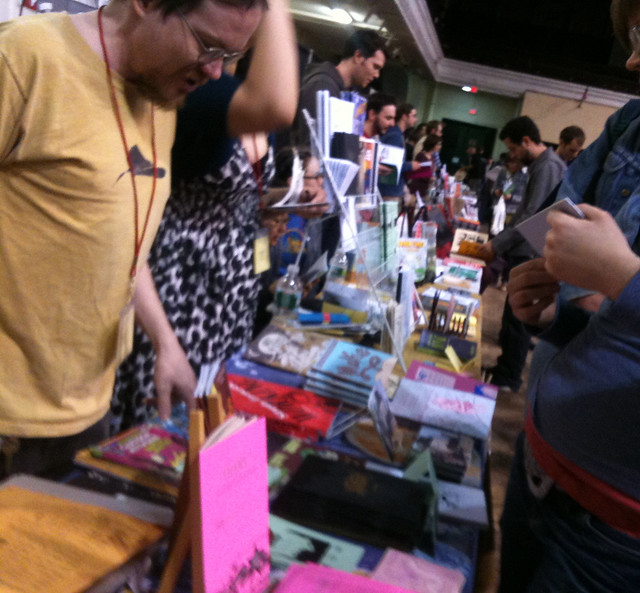
I also picked up a SLEW of comics, some of which I will review over the next few weeks here on The Long and Shortbox Of It.
~ @JonGorga
0
comments
Shortboxes: Danny Lewis, Dean Haspiel, Gabrielle Bell, indie, Jack Kirby, Jason Little, Jerry Robinson, Julia Wertz, MoCCA, News, The Village Voice, underground
Quote For The Week 3/13/11
Even when left to his own devices, Kirby’s architecture and costumes seem toylike; Kirby routinely went cosmic, but his “cosmic” still seems contained — if not entirely by his panels, then by the nickelodeon box of his imaginationChris Lanier, for hilobrow, on Jack Kirby's 2001: A Space Odyssey
Quote of the Week 12/16/10

"The characters were not Kirby characters- he famously grumbled about getting the Losers assignment, as he told stories about winners- and in most of the stories our heroes are barely distinguishable from each other: Captain Storm is more monocular, Gunner is younger, Sarge is tougher and Johnny Cloud is, well, marginally more Navajo.
But it doesn't matter. They became four everymen, standing in for all of us. And it's rarely about them."
-Neil Gaiman, from his introduction to the Jack Kirby Losers omnibus.
May We All Never Forget Where We Came From
My father, Carmine Gorga, turns 75 years old today.
My father's people had comics when most didn't because of things like Michelangelo's Sistine Chapel ceiling and the multiple-walled story-frescos of Giotto. As Paul Levitz is fond of saying: "Comic-book writers and artists are doing the same thing that story-tellers did drawing pictures on the caves at Lascaux, we're using story to create context for life."
First of all: That's amazing.
My father has somehow survived three-quarters of a century (mostly in the horrifying Twentieth Century no less): through the tail end of the Great Depression, World War II, the proliferation of nuclear weaponry, and the M.A.D.ness of the Cold War. After all that I have no doubt that the 9/11 terrorist attacks seemed rather tame. 'Someone else may or may not be trying to kill me and my family? Well, at least it's not the Nazi troops AND the American army AND Mussolini's government at the same time like it was when I was eight-years-old.'
He came to America, paid the bills, found love with an American girl and built a life with her, got married, had a kid, raised his foolish son somehow, and successfully centered his life around a noble cause: economic justice for all.
You know who else turned 75 this year? DC Comics. The company was formed in 1934, but the first comic they published "New Fun" #1 came out in 1935, the same year my dad was born.
Wow, right?
There was yet no Superman. When my dad was born, the superhero genre didn't exist. Comic-books barely existed. Comics were really only in the newspaper (both in America and in Italy) and in other sequential art forms they've always existed as: church ceilings, for example.

 The Sistine Chapel ceiling looks pretty sequential to me.
 The Sistine Chapel ceiling looks pretty sequential to me.
The sequential story art commissioned by powerful people for the internal walls of Catholic churches are essentially huge, complicated comic-strips, make no mistake.
[Images from Wikipedia's "Sistine Chapel ceiling" entry.]
Both Josh and I have been shocked at the low-number of people who turn out to show appreciation to the older comics creators and have said so publicly on this blog and elsewhere. Inspired men who worked in bad conditions for little pay and worked their backs and hands and eyes and brains and don't get the respect they deserve.
People like Superman's creators: Jerry Siegel and Joe Shuster. Jack Kirby. Harvey Kurtzman. Bill Everett. Wally Wood. Al Williamson, Dick Giordano, Mike Esposito, and Harvey Pekar (all four gone this year). People both passed but, especially, those still with us.
People like Joe Simon. Co-creator of Spider-Man: Steve Ditko. John Romita, Sr. Marie Severin. Her brother, John Severin. Murphy Anderson. Gene Colan. Jack Davis. Joe Kubert. Mort Walker. Jim Steranko. Al Feldstein. Trina Robbins. Roy Thomas. Jean 'Moebius' Giraud. Al Jaffee. Kazuo Koike. Ramona Fradon. Albert Uderzo. The creator of the Joker, Alfred, and half of what makes Batman a great character: Jerry Robinson. Russ Heath. Jules Feiffer. And Carmine Infantino.
All those comics creators are just at, or over, three-quarters of a century old and still alive and capable of taking your admiration and appreciation. The Eisner Award Hall of Fame is great, but you should not pass-up a chance to speak with these people, shake their hand, tell them that something they made meant something to you. And the corporations still making money off the fruits of the genius of these ladies and gentlemen could do a little better by them, and their legacies as well.
My point is simple: Respect your elders. They have memories you never will. And hopefully, they've put them to good use.
Happy birthday, Dad.
I love you and I'm lucky to have you in my life.
~ @JonGorga
Festive Curated Conventioneering
I love 'comic-cons'. From stories of Phil Seuling's New York Comic Art Conventions of the 1970s to the current annual monster known as San Diego Comic-Con or attending the wonderful annual Museum of Comic and Cartoon Art Festival in Manhattan, events to celebrate the comics medium have, and still do, vary in surprising ways. Gail Simone (@GailSimone) just wrote on Twitter about a new convention in LA specifically to celebrate LGBT comics creators and fans called Bent-Con[be warned, some stuff on their site is sexually explicit].
 The concept of the comics convention is evolving into some interesting avenues, and a new example of what it can be was put-up for the public this past weekend: The Brooklyn Comics and Graphics Festival. Entirely supported by Brooklyn, NY comics shop Desert Island Comics and publisher PictureBox, who together sent out requests for participation only to the creators, collectives, and publishers whose work they most enjoy. This allowed the event to be small, curated, and best of all FREE for all to attend since no fee was exacted from the exhibitors or artists to hold a table!
Another of the panels was on the concept of editing comics. Who better to get than Francoise Mouly, the woman who edited her husband's famous comic "Maus". And another on hyper-detailed or hyper-textured art and whether or not it disturbs the flow of the reading experience in the comics medium. The answer-like thing we got was: No matter what the art looks like, the eye must be somehow guided though the images or the comic will fail to be readable. Which makes sense and is damn key to understanding comics!
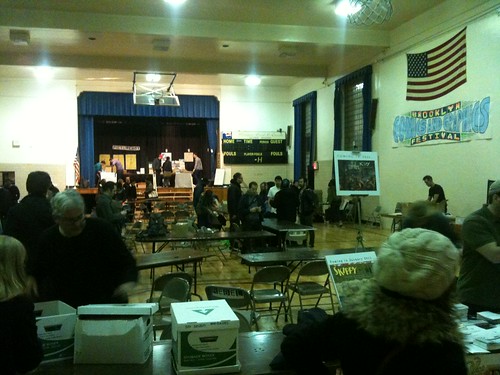
The concept of the comics convention is evolving into some interesting avenues, and a new example of what it can be was put-up for the public this past weekend: The Brooklyn Comics and Graphics Festival. Entirely supported by Brooklyn, NY comics shop Desert Island Comics and publisher PictureBox, who together sent out requests for participation only to the creators, collectives, and publishers whose work they most enjoy. This allowed the event to be small, curated, and best of all FREE for all to attend since no fee was exacted from the exhibitors or artists to hold a table!Why? In the words of the organizers themselves:
"It’s good to try new approaches to old models! We like this approach better than your standard free-for-all, and it makes a better experience for the random spectator, which is good for comics in general. It’s less like a typical small-press fair and more like an art fair or edited comic anthology. It’s frankly an expression of our own interests, which is intended as a positive contribution to the larger comic and art world." (from the festival website)But if the Brooklyn Comics and Graphics Festival is an experiment, it appears to be a highly successful one as this is the event's second year and everyone I communicated with had a great time. That's, both, on the exhibitor floor and on Facebook and Twitter after the fact.
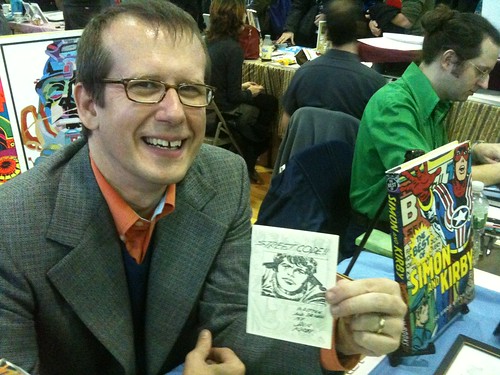
One of the many pleasant shocks of the Brooklyn Comics and Graphics Festival for me was the discovery that the Jack Kirby Museum offers, as a reward for membership sign-up, a mini-comic version of the singular example of the famous Jack Kirby making comics without editorial interference: "Street Code". It's about Jack growing up in New York City in the 1920s and it had never before been printed as a stand-alone comic. This is the guy who co-created characters like The Hulk, Captain America, and Darkseid bringing his fantastic design sense to the gang violence within, and the architecture of, the ghettos he grew-up in.
This is the museum's Rand Hoppe holding the comic in question:
I also saw the excellent comicsmith Jason Little (@beecomix) [who's in the above photo to the right] and spoke with him about publishing in print after publishing on the web, and bought his brand new mini-comic "Gimmick Illustrated" #1! And I saw and bought comics from the fine folk of Sparkplug Comic Books and the people who work together on the Sundays Anthology.
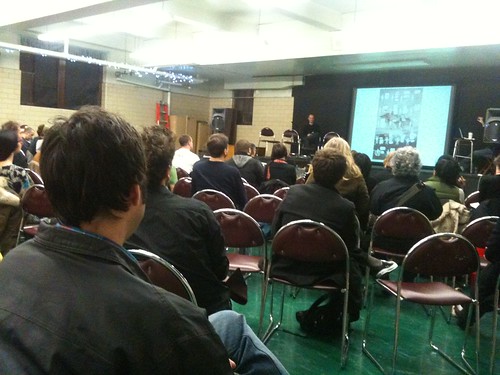
Bill Kartalopoulos (@bkny) ran SIX creator discussion panels from about 1 PM till just 40 minutes before the show's close at 9 PM. All the panels were held in the basement in which was built an impromptu stage and a screen with a small projector.
One of them was an introduction (for me) to the work of comicsmith Anders Nilsen. Guy creates some smart comics. He recently released "Big Questions" #15. (Nilsen maintains a website here.) This is Bill and Anders talking while the screen displays a page from a previous issue of "Big Questions":
Another of the panels was on the concept of editing comics. Who better to get than Francoise Mouly, the woman who edited her husband's famous comic "Maus". And another on hyper-detailed or hyper-textured art and whether or not it disturbs the flow of the reading experience in the comics medium. The answer-like thing we got was: No matter what the art looks like, the eye must be somehow guided though the images or the comic will fail to be readable. Which makes sense and is damn key to understanding comics!
The exhibitor hall (well technically it was a basketball court but who's counting?) was closing down as I was leaving and I took this photo on my way out the door:
I had a damn good time!
As I've said many times before, the fact that there are different kinds of comics is healthy and keeping that variety will depend largely on people being interested in them.
As such?
Events like this are important and I'm glad this one was packed.
~ @JonGorga
P.S.
The day afterward there was a nice festival tie-in event around the corner at The Knitting Factory:
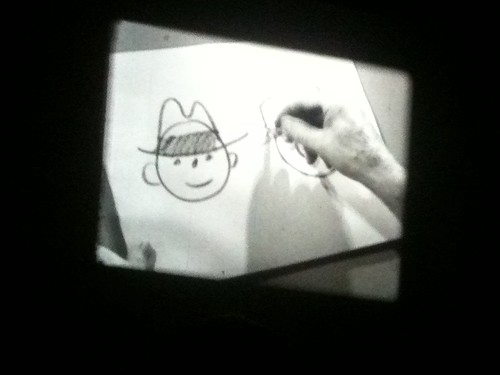
Mark Newgarden's 35mm reels "Cartoonists and Comics On Camera: 1916-1965"
[12/9/2o1o EDIT: Make that 16mm!]
This was in "How to Draw Cartoons #3 - Expression" with Fred G. Cooper from 1944.
Very... edu-taining.
3
comments
Shortboxes: Anders Nilsen, BCGF, Big Questions, Bill Kartalopoulos, Francoise Mouly, Fred G. Cooper, indie, Jack Kirby, Jason Little, Mark Newgarden, Maus, News, Retailers, Sparkplug, Sundays, underground
The Long and Shortbox Of It Reads Comics in Public!
A few days ago, the 28th of August, was the anniversary of Jack Kirby's birthday. The 'King of Comics' would have turned ninety-three this year. And unfortunately, he still wouldn't be getting his due respect.
(Check out this first part of a great two part video documentary if you're not familiar with his work.)
(Check out this first part of a great two part video documentary if you're not familiar with his work.)
In fact, STILL today lots of creators, publishers, editors, readers, and commentators such as us don't get the basic courtesy of being treated like everybody else. We can still get funny looks when we read 'picture books' in the public sphere.
Brian Heater, blogger with The Daily Cross Hatch, decided to make something out of the occasion and his own lingering feelings of embarrassment among the masses around the medium he enjoys and writes about. So he has started an unofficial holiday, to be held every year on the anniversary of Jack Kirby's birth, making comics comfortable and common in public spaces, out of the closet and in the light of day!
And The Long and Shortbox Of It! participated in International Reading Comics in Public Day! Yes we did.


In Which I Discuss Captain America Comics Again.
 I have a confession to make. I haven't read an issue of Captain America in months. I bought all the issues, and I'm sure that, some day, I'll go back and read them but, upon their purchase, I wasn't all that interested.
I'm not quite sure why. It was after that big Captain America tea-partier blow up back in February, so that may have had something to do with it. Maybe I was just a little tired- I've been living with these comics for a long time now. I've read them, re-read them, parsed them, wrote about them; I'm sort of surprised that I didn't burn out a long time ago. This week's issue #606, however, was the start of a brand new story line, featuring the return of Baron Zemo to the pages of Captain America, as well as the beginning of a new art era for the book (with Butch Guice taking over pencils from Luke Ross), and so I decided that it was, perhaps, time to return to the pages of my favorite comic book.
I was not disappointed.
Cap's had a little bit of a rough patch since the mess that was Reborn started, but I'm glad to see it's over- everything about this comic is pitch-perfect and spot on. Ed Brubaker is writing this book brilliantly again. That Brubaker has managed to seamlessly integrate Steve into the book as a supporting character is a feat on its own- he used to be the star of this book, remember. He plays Falcon off of Steve and both of them off of Bucky in a way that almost makes me wish that Ed had given us a whole issue of the three of them sitting around talking in a bar- this is how superheroes should interact with each other, out of costume. This is how superhero comic books should be written.
Brubaker's return to form was not very much of a surprise- he's done nothing but write brilliant comics for years, so a misstep or two was to be expected, sooner or later. What is something of a surprise is Butch Guice's art. My only previous experience with Guice was his inks on Reborn, and to say that they left something to be desired would be a significant understatement: Bryan Hitch's art was bad, and the inking didn't do it any favors.
Here, though, Guice proves that he knows his Captain America- at its best moments, the art references both Cap co-creator Jack Kirby and the artist responsible for perhaps the most famous Captain America page ever, Jim Steranko. This art is cartoony, kinetic, yet also impossibly realistic, which is the Kirby influence (I think there's even some Kirby Krackle in there!) and the design and surrealist elements are full-dose Steranko. Butch Guice does for Captain America's art what Ed Brubaker did for his writing- he is reexamining Cap's history, radically retelling it, in order that we may understand his present, his future. I'm in love with the technique in both art and writing- this is a hell of a book, if you like great comic art.
There's only one page that's kind of silly, and that's the oddly placed Steranko-style page near the beginning; it's not that the art's bad, it just doesn't make very much sense.
If you're looking to get into Captain America, now's a good time. If you're looking for something new? This is a good choice for that, too. This is a damn good comic book- I wish they were all this good.
0
comments
Shortboxes: Butch Guice, Captain America, Ed Brubaker, Jack Kirby, Jim Steranko, Marvel, Reviews
This is a Tough One
On the one hand, the heirs of Jack Kirby really do deserve the money. The King really got screwed by both Marvel and DC over the course of his illustrious career and, of course, some kind of compensation should be rendered.
On the other hand, though, the Kirby heirs probably would only have the rights to the aspects of those properties which Kirby had a direct hand in creating- that's one of the few things that seems to be clear coming out of a similar trial involving the heirs of Siegel and Shuster- so they might not be entitled to everything they think they're entitled to.
Furthermore, and rather selfishly, I'm worried about what it means for my future comics purchases. If all of this were to get tied up, what would happen to Captain America? Thor? Spider-Man? Could you imagine how crippling this could be for the Marvel and the American comics industry on the whole? If anything, it's proof that Kirby was just as influential as his heirs say; but it also means that the outcome could be disastrous.
From here on out, I hope everyone treads carefully- the health of a whole industry and the sanity of an entire fandom depends on it.
To the Heirs of Kirby the King
Please don't do this.
Please, please, please don't do it. I know you guys think you deserve more than you got (and you certainly do) but do us a favor: try to work it out with Marvel. See if you can't get some credit and some money from that without dragging yourselves, them and, most importantly, Captain America, through the American court system.
Jack Kirby got cheated, that's for sure, but what exactly do you think you're going to accomplish? Kirby probably knew full well exactly what was going to happen to his creations, and I suspect you (and your lawyer) know that too. It's not like he was new to the business; by the time the Silver Age hit he had already been in the business for twenty years
Please, please, please find some other way to get what you want.
Subscribe to:
Posts (Atom)


