The concept was simple, and there lay its success and its downfall: Showcase the women of Marvel Comics, both professional and fictional, over the months of 2o1o.
Do you see the problems here yet? Let's break this down:
To say: 'Look, there IS female point of view in mainstream American comics!! See!?' is great because people should be aware of it and (hopefully) feel positively about it; but equally and obviously awful because if it needs to be pointed out so loudly to see that it's there at all, something's very wrong.
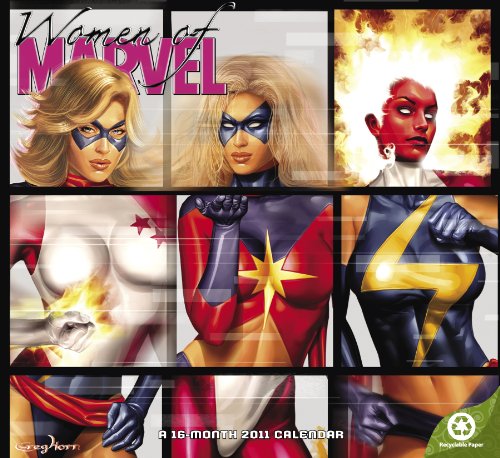 To showcase something is to display something you are proud of. Like on a shelf. Like your collection of action figures. (No disrespect to people with a collection of action figures. Interactive sculpture! I dig it. I have a lot of them.) Showcasing the women of Marvel (@Marvel) sounds like parading something for show.
The fictional female characters of comics are important and great. Our real-world female artists are important and great. But in very different ways. Equating them is a horrendous, horrendous mistake. Let's be honest: The female superheroes of mainstream American comics are presented in a manner that can be easily connoted as sexist. Mind you, male characters are also essentially treated equally badly in most respects. If you have had this argument with someone before then you've heard all this, so I apologize and I will not go into detail, but MANY people have never stopped to consider this. [Note, that the cover of the "Women of Marvel" 2o11 calendar above literally presents the character's bodies as interchangeable... And two of the three figures wear skintight swim-suit-style jumpsuits. Probably nobody's fault. In fact, if I'm not mistaken, two of the figures that have been chopped-up in the image are both Ms. Marvel-- one in her current costume and the other in her previous one. Proof that no one was paying very close attention to anything there.]
In January of last year, I attended a panel at the Brooklyn Public Library titled "Brooklyn Women in Comics: 3 local comics artists" the three female comicsmiths speaking were: Jessica Abel (@jccabel), Gabrielle Bell (@luckygab) and Jillian Tamaki (@dirtbagg). It was moderated by PW The Beat's Calvin Reid (@calreid). After the panel, I put my foot in my mouth pretty bad. I asked the two remaining panelists: "Wouldn't you agree, as successful women, happily making your own comics, that the perception that the comics world is sexist is a construct of people's perceptions?" I was rightly shut down.
The gist of what Jessica Abel and Gabrielle Bell said to me was:
'Indie comics have accepted women creators, but pigeon-holed them into autobiographical work. Marvel and DC are like a mens' club with impenetrable walls.'
"Oh" was probably all I could say. Although, I then expressed gratitude for their honesty.
Comics, as a medium, is not sexist. No one's saying it is. I still do not believe the comics industry itself is sexist. But I have come to realize my naiveté in thinking there wasn't a large majority of sexist-minded people in comics. I am not sexist. I actually consider myself a feminist. I am however, and unfortunately, capable of sexist-minded perceptions as a result of ignorance. And you know what? I am a bit more educated about the professional ladies at Marvel Entertainment and the barriers some faced than I was a year ago. And there's two very clear reasons for that: The "Brooklyn Women in Comics" panel I attended and the "Women of Marvel" promotional campaign.
Three mini-series were launched as part of the campaign: "Heralds", "Girl Comics" and "Her-oes" (about which we had commentary right here on the Long and Shortbox Of It). Each to differing, but none to a wild, success. "Girl Comics" was 100% written, drawn, edited, lettered, and colored by women creators, a first in mainstream American comics to my knowledge. Almost certainly in superhero comics. Interviews with female creators who often work on Marvel's books were printed on a roughly month-to-month basis on single (or double) pages printed in many issues of that month's comics. Almost every single time the interviewer ended with the question: 'What would you recommend to young women interested in the American comics industry?' And almost every single interviewee ended with the answer: 'The same thing I'd recommend to anyone...' followed by a personal and useful piece of advice from the interviewee's point-of-view.
Writer Kelly Sue DeConnick's (@kellysue) interview was particularly interesting, important, and poignant [I, in fact, already quoted from it in our recent Quote of the Week post]. If we can get USA TODAY to take a look at women in comics, we're making progress in educating the larger public. And we got a handful of interviews with women creators and even if just the one was excellent, we're making progress in educating poor slobs like me. Here's her answer to the same question they all received:
~@JonGorga
Three mini-series were launched as part of the campaign: "Heralds", "Girl Comics" and "Her-oes" (about which we had commentary right here on the Long and Shortbox Of It). Each to differing, but none to a wild, success. "Girl Comics" was 100% written, drawn, edited, lettered, and colored by women creators, a first in mainstream American comics to my knowledge. Almost certainly in superhero comics. Interviews with female creators who often work on Marvel's books were printed on a roughly month-to-month basis on single (or double) pages printed in many issues of that month's comics. Almost every single time the interviewer ended with the question: 'What would you recommend to young women interested in the American comics industry?' And almost every single interviewee ended with the answer: 'The same thing I'd recommend to anyone...' followed by a personal and useful piece of advice from the interviewee's point-of-view.
Writer Kelly Sue DeConnick's (@kellysue) interview was particularly interesting, important, and poignant [I, in fact, already quoted from it in our recent Quote of the Week post]. If we can get USA TODAY to take a look at women in comics, we're making progress in educating the larger public. And we got a handful of interviews with women creators and even if just the one was excellent, we're making progress in educating poor slobs like me. Here's her answer to the same question they all received:
"I'm afraid I'm of the mind that there is still a glass ceiling; but there is also an open door. At this point in my career that ceiling is not something I find myself bumping up against--no matter what your gender, you've got to earn your shot at the top floor and it's way too early for me. But I'd be lying if I said, you know, 'Chin up, gals! Those days are behind us!'That said, my great-grandmother was a girl when women got the vote in this country. My great-grandmother passed away when I was in college. Look at the strides that were made just in her life-time! I think of my daughter and what's possible in her lifetime and I tear up a little. I would give those female fans and creators the same advice I hope to give my daughter: embrace your passions. Be authentically yourself. It's okay to be daunted; it's okay to be afraid--move forward anyway. If this is what excites you, if what you want to do is make comics, then make comics. If you want to make super hero comics, I think that's great. There is nothing inherently masculine about heroism. Let me be the one to give you permission to scratch that itch.And when someone tells you that science fiction and action stories aren't for girls, or women aren't good comic creators because they're not as visually oriented as men, or you're, you know, pretty good for a girl--don't let it wound you. Let it be fuel for your fire."
Good advice for all of us.
~@JonGorga