So. I wrote up
a review recently of "Flashpoint" #1, written by Geoff Johns (@geoffjohns).
Note the specificity in that sentence. A REVIEW of FLASHPOINT NUMERO UNO. I didn't review the whole "Flashpoint" event (after all, it's not over yet) and I didn't review Geoff Johns' entire career (it's not ending anytime soon either) and I didn't review every comic in the fictional DC Universe. And I reviewed the issue in question fairly negatively.
But I just read "The Flash" #12, the last issue of the current series and the end of a four-part story titled "The Road to Flashpoint", and goddammit if it doesn't give the story more emotional weight for our central hero Barry Allen! The truth is the story is stronger for being in a few parts. Spread over several examples of what writer Tom DeFalco once called "a complete unit of entertainment" (MARVEL Podcast, "The Amazing Spider-Girl", 4/28/2oo7), i.e. one comic-book, not two or three.
In this separate comic-book (also written by Johns), Barry mentions that the birthday of his long-gone mother is the next day and asks his wife Iris to "just give me
tomorrow", for "one more day" (I know,
very weird considering
what Spider-Man's been through for the past few years) to think his life through, all quite wonderfully drawn by Francis Manapul (@FrancisManapul), and well, just look...

...
In the comic I reviewed, Barry wakes up on his mother's birthday, everything is different, she's alive, he's not the Flash, some of his allies are enemies to the world at large, and Iris is in love with someone else. OUCH. Not the "tomorrow" Barry Allen expected he'd be waking up to.
Johns set us up in the end of "The Flash" #12 and knocked us down in "Flashpoint" #1. IF you read both. (Mind you, "FP" #1 also has a huge amount of very obvious set-up for more to come.) Could it all have fit into one comic, one "unit of entertainment"? Probably. But if it was, it definitely wouldn't have had the space for all the other characters' story-lines, most of which I made it clear I found uninteresting. But something dramatic with a splash of traumatic has happened to Barry Allen and this particular thread is a wonderful surprise! The weirdest part? Neither are excellent comic-books. But they are excellent together.
This is what I love about American superhero comics, really. This is why I fell in love with comics in the first place. I was given a copy of "Spider-Man" #35 in 1993 or '94, read it lying down on the couch in my parent's living room, and I realized that because it was labeled "Maximum Carnage" Part 4 of 14, something came
before it and something came
after it. I HAD to know what. (There's
a page devoted to the issue on The Amazing Spider-Man Gallery that gives you a good feeling for the flow of continuity.)
Et voila:

Shared universe ongoing stories. It doesn't end. As Adrian Veidt says "Nothing never ends." Something came before and something comes after. Like... life.
But it's problematic. Most people's brains don't seem to work like mine does apparently. "This is only part of a story? I'm not going to buy this. It's not complete."
So what's a mainstream American superhero comics publisher to do? For that matter, what's a review of mainstream American superhero comics to do? Can you see the dilemma here? You, the consumer, should not have to buy multiple items to get a complete story. I stand by that. But I know stories can become richer, fuller, and more life-like when expanded over multiple items. Several 'units of entertainment'. I stand by that.
I guess a quick and dirty solution is to do just what I did. I wrote a review of "Flashpoint" #1 with a side note alerting all of you, my readers, to consider that ramifications affecting perception of the story might be sitting in recent issues of "The Flash" and/or upcoming issues of "Flashpoint". As part of a larger, shared-universe, semi-mythological, 80-year story something did come before it and something will come after it.
Continuity flows:
*Superman was alive, then dead, then alive. Then "Dead Again", I believe. Since? Alive again.
*Spider-Man was single, then he got married, then he was a widower, then he was married again, then he was magically never married at all.
*Batman was alive, then his spine was broken, then he got better, then he was dead, then suddenly he was just trapped in a repeating pattern through time itself. Now he is back.
*Then there's Brás de Oliva Domingos, main character of the brilliant "Daytripper" by Fabio Moon and Gabriel Bá. In just about each of the ten issues of the series he's alive and then suddenly and tragically he's dead. Slowly, a picture of a life emerges across those ten comic-books.
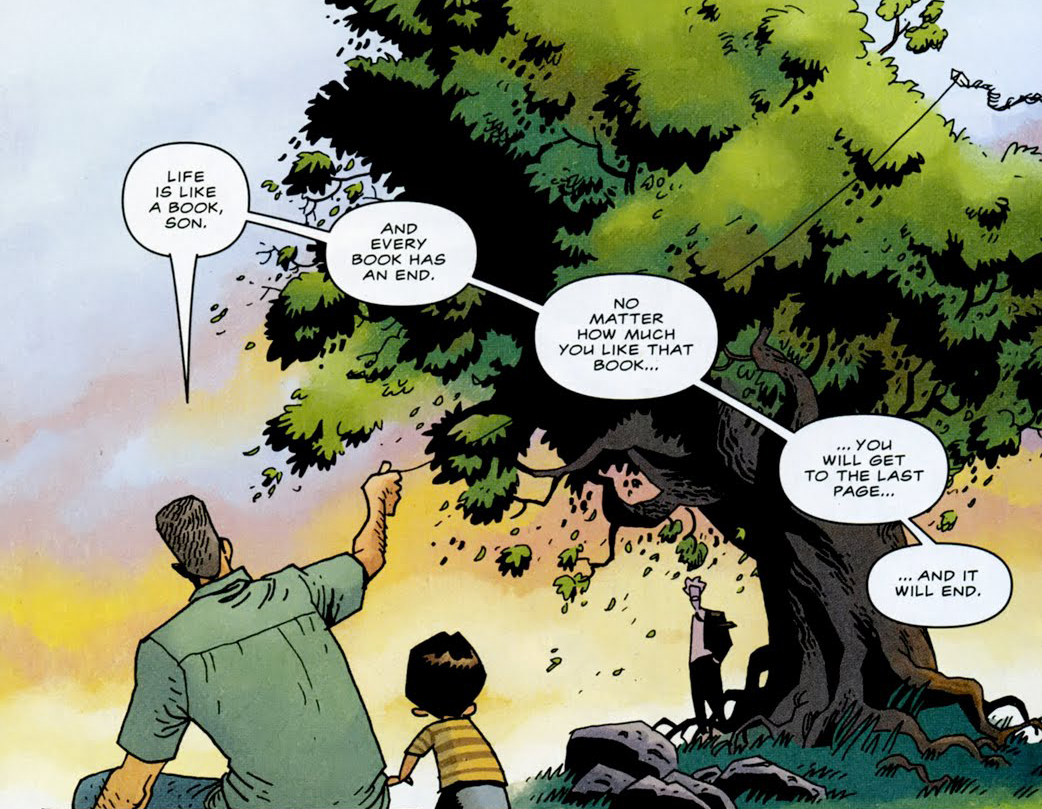
But each issue stands alone, a cohesive
unit. Of entertainment-- or art depending on the eye of the beholder.
Writer Grant Morrison once said at New York Comic-Con, that it occurred to him one day: When you pick up any issue of Superman, what you're looking at is a piece of a life. And what if some god was doing that with his life or my life right now? Picking up and reading it, a slice at a time.
This is actually the exact structure of the late Harvey Pekar's ongoing autobiographical stories. The first series "American Splendor" combined with the mini-series that followed and various graphic novels along the way, the latest of which was published quite recently: "Huntington, West Virginia 'On the Fly' ". And it's not the last. "Harvey Pekar's Cleveland" is yet to come out. Harvey's been gone for over a year and the output of stories still isn't quite over yet. All of them together tell the story of his life. I'm far from the first to point this out. He's made us all like gods who can peer into the memory of his imagination.
I wrote in my recent review "I don't believe we should encourage this one-comic-is-needed-to-understand-another storytelling structure" but you know what? I also really do. That's what first made me fall in love with comics and it's STILL a big part of what I love about comics. Barry Allen, Spider-Man, Brás, and Harvey included. A multitude of short incomplete stories that add up to more than merely the sum of the parts.
Part x of
∞
And so the monkey has swallowed its own tale, this linear-publishing model of life becomes a circle of death and resurrection, and I am back where I started all those years ago on my parent's living room couch. It's exciting. It's about life and death and the tension inherent in moving forward.
So I'll continue to review these units by themselves, while taking into account the traditions and ongoing stories as ever-expanding structures, of which each each comic is a single brick.
Long live the serial narrative.
~ @JonGorga



