Everyone is in a Media Tizzy Over This?

I worry about the mental state of a world that puts at such importance the decisions of fictional characters in regards to their legal citizenship.

Yahoo.com's main page 'trending' searches as of two weeks ago, just after the release of "Action Comics" #900 on April 27th.

Maybe I'm just being cantankerous. I can see how, to the general public, the idea that Superman is now fighting for 'Truth, Justice, but NOT the American way' is shocking. But Superman's writers had long ago deduced that if Superman, as a character, was purely an American man the balance of power would be tipped unfairly and DC universe's American politicians would attempt to use him as a weapon, either literal or propagandistic. That was one of the many lessons of Alan Moore's and Frank Miller's respective late-Cold War epics of 1986: "Watchmen" and "The Dark Knight". "God exists, and he's American." ("Watchmen" #4) Nobody would take this naively anymore. The solution was to stress him as a world-wide protector of all human life. Renouncing his American citizenship was implied as a done deal a long time ago. That makes this recent move not tremendously newsworthy from an insider's perspective.

It is ONLY interesting as a nudge-in-the-ribs version of 'Hey look! These aren't your Papa's comic-books!' Something more dramatic is needed. We need to put interesting comics in front of people, not just tell them about one single incident of a single comic with some mild ramifications related to the public's retro-active understanding of certain mainstream characters. Last night after seeing the "Thor" movie adaptation in Times Square I stood on the street and watched the jumbotrons play the movie's trailer as well as the trailer for "X-Men: First Class" and lots and LOTS of other things: Martha Stewart. Good Morning America. Lady Gaga. Coca Cola. The Simpsons. Sit-com television.

The comics industry needs to concentrate less on 'stunts' and more on making comics themselves as visible as the things I saw on those huge screens.

And, well, if we're going to get technical? Clark Kent has a social security number. Superman doesn't. Superman is not a legal US citizen and therefore can't renounce his citizenship. Does that really need to be pointed out?

~ @JonGorga

Boredom Brings Tall Tales and Good Comics.

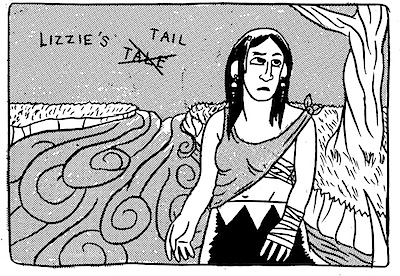
"Lizzie's Tale Tail" from Darryl Ayo

In a world of huge superhero event-comics (Marvel (@Marvel) has begun "Fear Itself" and DC (@DC_NATION) has released the first issue of "Flashpoint" this past month) and unnerving underground sexual-confessional comics (Chester Brown just spoke at The Strand bookstore (@Strandbookstore) yesterday on "Paying For It: A Comic Strip Memoir About Being a John") and comics from different world cultures crowding my brain (these past months I've been introduced to the work of comicsmiths from Japan, Denmark, and Romania)... it's really nice to read a short, simple, well-made, (and best of all) FUN mini-comic.

Darryl Ayo (@darrylayo) puts heart and mind into his comics full-throttle:
This one's got a fawn, a magical mermaid, a guy with dreads and four arms, and one bad-ass humanoid main character with a tail named Lizzie! And the whole thing can be read between average NYC subway stops.

Ayo's art is not supremely polished here, he is not a master draftsman, but his storytelling technique is excellent. Note the depiction of a few feet of water in which hides our hero's rescue in the form of a mysterious mermaid! A simple double smooth stroke denotes the water-line and all items below said water-line are ever-so-slightly distorted to give us that underwater fish-eye-camera view.

The action is smartly realized on the page (most of the time...) despite the fact that the piece is pure comedy and the action could have looked like crap and we would have gotten the jokes just as well.

My favorite panel is the climactic moment two pages later in which the mermaid smacks into the four-armed dude! The figures don't seem to have the proper weight of collision but the composition of the panel is dramatic and FEELS accurate (the four-arms on the single torso rarely works as well as it does here), and the cartooning-work in the faces of all three figures belies this great surreal feeling for me: Each character clearly has a distinct thought in their head at this exact moment. I love it.
A good amount of the faces in the comic in general are delightful actually. Lizzie's near-constant look of nonplussed bravado in the face of chaos makes for great deadpan humor.

She battles these various creatures to a stand-still and is finally gifted a bronze pendant by her silent aquamarine saviour. But the entire delightful little pseudo-mythological story is a framed story, opening and closing with a simple interaction between friends in a typical urban setting.

A simple question lead to this grandiose over-the-top spun tale of courage and violence and it ends with:
"
Oh come OFF it!
You got that pendant at Medusa's antique shop. I was there.

Oh yeah.
Yeah.
"
Priceless.

"Lizzie's Tale Tail" premiered last month at MoCCA 2o11 where I met Darryl and bought the mini on the recommendation of Mike Cavallaro. Darryl maintains a website with a lot of comics and excellent comics commentary at Let'sGoAyo.com Check out his stuff.

~ @JonGorga

THIS Is Why I Do This.

The Society of Illustrators held an evening panel entitled "Drawing the Line: An Evening with Comic Luminaries" three nights ago on Wednesday the 11th of May. The Society brought together mainstream American industry legends Jim Steranko, former Marvel Comics E-i-C Joe Quesada, and Walter Simonson to be questioned by Dennis Calero, a man with a young but varied career in comics himself, to speak about the craft of making sequential art.


Here's my Twitter blast from the evening with some new, fuller commentary from me:
@LongandShortbox
Listening to Jim Steranko, Joe Quesada, & Walt Simonson at the Society of Illustrators in NYC moderated by Dennis Calero! Amazing.~@JonGorga
11 May
Jim Steranko: "You want to be in comics? Four words: Draw. Like. John. Buscema. Draw every day until you have maximum facility."
The statement sounds like he's saying 'Just get good enough so you can coast' but the three artists were talking about 'good-art' days and 'bad-art' days. Times when the pencil just doesn't flow over the page like it should. The goal, as a professional, is to be able, even on those really bad days, to produce work that is still competent.
Jim Steranko: "I can't recognize my own work as apart from other artists. I'm in the middle of the forest, I am the forest."
As an over-active creative myself, I am far too familiar with being unable to see the forest for the trees, but what Steranko is referring to here is seeing instead of his own style or his own hand, only his mistakes. More on this concept to follow.
Walt Simonson: "I had to quarry it from the blank page. I know two people who seemed to just trace it out: Jack Kirby & Bernie Wrightson."
Simonson revealed at several points over the evening genuine frustration at making the lines on the page do what they needed to do. And the subsequent unique solutions and creative diversions that resulted from that frustration.
"Your style is defined by the things you can't draw well because you have to make it work in your own way." ~ @JoeQuesada
Quesada followed this by saying: 'You'll always hear people say "Oh, I love how you draw feet" and you smile and thank them while you think to yourself: "I can't draw feet to save my life" because you came up with a creative solution to a personal stumbling block.' (This writer thinks it's entirely possible that the specific mention of feet was a side-jab at a certain well-known artistic punching bag in the American comics industry whose ability to draw basic things such as feet has often been called into question.)
"Great advice I received: You won't be good until you have complete disregard for your own work. You have to forgive yourself." ~@JoeQuesada
This was really good for me and I suspect any and every young artist to hear. He also said 'Somedays it's all coming out of the pencil just the way you want, and somedays it just doesn't flow. On those days you have to forgive yourself for sucking, take a breath, and go write or go walk in the park. Just take the time to be away from the drawing-board and when you come back tomorrow you'll be refreshed instead of losing multiple days to the frustration and anguish of being angry at yourself for sucking.'
Walt Simonson: "I came in the 70s. I thought I'd be in comics 5 years and get a real job. I never got a real job and I'm happy to be here!"
Simonson was asked about how it felt to see some of the things he'd created for the world of Marvel's Thor become three-dimensionally realized for film and he proceeded to share some delightful stories from his three days on the set of "Thor" a year ago.
Q&A time. I REALLY don't want this evening to end.
I really didn't.
Walt Simonson: "I took mythology classes in college, I was fascinated by the stuff as a kid and it had a huge influence on my work on Thor."
This was, I'm sure, especially interesting to hear for long-time Thor fans. The statement was part of Simonson's answer to an audience question for all three panelists: 'Do you find your work draws on mythology?'
Jim Steranko: "I think many comics creators are children of urban mythology."
This was part of Steranko's answer to the question about mythology. He went on to say: 'Comic-book artists often grow up in cities and draw cities. Into these urban settings they place gunshots and brawls and crime, but these guys have never been in a fight in their lives!'
Jim Steranko: "Don't try to beat us at our game. Find what's unique about you and you'll make a name for yourself." #makingcomics #advice
This is where things went from educational to inspirational.
"Pacing is important. Find the crescendo. There might be smaller ones, but find the largest. The explosion could be a kiss." ~ @JoeQuesada
Quesada illustrated this by telling a story. A younger and more popular artist in the mid-Ninties saw him at a convention and asked: 'How do you get that awesome pacing down, Joe?' And Joe asked the intense prototypical 90s artist back: 'How would you open a story with all the major Batman villains sitting in a hideout drinking tea?' And this young gun answered: 'I'd draw them really angry and excited with The Joker screaming so there was spittle flying out of his mouth and the tea splashing everywhere!' Joe then said: Okay, then on page two Batman crashes the party.'' This got the guy even more excited according to Joe: 'I'd have him crash through the skylight with glass everywhere and his boot coming right at the reader's face!' Then Joe said: 'Okay. Page three. An atomic bomb goes off. How do you sell it?' And the guy had nothing to say. Hopefully he learned something.
"I always do my main layout at print-size, otherwise you'll have to walk ten feet away to see your work as the reader does!" ~ @JoeQuesada
This is really interesting because it is industry standard to my understanding to work at roughly 1.5 times print-size. Marvel and DC's pencilers and inkers produce their artwork on huge pieces of bristol board that look almost like the boards we all used to buy to display our science projects with in elementary school.
"I took two #comics classes at #SVA. One with Will Eisner. One with Harvey Kurtzman. I failed both of them." ~ @JoeQuesada
Quesada didn't intend to enter the comics industry when he was a student. He took the classes for the fun of it and when push came to shove between doing those classes' finals or his non-sequential illustration classes? He just didn't pass anything in. He learned his sequential storytelling from a storyboard class he took at SVA. (I stand outside SVA's main building as I write these words.) He went on to say he saw Eisner years later at a convention and thought they could have a laugh about it now as two adults in the industry, but Eisner wouldn't have it. He was still mad.
Jim #Steranko: "Start with the story. The story will tell you what to draw, what to do."
I can think of fewer words that make for better advice for comics artists and/or comicsmiths. Find a good story, then find what that story needs on the page to be most effective.
That was one of the best #comics events of the season. #Makingcomics #advice & #comicshistory, all #wonderful! ~ @JonGorga
That it was.

~@JonGorga

Weekly Process Roundup 5/13/11

The weekly process roundup is a collection of sketches, pencils, inks, thumbnails, everything other than finished product, from The Long and Shortbox of It's favorite artists and illustrators, hitting every Friday.


Joe Quesada, Walt Simonson, Jim Steranko, and Dennis Calero gathered at the Society of Illustrators for a panel discussion about their history and working process on May 11th. The Long and Shortbox Of It was there and you can see some of the evening quoted on the @LongandShortbox twitter account. A more detailed account is forthcoming.

~ @JonGorga

Impressively Sized Billboards, Budgets, and Bludgeons

Last year, at around this same time, I wrote a somewhat harsh editorial about the comics industry and advertising after seeing a different ad for a fairly different Marvel comics-adaptation movie on this same Times Square billboard:

[If nothing else, it's pretty interesting to see how that specific corner of Times Square has changed in the year since, if you go back and look at my photograph from a year ago.]

Now, unlike "Kick-Ass", I am so freaking excited for this film. Not just because it's a superhero comic-book adaptation spear-headed by a man better known for his Shakespearean adaptations (Kenneth Branagh), and not just because the production seems to have picked up on the crazy design-style Jack Kirby originally brought to Stan Lee's interpretation of the god of Asgard, but because this film is the first to come out of Marvel Studios with Disney (@Disney) money behind it. Thus promising something even more spectacular than "Iron Man" in production, and hopefully, success. (According to rumors...) the production had run entirely out of money and would never have been made if not for Disney's purchase of Marvel Entertainment (@Marvel). The movie is scheduled to arrive in theaters May 6th.

Look at all the awesome on display here as well:
Well done, Marvel Advertising. Well done.

Classy! Let's hope the rest of the ad campaign follows suit...

Oh not so much, huh?
Maybe not so well done here, Marvel Advertising.

Not exactly classy. But still in the open, where the common man will see it, and that's good.

The film reportedly cost $150 million [via IMDb.com & Wikipedia.org] so I would assume no expense has been spared on advertising. And the billboards and posters seem to be in a wide range of locations here in New York City. The one I photographed is east of Times Square but there's another one just a block away from the 7-11 where I took the other photo in Queens.

I'm currently working at another comic-book shop in Manhattan and several shelves and long-boxes are organized into sections devoted to comics with upcoming film and television adaptations: Green Lantern, X-Men, Avengers, Captain America, and of course, Thor...

People who are going to say: Huh, this idea of the Norse gods like Thor being from a world where science and magic are the same thing is fascinating OR The idea of Thor being an agent of protection for human beings because he is forced out of Asgard for his arrogance is cool OR The sight of a huge dude with a hammer smashing frost giants is super fucking cool AND then deducing that just as a series of novels are more complex, fleshed-out, and original than a film adapted from them, all of these things are available in more complexity, more frequency, and more originality in the Thor comics that have been coming out since the Sixties... will then travel to a store like the one I'm working in to find a few of them.

Well, these are my hopes. It happened on some level with "Watchmen" and "Scott Pilgrim". Let's see if "Thor" brings another piece of the puzzle into place.

~ @JonGorga

UPDATE 7/8/11: