TOKYOPOP Deflates, Will Cease Publishing in May

North American publisher of manga, TOKYOPOP, has announced the shuttering of the publishing arm of the company by May 31st.

[At left, TOKYOPOP's current website home page with a prescient advertisement left over from wintertime.]

ComicsAlliance.com has stated that the corporate bankruptcy, and closing, of most Borders Books, Music, and Movies retail locations is partially to blame.

TOKYOPOP was among the largest, most varied, and financially successful publishers of Asian comics in the US. It was the second US publisher to enter the market (after VIZ Media) and, to this journalist's mind, the one with the highest profile throughout the initial manga craze of the first years of the new century.

The company was among the first to offer manga as "100% Authentic Manga", i.e. comics translated into English but designed to be read right to left and thus not photographically 'flipped', retaining a unique element of a comic from a non-English culture. The novelty of this format was part of what attracted young teens to the work in the first place.

The founder's final message to the community he helped create takes quite beautiful and sad turns: "I’m laying down my guns."

[via @comicsalliance via ComicsAlliance.com via TOKYOPOP founder message]

The comments below the message seem full of entirely unneeded vitriol:

-"I am really sad to read this...but it seems you are selling out...giving up when the tough times come. Greatness is measured in endurance and you sir will be nothing but a ink stain in manga history." said a user with the handle SORAPKER.

-"you just gave up." said another going by MARIAUR.

Unquestionably, this is a community scorned.

This story is scary, yes. And not just for manga fans/publishers. The idea that one of the biggest producers of not just comics, but manga which fill shelves and shelves at big box stores, could up and close shop presumably for financial reasons portends an unhealthy future of print comics. The sales of manga were in the HUNDREDS OF MILLIONS in 2oo3. I know people who now read comics at all because of a young start on titles like "Sailor Moon". (And let's be honest, I'm talking about FEMALE readership. Traditionally/generally, manga has it & American comic-books don't.)

So I've said it before and I'll say it again: If any company gets anybody who wouldn't have discovered the medium, to read good comics? It's a win in my book.

~ @JonGorga

Weekly Process Roundup 4/11/11

The weekly process roundup is a collection of sketches, pencils, inks, thumbnails, everything other than finished product, from The Long and Shortbox of It's favorite artists and illustrators, hitting every Friday.

Last Weekend's MoCCA Festival Got The Voice

If you happen to be a comics creator and a comics journalist you probably got the same weird experience I did from reading the latest issue of The Village Voice, "The Comics Issue". The main article is about how underpaid comicsmiths really are. The article is quite good from a journalistic point-of-view: honest and comprehensive. But tremendously depressing from an artistic one. The article is well worth checking out if for no other reason than to hear in first-hand quotes how hard it is for even fairly well-established comics creators to make some money.

On a lighter note, just try and tell me that cover isn't hilarious! Wonder Woman as if drawn by Lynda Barry! Charlie Brown as if drawn by Jack Kirby! The Thing as if drawn by the SpongBob SquarePants... guys. Dilbert as if drawn by Dan Clowes! Dagwood as if drawn by Chris Ware! Archie as if drawn by Peter Bagge staring at the ass of an Olive Oyl as if drawn by R. Crumb!

I love it. It's wrong and disgusting and clever and true all at the same time.

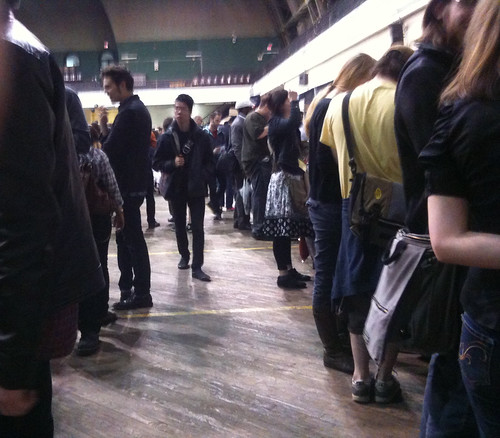
MoCCA Festival 2o11 - The Floor
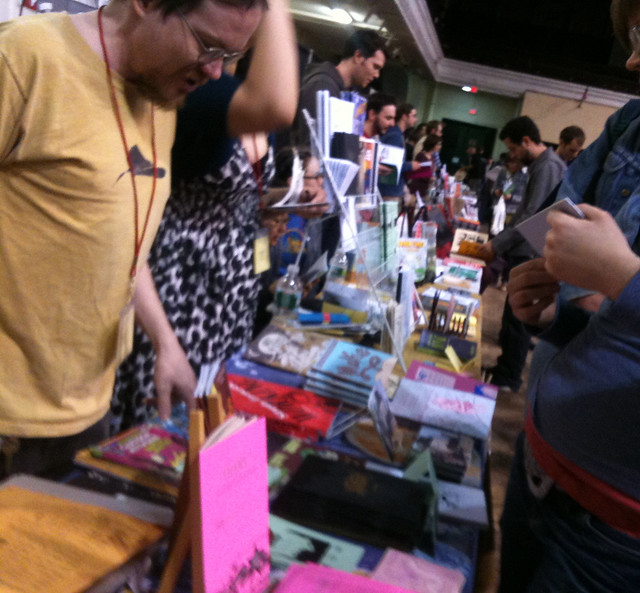
On a MUCH more positive note, this year's MoCCA Festival was great! The Voice issue was obviously timed to coincide with the Festival and they were smart to do so as the The Museum of Comic and Cartoon Art's (@MoCCAnyc) annual fund-raiser has grown to be the premier event of the New York City indie comics year. It also drives in loads of alternative/indie/hipster/zinester/curious types who may have never picked up a comic in years. And this makes me feel good about the health of the industry in general, and the print and independent elements in specific. Jon Lewis, creator of some very cool comics, [pictured at the left below] and I talked about that specifically. Underground people making comics intended to be PRINT comics, as I wrote about for the blog here.

I met, re-met, bumped into, and passed by more people than I can remember.

Jason Little (@beecomix) was there, as was Josh Neufeld (@joshneufeld). Comicsmiths Danny Lewis (@dannydoodar) and Jen Overstreet (@streetoverjen) shared a table. I met Melvin Ylagan, who was once an assistant to Joe Quesada, former EiC of Marvel Comics. Near him was a very talented artist and new friend to me in comics, Miguel Guerra (@SamuraiElf). Steve Seck and Sara Lindo rocked me with their mini-comics making knowledge as usual. They tabled with Lance Hansen of Kettle Drummer Books this time around. Morgan Pielli (@UltraMorgnus) was in the back, holding the fort with his awesome comics [he's one of the fuzzy heads in the phtoto below!] The very talented Mike Cavallaro and Dean Haspiel (@deanhaspiel) were in attendance representing the ACT-I-VATE folk! Plus the always lovely Gabrielle Bell (@luckygab) was selling her minis near the Pizza Island Collective (@Pizza_Island) booth.

The two most exciting moments for me (other than actually working behind a table a little bit for the first time!) were: A sighting of the true gentlemen of comics, Jerry Robinson. And meeting Julia Wertz (@Julia_Wertz) creator of the wonderful autobiographical series "The Fart Party" and graphic novel "Drinking at the Movies", which feels very much like what it is to be in your twenties, living in New York City in a recession, making comics but no money. (I know from experience.)

I wrote some shout-outs right after leaving the convention on the @LongandShortbox Twitter account! Check them out.

MoCCA Festival 2o11 - Jon Lewis Tabling
I also picked up a SLEW of comics, some of which I will review over the next few weeks here on The Long and Shortbox Of It.

~ @JonGorga

Weekly Process Roundup 4/8/11


The weekly process roundup is a collection of sketches, pencils, inks, thumbnails, everything other than finished product, from The Long and Shortbox of It's favorite artists and illustrators, hitting every Friday.


Talk Over Balloons: Anders Nilsen

During the last week of my winter break this past January, I made it to Chicago's Museum of Contemporary Art to see an exhibition called New Chicago Comics. While there, I encountered the work of cartoonist Anders Nilsen and was immediately enthralled. Anders recently finished up work on the collection of his many-years-in-the-making opus Big Questions, and kindly took the time to answer some questions for me.

Josh Kopin: What are you reading (comics, prose, poetry, whatever) right now?


Anders Nilsen: I recently read The Reluctant Mr. Darwin by David Quammen. And God is Not Great by Christopher Hitchens. What else? I just had dinner with Jeff Brown and he gave me a stack of stuff. He did a little minicomic about stuff his son says. Which is awesome.

JK: Are there particular artists or writers that you feel indebted to as an artist?

AN: Sure, tons. Since finishing Big Questions I've been reflecting about it a fair amount. It occurred to me the other day that it might be my best approximation of Herge combined with Daniel Higgs, formerly of the band Lungfish.

JK: You live and work in the city (Chicago) that I consider key to my own cultural growth. Can you talk a little bit about what, if any, artistic relationship you have with the city?

AN: I don't know. The Department of Cultural Affairs gave me money several years ago to help with printing costs when I was still self publishing. People often ask why so many cartoonists come from, or live in, Chicago. I really have no good answer for that. Part of the reason I'm here is that I'm from the midwest originally, and after living in other places for a while I wanted to be back here (even though Chicago is in many ways very different from Minneapolis, where I grew up). The people are down to earth in a way that I appreciate. There's a sense among the artists and creative types that I know, that we're all in this together, us against the world. A place like New York feels much more competitive and cut throat to me. Which has its good points certainly–the place is brimming over with interesting art and culture–but it's not an atmosphere I'm suited to.

JK: I was first introduced to your work at the Museum of Contemporary Art's New Chicago Comics exhibition. How did you get involved in that show?

AN: The curator, Michael Green, emailed me and asked if I wanted to do a studio visit. It sort of fell in my lap.

JK: Taking that exhibition in, it was striking how truly bizarre it is to see comics art presented outside of the context of its original sequence. As not only a comics artist but also a visual artist, what do you think about comics art presented in that way? Do you approach drawing and writing comics differently from the way you would approach drawing or painting?

AN: I selected the work I did with that in mind. I tried to pick out pages that worked in some way as single images--as drawings by themselves. Obviously, since they were all from a single long story my hope was that they would work for the viewer as single drawings, but also as a kind of 'trailer' for the book. A group of highlights. That people would begin to draw connections between them that would suggest the larger whole.

Obviously drawing comics is different than doing single, stand-alone drawing or painting. Every page of comics is going to be preceded and followed with more related information, so it doesn't have to convey everything that you need to know. Whereas with stand-alone images, everything has to be there, in one frame. Also with single images you can kind of pack it, more. You can hide things, on the assumption that the viewer will take a little more time. With comics you need to be pretty direct. A reader may linger, but ideally they are absorbing the relevant information and moving on. Reading, rather than looking.

JK: Last year Drawn and Quarterly released the last issue of your series Big Questions and later this year they're also releasing a volume collecting the series' entire run. Can you talk a little bit about the history of Big Questions?

AN: It's hard to talk about without going on and on. It's a long history. The first strips in the book are 15 years old. I actually just finished writing an Afterword for the book which deals with that. Where it came from, how and why it evolved the way it did. In a way the story of the book is the story of me figuring out how to make comics. How to draw, how to tell a story. It started out as a series of single page gag strips about these little birds that I was drawing in my sketchbooks. I thought I was going to be a painter, or an installation artist. The birds held my interest and I just kept adding elements, expanding the story, adding characters. It was very organic. I self-published it for the first six issues, but that became prohibitive both time-wise and financially, and Drawn and Quarterly was good enough to take over with #7.

JK: What is it like to create a single work with so many small pieces over so long a time? Do certain issues of Big Questions now remind you of moments in your life?

AN: Oh, yeah, totally. I can remember when I did stuff by picturing what house, or what room I was in when I was drawing it. Part of the reason I felt like I needed an Afterword was that the drawing style changes pretty dramatically from beginning to end. Partly that was because I was getting better at drawing, but it was also because I wasn't entirely sure how I wanted the drawings to look, how careful and clean, for example. I don't think I really settled on that question until around issue seven or eight. And yeah, there is something sort of bittersweet about finishing the book, because it has been such a huge part of my life for so long. It feels very much like a chapter of my life is closing or something.

JK: Similarly, how did you plan Big Questions? Did your intentions for the series change from the time you began the series to the time you ended it?

AN: For the most part, by the time I was working on #4 I had a pretty good idea of where the story would go, what the major plot points were. But it expanded. New characters continued to be introduced into issue nine or so.

JK: Have you gone back and reworked some of the earlier issues for the collection?

AN: Yeah. There was one plot thread that became more important than I had expected and I did have to go back and add a short scene here and there, change some dialogue in a few places. There were also a few places I felt like I wanted to give the scenes a little more space than I'd been able to in the single issues.

JK: How do you see the collection as different from the original issues?

AN: Because the issues came out only once or twice a year, and the action tends to be fairly slow and dreamy, I think a lot of readers experienced them almost as short story collections. To me there is a very strong thread running through them, but because it's split up so much, between characters and between books, I think it was a little hard to follow. The fact that all the birds basically look exactly the same didn't help. Having it all in one place, to be read in a single chunk will make a huge difference in that way.

JK: How would you describe Big Questions to someone who'd never heard of it?

AN: An epic existential fable with talking birds.

JK: Now that you're done with Big Questions, what's next?

AN: Catching up on my sleep. Getting this book done has been a bear. I have several half finished projects to tie up. There's a book I did with Fantagraphics called The End that I may do a second volume of. I'm planning to do a collection of the strips I do in my sketchbooks. I've done two books of more stream-of-consciousness comics, called the Monologues, and I'm planning a third and final volume of that.

JK: Is there anything else you want our readers to know?

AN: Maybe this falls in the category of 'what's next', but I'm about to release a self-published version of the giant sized, fully painted strip I did for Kramer's Ergot #7 back in 2008. It's called The Game. It features an angel with a machine gun and a boy with an antelope's head.

JK: When is The Game coming out and where will we be able to find it?

AN:
The Game should be out sometime in mid-April. I'll have an announcement on my blog , and it'll be sold in my webstore. I'm also selling it to shops around the country that sell that sort of thing: Quimby's in Chicago, Family in L.A., Desert Island in Brooklyn, places of that sort.


Many thanks to Anders for taking the time to speak with me, and look for the Big Questions collection, out from Drawn and Quarterly later this year.