
What does THAT mean? Just that Marvel Comics announced plans this morning for a further flirtation with simultaneous digital and paper release of a comic-book at the same paper cost ($3.99) and this time with all the issues in a short but high-profile crossover 'event': namely the "Death of Spider-Man" from their Ultimate Comics imprint.
Those easily alarmed take NOTE: The Peter Parker in "Ultimate Comics Spider-Man" isn't the same Peter Parker in "the Amazing Spider-Man". "Twice the Spider-Man!" said the marketing people in the year 2ooo and we've had two separate ongoing universes ever since.
And in the words of those marketing people: "Marvel is proud to announce that every issue of the hotly-anticipated DEATH OF SPIDER-MAN will be available day & date on the Marvel Comics app, available via iTunes for the iPad, iPhone & iPod touch."
CBR.com's article by Kiel Phegley reprinted that press release with a few comments from the main writer of the upcoming story, Brian Michael Bendis, and the interesting comment: "the issues mark the first event comics – a driving force in comics retail for the past decade – to be offered day-and-date online, though Marvel has been experimenting with high profile releases in this format including the recent 'Invincible Iron Man' Annual and the 'Ultimate Thor' mini series."
The first issues in the "Death of Spider-Man" story are to release in comics retail stores and on the iPad, in February of 2o11.
[via ComicBookResources.com]
And what of those comics retailers? Should they be worried? The crossover 'event' has meant big bucks for them for a long time. I've written on this very site about how much better suited the crossover is to digital simply because it the eliminates the: "Damn! I won't know how this story ends without reading a DIFFERENT comic-book? What the HELL!?" Press a button, problem solved much faster. Or could this prove one of the failings of digital comics? No ACTUAL HUMAN BEING to point to a comic-book and say: "Oh, I've already flipped through that, if you want the whole story you'll have to read THIS first."
However, whether or not "Death of Spider-Man" is a crossover 'event' at all is questionable to me because one of their defining characteristics is the multiplicity of inter-locking comic-book series. Not just one or two. I think one character (or set of characters) appearing in another's book is a guest appearance, two sets of characters appearing in the other's books for one story is a crossover, but a crossover 'event' requires a wider net. Those definitions are far from all-encompassing, I know, but are worth mulling over if for no other reason than nobody else seems to! Why has Phegley specified that "Death of Spider-Man" is an "event" not a "crossover event"? What does he mean when referring to other comics as "high profile" as opposed to "events"?
Is the entire family of terms: crossover, event, and crossover 'event', just marketing hype pure and simple? Perhaps this is all best left to the comics historians of the next generation to worry about, because by just about any definitions you can't call it a crossover 'event' until it's over and done. We will all have to wait and see.
~@JonGorga
P.S. ~ Josh and I have a little plan in the works to probe the nature of digital day-and-date releases in a series of reviews in the coming year!
An Opportunity I'm Not Library To Pass Up
 I don't like winter break very much. It's not that I don't like the time off (I do), and it's not like I don't like my family (I love them, that's why I come home), there just isn't very much to do in Chicago's north suburbs in late December and early January. Rather than find things to occupy me, then, I have often to make them.
Luckily, my local library has a pretty sweet graphic novel and collected comics collection. It's growing, too: when I started checking books out as a freshmen in high school, the whole shebang occupied maybe four bookshelves. Today, when I walked into the library for the first time in probably about a year, it took up four whole bookcases.
Clearly, someone at the Highland Park public library likes me very much.
I always use the opportunity of being home to read some stuff I wouldn't have read otherwise; things that just aren't my speed enough to buy, or things that are just too big, unwieldy or expensive for me to consider purchasing on a normal occasion. This vacation, I've chosen three things to read, all of which encompass both categories of comics I borrow from the library.
The first, Fantagraphics' complete collection of Gilbert Hernandez's Palomar, is my introduction to Los Bros Hernandez. That I've read nothing of their work means that I have a pretty big hole in my comics knowledge, and I hope the experience of this tale, which originally ran in the Bros' Love and Rockets anthology, is as fantastic as everyone says it is. The HPPL also has Luba, Locas I and Locas II, so it's possible I'll also get to at least one of those before the break is over.
The second, Top Shelf's collection of Eddie Campbell's Alec comics, entitled The Years Have Pants, is something I've thought about buying a couple times, on the strength of recommendations alone. It's a huge, beautiful, book- I hope I enjoy reading it as much as I enjoy looking at it.
The last maxi-sized comic currently on loan to me is Brian Wood and Ryan Kelly's Local, which looks about as perfect a comic for me as there ever was. If Wood's Demo proved anything, it's that he writes a great short comics story and this collection of twelve interconnected ones, about a girl who sets out from Portland, Oregon and just travels around the country, looks perfect. And pretty.
I'm hoping to review each of them; I'm curious how their massive size and quality paper changes the experience of reading comics. I'll let you know how it goes.
The Memory's Telling of the Journey is the Worthier Part
"Serenity: The Shepherd's Tale" from Dark Horse Comics
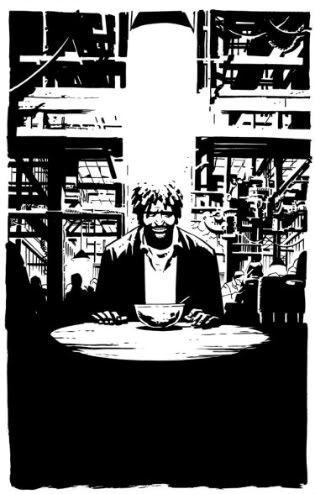 If you are at all a fan of Joss Whedon's ongoing sci-fi story: TV's "Firefly" and its feature film sequel "Serenity", you have been waiting for this comic even if you didn't know it, because you've been waiting for this story for a long time. And it does not disappoint. If you're not familiar with Joss Whedon's 'verse this may very well be the place to start.
Chris Samnee's art is wonderful. Clean-lined and smooth, alive and full of delightful human imperfection. His work retains that feeling of being hand-made (what the art historians call gestural artwork) and the result is great cartooning. But somehow his stuff is also realistic enough that it holds some weight. His people look like their bodies are moving over real terrain and through real air. Samnee (@ChrisSamnee) is one of those fantastically rare visual artists who is perfect for comics: smartly cartoony and fluid with strong recognizable shapes that build volume and give a realitic feel to the entire product.
There really are just a handful of them alive and working in the American comics industy at any given time: Dean Haspiel and Erik Larsen are the only other two that come to my mind.
Samnee's art is never a weak link in making visual narrative art. He was unknown to me when I first saw his name attached to this project, but after I saw the preview images [like the one above] and his work on Marvel's "Thor: The Mighty Avenger" series I had no fear about his art doing justice to the brilliant work of Joss Whedon and the original cast of the TV show that started the franchise in 2oo2.
Just look at the sketches from his blog, taking the actor's face and extrapolating the character's younger self(ves). How cool is that?
 Now that I sufficiently sound like I'm obsessed with Chris Samnee and you think he's paying The Long and the Shortbox Of It money for these positive reviews both Josh and I have given him now... let's move on to the story.
To clearly depict a character's emotional journey is a tough act in any narrative art medium. To do so with a character who was already well-established and defined in a completely different art medium by a writer, actor, costumers, and cinematographers? And to then do it IN REVERSE?
That's remarkable.
Just as Samnee had to reverse engineer Ron Glass' face in the character of Shepherd Derrial Book, so too did Zack Whedon (@ZDubDub) find himself challenged with crafting a single linear story (a backwards linear story) that presents us his brother's notes on the character's life-story at all different stages from childhood to the middle-aged man we met in the show's first episode when he said: not the destination, but "how you get there is the worthier part." All this material was probably intended to be revealed bit by bit over two seasons of television. Remarkably, the resulting story is smart, unnerving, and emotional. Especially on the re-read.
THE LONG AND SHORTBOX OF IT?
"The Shepherd's Tale" is an exceptionally well-written and well-drawn character biography in reverse. Buy it. Read it. Read it again.
If you've been wondering about whether these Serenity comics from Dark Horse are worth your time, this is one you should have no doubt about. If you were a fan of Joss Whedon's original TV series or the movie sequel you should not hesitate to buy and read this graphic novella. Even if you've never heard of the stuff, you can find something you will love here.
Go get one at your local comic shop! And try to enjoy your trip there because life is wonderful but will be over all too quickly and "how you get there is the worthier part"!
~ @JonGorga
If you are at all a fan of Joss Whedon's ongoing sci-fi story: TV's "Firefly" and its feature film sequel "Serenity", you have been waiting for this comic even if you didn't know it, because you've been waiting for this story for a long time. And it does not disappoint. If you're not familiar with Joss Whedon's 'verse this may very well be the place to start.
Chris Samnee's art is wonderful. Clean-lined and smooth, alive and full of delightful human imperfection. His work retains that feeling of being hand-made (what the art historians call gestural artwork) and the result is great cartooning. But somehow his stuff is also realistic enough that it holds some weight. His people look like their bodies are moving over real terrain and through real air. Samnee (@ChrisSamnee) is one of those fantastically rare visual artists who is perfect for comics: smartly cartoony and fluid with strong recognizable shapes that build volume and give a realitic feel to the entire product.
There really are just a handful of them alive and working in the American comics industy at any given time: Dean Haspiel and Erik Larsen are the only other two that come to my mind.
Samnee's art is never a weak link in making visual narrative art. He was unknown to me when I first saw his name attached to this project, but after I saw the preview images [like the one above] and his work on Marvel's "Thor: The Mighty Avenger" series I had no fear about his art doing justice to the brilliant work of Joss Whedon and the original cast of the TV show that started the franchise in 2oo2.
Just look at the sketches from his blog, taking the actor's face and extrapolating the character's younger self(ves). How cool is that?
 Now that I sufficiently sound like I'm obsessed with Chris Samnee and you think he's paying The Long and the Shortbox Of It money for these positive reviews both Josh and I have given him now... let's move on to the story.
To clearly depict a character's emotional journey is a tough act in any narrative art medium. To do so with a character who was already well-established and defined in a completely different art medium by a writer, actor, costumers, and cinematographers? And to then do it IN REVERSE?
That's remarkable.
Just as Samnee had to reverse engineer Ron Glass' face in the character of Shepherd Derrial Book, so too did Zack Whedon (@ZDubDub) find himself challenged with crafting a single linear story (a backwards linear story) that presents us his brother's notes on the character's life-story at all different stages from childhood to the middle-aged man we met in the show's first episode when he said: not the destination, but "how you get there is the worthier part." All this material was probably intended to be revealed bit by bit over two seasons of television. Remarkably, the resulting story is smart, unnerving, and emotional. Especially on the re-read.
THE LONG AND SHORTBOX OF IT?
"The Shepherd's Tale" is an exceptionally well-written and well-drawn character biography in reverse. Buy it. Read it. Read it again.
If you've been wondering about whether these Serenity comics from Dark Horse are worth your time, this is one you should have no doubt about. If you were a fan of Joss Whedon's original TV series or the movie sequel you should not hesitate to buy and read this graphic novella. Even if you've never heard of the stuff, you can find something you will love here.
Go get one at your local comic shop! And try to enjoy your trip there because life is wonderful but will be over all too quickly and "how you get there is the worthier part"!
~ @JonGorga
 0
comments
0
comments
Shortboxes: Chris Samnee, Dark Horse, Dean Haspiel, Erik Larsen, Firefly/Serenity, Joss Whedon, Reviews, Zack Whedon
The Secret Is Out
 Secret Avengers is a pretty damn good comic book.
I was pretty sure it was going to be, with Brubaker writing it and all, but still, months ago, I was worried: what if it isn't any good? What if Brubaker can't write a team book? And isn't Mike Deodato's work a little stiff?
And, at the beginning, some of those fears were justified. Brubaker's writing was a little slow, at the start, and it just felt like he was being weird for the sake of being weird. Awesome weird, but still- it didn't really seem to have much of a point.
By the end of that first arc, though, Brubaker really hit his stride. By the time he hit the second arc, after an interlude drawn by David Aja and Michael Lark, he was really hitting it out of the park: now that he's playing with Shang-Chi and the Prince of Orphans, things seem really fluid and each piece fits together perfectly. Fluidity, too, is not something I was expecting from Mike Deodato Jr. and, while I guess "fluid" is probably the wrong word, there's a certain energy in his art. I can't place my finger on its source, precisely, and it doesn't help that his figures still look like, well, action figures. Action figures articulate, though, and you can look at them from all sorts of angles, which is precisely what Deodato does. The art here is good. Really good. The stiff look isn't usually my thing, but it's impossible not to appreciate the work and not only because he's clearly good (maybe even the best at this sort of style). Mostly it's because he's just so damn good at presenting it, with panels and page layout that are fluid and dynamic in a way that his pencils aren't. The way we look at it moves, even if what we're looking at doesn't and that's just utterly brilliant.
This aspect of Deodato's work is front and center in Secret Avengers #8, the third part of a five part story centering around the return of Shang-Chi's father, a character who can't be named for copyright reasons, but who I'm more than happy to tell is Victorian villain Fu Manchu. Brubaker finds plenty of clever ways around that particular obstacle, just like he does some pretty cool stuff with what is essentially a book-long fight scene. It goes maybe a mite too fast for my liking, and I'm concerned that he's used Sharon Carter as a damsel in distress two storylines in a row, but everything else seems spot on. He knows his characters, and not a word seems out of place or out of character. If he keeps writing the book like this, and Deodato keeps drawing and designing the hell out of it, I'm all in.
----------------------------------------------------
Also, here's to hoping Brubaker keeps Prince of Orphans around. He's a fantastic character, one of my favorite minor ones, and he's been in stasis too long. Would it be too much to ask for a mini-series or something?
0
comments
Shortboxes: Ed Brubaker, Marvel, Mike Deodato Jr., Prince of Orphans, Reviews, Secret Avengers
Quote of the Week 12/24/10
The war was much on my mind in those days, and it was almost entirely the one being fought on movie screens and in the pulp pages of "funny books," known as comic books in other parts of the country. Both names were misleading for the kind I liked, the ones featuring costumed vigilantes who made violent swoops on spy rings and gang hideouts, with no Miranda palaver. Along with Superman and Batman, there were many others, now largely forgotten, such as Bulletman, Plastic Man, The Sandman, Doll Man (a fighting homunculus about six inches tall, in a red cape), The Human Torch, Daredevil, Blue Beetle, Captain Marvel, Captain Midnight, and Captain America. Under any name the books were quite a bargain early on, at sixty-four pages in color for a dime. Or a kind of color. The palette was limited; Superman had blue hair. I never tired of the repetitive stories or the familiar scenes that were enacted over and over again.Charles Portis, author of True Grit, for The Atlantic in 1999.
(As an aside, the Coen Brothers True Grit came out on Wednesday and it's pretty good. Not great, much better for Jeff Bridges' acting as Rooster Cogburn, but still very good. Worth going to see, anyway, even if it won't rock your world or anything.)
Portis, probably without realizing it, has articulated precisely the problem with the Modern Age of comics. Comics readers, on the whole, never tire of those familiar scenes, the ones enacted over and over again. In fact, far from tiring of them, comics readers on the whole beg to see the same scenes reenacted repeatedly, and continuously.
Actually, I'm wrong. This is the behavior of comics fans.
I think I've mentioned before that I am ill content with the label of "fan." One of my professors never fails to remind us that "fan" is short for "fanatic," and, as much as I sometimes bristle at his insistence, he's right. I'm not a Captain America fanatic, nor an Iron Fist fanatic, nor even a comics fanatic. I like these things. It may be that I even love these things, but I am not fanatical about these things. There are no characters or stories that I love so much that they are sacrosanct, no notions, no costumes, no thing about comics that is so important to me that I would prefer to preserve it than to see it change for the sake of a good story.
There is nothing wrong with that way of looking at things. In point of fact, most readers of mainstream comics are "fans" and far be it from me to tell them that they're doing it wrong: it's just not the way that I want to do it. I would much rather see writers and artists do what they do well than see Captain America live forever.
Heed the warning that Planetary left us with a little over a year ago: there are so many places to go. Rather than keep re-reading the past, why don't we ride right on into the future?
Here's to what's interesting, ladies and gentlemen, here's to what's new.
Have a merry Christmas and a happy new year.
Subscribe to:
Posts (Atom)


