In September, Dark Horse is putting out a 700 page Astro Boy omnibus. 700 pages. Somehow, Amazon has the retail price listed at $20, which seems impossible, but, hey, I'm in. Tezuka is such an important creator, and Astro Boy is such a well known property, that I'm positive that this isn't the first time we've seen this work in English. I can't, however, ever recall actually seeing it in a comic book store, so I'm looking forward to cracking it open.
Wednesday's New Things: Gone Digital
Filed by
Josh Kopin
on
Wednesday, February 18, 2015
Digital is a place. Or something. Click on the covers for previews, where I could find one.
Atomic Robo: The Kinghts of the Golden Circle, written by Brian Clevinger, Scott Wegener
Atomic Robo is a comic book I've always wanted to read. I mean, it's got adventuring robots and a dinosaur and it just looks like a lot of fun. In what longtime readers will recognize as a theme of this column, I just never got around to it. In part, that's because I was never really looking for it, but also because it wasn't really at hand--I would have had to go looking for it--and so I never gave it a shot. But this release is the last time that's going to be a problem since, as of mid-January, the Atomic Robo team has ditched their publisher and gone totally digital, using the webcomic model. They're in the process of uploading all of the previously released content, at the rate of about three issues a week, and they'll say that'll put them in a position to start releasing new stuff sometime in mid-May. This is the only time I've heard of someone doing something like this, the transition usually goes the other way and is rarely a total one, but I think it has the potential to expand their readership exponentially, putting it within the reach of many more hands (or, in this case, cursors). It's a pretty bold strategy, although probably a cost effective one insofar as it drastically reduces costs and has the potential, with exposure, to actually increase physical circulation. It's certainly an interesting alternative to the comixology strategy of digital archiving, insofar as they're betting on the community of the internet. It'll be interesting to see how this works out for them, and if anyone follows suit. In the meantime, there's robots and dinosaurs-- what's not to like?
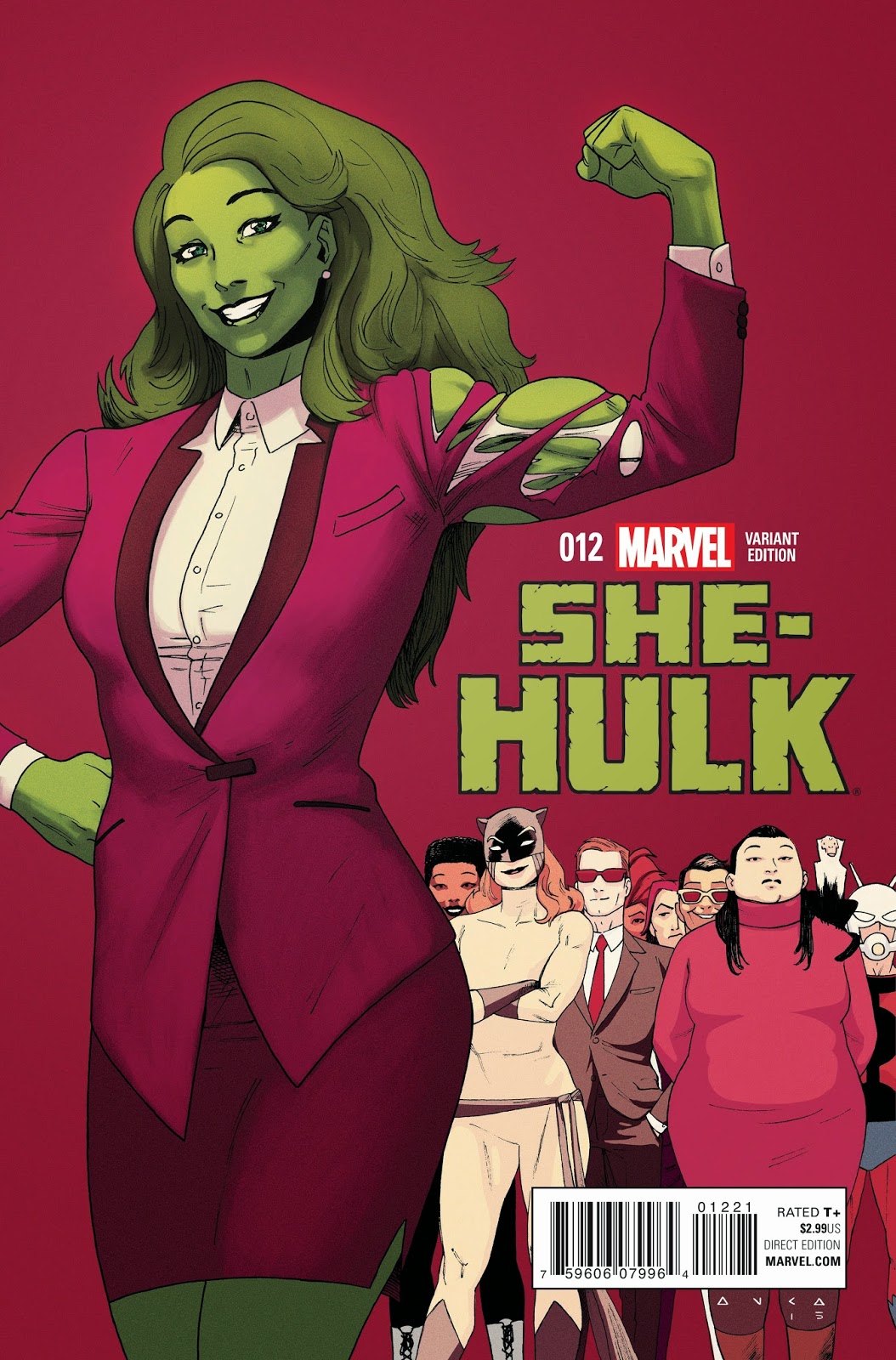
She-Hulk #12, written by Charles Soule, art by Javier Pulido
This book was one of the good ones, a memory of a moment just a year ago when Marvel was combining good concepts with talented writers and dynamic artists to make a bunch of really good comic books. Not all the books are gone, but the company has moved on, and, although there's no more definitive sign of that than the upcoming notareboot, the end of She-Hulk, which was announced first, certainly felt like a mortal wound to any hope that that moment was going to have any real duration. The economics of comics are what they are, but it's a real shame, if not necessarily an indictment of anyone, that we're going to lose this super smart, super well drawn comic book.
Black Widow #15, written by Nathan Edmondson, art by Phil Noto
Multiversity: Master Men #1, written by Grant Morrison, art by Jim Lee
Bitch Planet #3, written by Kelly Sue Deconnick, art by Valentine De Landro
The Autumnlands: Tooth & Claw #4, written by Kurt Busiek, art by Ben Dewey and Jordie Bellaire
Wednesday's New Things: The Shortest Distance Between Point A and Point B, No Matter How Far You've Gone
Filed by
Josh Kopin
on
Wednesday, February 11, 2015
Let's get mathy...
Displacement by Lucy Knisley
I had the good fortune to read this book's twin, An Age of License, just after the new year. That book is about what happens after we grow up, and Displacement is its other side, what happens when our loved ones grow old. Knisley's work, delicately colored and generally free of the visual structure provided by panels, has an easy touch, but also hits right where it hurts-- something about just how diagrammatic it is, something about how all the open space draws you in, something about her inward focus, makes for very effective memoir, like Lucy Knisley's books are, more or less, guides to being Lucy Knisley. I'm looking forward to this one. Preview here.
The Sculptor by Scott McCloud
Help Us! Great Warrior by Madeleine Flores, colors by Trillian Gunn
Speaking of McCloud, one of the things he talked about on Sunday, something I didn't write about yesterday, was the fact that, for aspiring cartoonists, putting your work out online is never a bad idea. If it's good, if it's interesting, if people like it, then either companies will come calling or you'll be able to put the work out yourself. Help Us! Great Warrior is a good example; formerly a webcomic, Flores has recently been working for Nickelodeon, and also managed to get Boom to put out her sweet and funny comic in physical format. Seems like a win win.
The Empty by Jimmie Robinson
It's curious that comics haven't really embraced the trends that have emerged from YA literature over the last decade or so and then proliferated into television and movies, notably dystopian fiction and vampires. You see bits and pieces, here and there, and, as the eighties showed, any world with superheroes in it is, in one respect or many, a dystopian one. Jimmie Robinson's The Empty doesn't quite fit in with that paradigm, seeming to align more in tone with sci-fi comics like Prophet and Saga, but, from the preview, it does seem to share the deep darkness and cynicism of the former genre. I've never read Robinson's long running Bomb Queens, but The Empty, with its wide open imagination and its melodramatic beats, seems like its worth a look.
Satellite Sam, written by Matt Fraction, art by Howard Chaykin
Satellite Sam's third act is upon us. In some ways, I think the television murder mystery represents the positive side of a shift, as of maybe 18 months ago, to a later stage in Matt Fraction's career, in which he's only working on projects he really cares about (and, not coincidentally, that are largely creator owned). This book, too, has grown up a lot-- I found Chaykin's black and white art hard to follow in the beginning, and several of the characters hard to tell apart, but he quickly straightened everything out. I've been trade waiting this one; I think perhaps it's time to catch up.
Darth Vader #1, written by Kieron Gillen, art by Salvador Lorroca, color by Edgar Delgado
The great licensing comic conundrum returns! Gillen is usually an auto buy for me, although this is the second of his recent comics about which I'm unsure (the first being Angela: Asgard's Assassin). I have no doubt that this comic is good, and I bet Sal Lorroca's sheen is perfect for it, but at $4.99 I think I'll see if I can't read someone else's copy. Preview here.
The Cartoonist and The Sculptor
Filed by
Josh Kopin
on
Tuesday, February 10, 2015
![]() |
| I was so engrossed I only remembered to take one picture! That's McCloud on the right. |
He was, unsurprisingly, gregarious, and very funny. The afternoon was a Q+A moderated by the Austin Chronicle's Wayne Allen Brenner, who also did an interview that ran in the alt-weekly last week. The Q+A, like the interview, was wide ranging, with Brenner asking McCloud to return to and elaborate on several themes and specific questions from their earlier conversation. The early going was taken up with a discussion of McCloud's imminent graphic novel, The Sculptor, a project he's been working on for about a half a decade. Using powerpoint, he shared with us his all digital workflow, which, at the thumbnail stage, includes sequences many pages long. This setup, he says, prevents him from getting "hung up on a given page" and enables him to see the forward flow more clearly. It also makes for an easier revision process, allowing him to move pieces around-- or take them out-- like sentences or paragraphs in a word processor. Using photoshop further allows him to draw layers on top of layers, he estimated an average of 40 per drawing, making complex illustration easier to do, undo, or redo. Ultimately, McCloud says, he likes digital because it allows him to stay focused on his work all day, getting caught up on the art rather than the tools that he uses to make that art. The only time he ever prints the sequences out is to see the whole flow-- and he does that at a very small size.
This idea of a comic's flow, and flow's relation to length, seems central to McCloud's thinking these days-- he spent a lot of time talking about how American comics are limited by the 22 page average. Citing his friend Kurt Busiek, he called that standard "the original sin of American comics," and suggested that the industry made a mistake half a century ago when it chose to keep prices steady rather than keep page count high (the idea that we might have even had a choice, that it was one or the other and not both, now seems utopian). As McCloud describes it, this compression has lead to a problem where both words and pictures are used as shorthands, with art talking precedence over characterization and words used as a short cut to the kinds of description proper to the juxtapositional grammar of comics. Later, during audience questions, he said that he believes that this is why we get the same stories over and over; there's only so many things that "fit in the shoebox." Comics that are longer have more room to breathe, and both elements of the invisible art become more effective, and you get an entire page of a character coming to a realization or actually get to work out the rhythm of a conversation--silences, essential to any natural talk, are impossible when every panel needs to be action packed.
With this in mind, and with prompting from Brenner, he praised several creators. Most notably, he cited David Aja's work on Hawkeye, saying that the Spaniard's work with Fraction on that series represents nothing less than a deconstruction of the form of the 22 page comic (which, I think, we can generally understand as superhero-length) in order to try find a way around some of the problems with that duration. He also mentioned Jillian and Mariko Tamaki's This One Summer ("it's like virtual reality, you just plunge right in") and James Sturm's Market Day, which he called "bulletproof" even as he described it as a story about a rug merchant having trouble selling his rugs. He finally turned to Raina Telgemeier, whom he praised in both formal and cultural terms, saying that she solves the compression problem by giving every emotion a panel, while also putting her at the vanguard of a group of young, largely female, fans who have comics for childhood and adulthood and every step in between. This group, McCloud says, is charging over the hill-- "in nine years, the industry will be majority female."
That last little bit was, I think, the most important of the afternoon, in both its generalities and its specifics. At this point, McCloud is an optimist before all else, and what he sees in a medium constantly in the process of reinventing itself is infinite possibility, much like the infinite time and infinite space signed by the gutter.
I'm very much looking forward to reading The Sculptor.

Wednesday's New Things: The Goon Runneth Over
Filed by
Josh Kopin
on
Wednesday, February 04, 2015
Man, I just love the Goon...
The Goon: Once Upon A Hard Time #1 by Eric Powell
In Eric Powell's recent Reddit AMA, he suggested that things were about to change for the Goon:
All that's very exciting, but I'll be a little sad if this is the last we see of him. I'm way behind, and now seems like a good time to catch up on what I've missed, maybe even to fill up my bookshelf and start from the beginning. I just love the Goon.Once Upon a Hard Time is the climax to everything I’ve done in the Goon so far. In fact, it may be the last story entitled “the Goon” I ever do. The mythology I’ve created will keep going. But I’m creating new characters to interact with the old ones, shifting barely used characters to the limelight, and putting everyone in different environments. The next mini-series I do involving this mythology will have a different title and will feature a large cast of characters including several who survive the last Goon series.
Love and Rockets New Stories #7 by Gilbert Hernandez and Jamie Hernandez
As always, Los Bros speak for themselves.
Nameless #1, written by Grant Morrison, art by Chris Burnham
It's good to see that Morrison and Burnham, who together concluded Morrison's Batman, Inc. story line, are still working together. Although is a little unfair to Burnham, I think part of the reason that Morrison likes working with him is that he works with a thin, hairy line that makes color is the dominant art element on the page, a style that very closely resembles Frank Quitely's (with one of the differences being that the colors in Quitely's work are often slightly darker and more muted than the ones that Burnham uses). That style seems perfect for what Burnham has called "the ultimate horror comic," so the key here is going to be which Morrison shows up, which side of what Jon calls "cuckoopajamapants" is the book going to be on. The preview has me a little worried, but new Grant Morrison is always worth a look.
Stray Bullets: Sunshine and Roses #1, by David Lapham
Saga #25, art by Fiona Staples, written by Brian K. Vaughn
Two Image series returning from short breaks, each of which I need to catch up on (well, in the case of Stray Bullets, which I need to read any of at all). The question, as always, is in what form?
Velvet #9, written by Ed Brubaker, drawn by Steve Epting, colors by Elizabeth Breitweiser
Velvet is the best espionage comic on the market right now. It just comes out... so... slowly...
Captain America: Fear Him #1, written by Dennis Hopeless, art by Simon Kudranski and Mast & Geoffo, colors by Andres Mossa
I thought I would always buy Captain America, but Rick Remender runs so hot and cold I just couldn't take it anymore (I think it was the issue long straw man argument between Captain America and Nuke that really did it in for me). I'm waiting out the rest of his run on the character before I give it another shot, which is too bad because I think putting Sam Wilson in the flag is a fun and interesting idea, and I expect by the time we get a new writer that we'll have Steve back to full strength That's why this is sort of exciting, even though I don't really like to buy mini series and the art looks a little goofy. I don't know if it's a buy. But it's certainly worth a look.
Jungle Jim #1, written by Paul Tobin, art by Sandy Jarrell
As part of a celebration of King Feature's hundredth birthday, Dynamite put together a small run of series featuring characters from the syndicate's strips, which I think is a pretty cool idea. I haven't seen any of these out in the world, and $3.99 seems like a lot for a comic book that seems to be largely written in the stilted dialogue register comic strip... but it also looks kinda nuts. If the trade is more reasonably priced, I think I'd like to give it a shot.
Subscribe to:
Posts (Atom)


.jpg)