Showing posts with label Grant Morrison. Show all posts

Burnham and Quitely


From the Department of Things You Can't Unsee Once You've Seen Them, comes something I'm sure everybody else realized months ago:

          
Chris Burnham's art (left) looks a lot like Frank Quitely's (right).

It's got that same sort of kinetic sketchiness, although Burnham's is firmer and less prone to random lines while Quitely's work moves better, so it's a nice way to tie the second phase of Morrison's Batman run together. I just wish they'd managed to coax Quietely out of the cover artist hole he's fallen down. His collaborations with Morrison are cackling, electric, his live art and Morrison's energetic scripting coming together for work that is an experience like reading animation, fantastic comics, in other words. That said, Burnham's work on Batman, Inc. has been excellent, and he's worked with Morrison on Batman longer than anyone has in years. For the first time in a long time, the book has a consistent aesthetic, which is a nice thing to see, particularly as Morrison's time on the series comes to a close. 

One Expanding Comicsmith in DC's Reboot, Many More in Other Avenues

Is a filmmaker better if he plays several roles in the creation of his film, like a writer/director or writer/actor? Is a film better for having a single authorial voice or better understood for being watched expecting a single voice? This guy thought so:

Francois Truffaut first advanced the position that the director of a film was its primary creator in France in the 1950s

Auteur theory (auteur is merely the French word for author) is a term for the theory or concept that states: the director takes control of a film, therefore he/she is responsible for it. It seems to me, the term could apply to any of the other principle craftsmen on a film, and I prefer the less-pretentious filmmaker. Film + maker.

Firstly, as I understand it from studying the industry, the closest parallel to the director in comics is the editor. The editor coordinates and guides the writer, artist(s), colorist, letterer, etc. to make a single cohesive work of art. The Japanese already have a word for a one-man-comics-machine as their comics industry is primarily made up of writer/artists leading teams of assistants. They call creators manga-ka. Manga = comics + ka = person. This is as similar as we will get to auteur in comics. As a parallel and as a hopefully more down-to-earth option, I have been referring since sometime in college to someone who undertakes several roles in the creation of a comic as a comicsmith. Comics + smith, a synonym for maker.

-Language lesson OVER.-

Storytelling in comics is a unique game. It requires visual/space thinking but also narrative/time thinking to do both sides properly. Doing both well is a rare thing.

MajorSpoilers.com has posted a simple list of the new series debuting from DC's re-boot in August/September you can read here. Out of the 53 titles they list, one of them will be written and drawn by the same person:

"Detective Comics" will be scripted and penciled by Tony Daniel. [The cover of the new #1 by Daniel is at left.] After illustrating Grant Morrison's scripts for a few years, Daniel held-up both ends of the creative exchange on "Batman" from issues #692 to #699 and then from #704 to the most recent issue, #711.

CBR interviewed him about his work at the keyboard and the drafting table twice. Once when his first run was about half over and again recently when his part in the relaunch was announced.

My opinion?

Sadly, Tony Daniel's issues of "Batman" were some of the most boring superhero comics I can remember reading. Very nice art. Nothing in the writing made me want to continue reading it. And sometimes I felt that things in the art seemed rushed and I suspect that it looked as good as it did thanks to inker Sandu Florea.

I thought of Daniel's first stint as a comicsmith as an exciting experiment for contemporary American mainstream comics and expressed that I would be curious to see how it was way back when we were posting weekly looking-forward-to posts here on The Long and Shortbox Of It. But as an experiment, I was sadly dissatisfied with it. DC doesn't seem to think along the same lines. According to Daniel's second interview linked-to above, he was approached by the company to do the writing for a second series as part of the upcoming relaunch. He is now also writing "The Savage Hawkman", to be drawn by Philip Tan (@philipsytan) according to Daniel's scripts, as well as swapping Batman titles with Scott Snyder (@SSnyder1835) and Francesco Francavilla (@f_francavilla), who were the team on "Detective Comics" previously and will now work on "Batman" instead. And Daniel is actually just one of several comics-artists being given a crack at writing scripts for another artist to illustrate. They might all turn out to be excellent writers, but it seems like a dangerous chance to take at such a crossroads for the company and the whole industry.

(Before I move on I have to say: "Batman" #702 written by Morrison, drawn by Daniel, and inked by Florea made it to my Best of the Year post. So I've got nothing against Tony Daniel. Truly and wholeheartedly, I wish him luck writing two series and drawing one of them. A challenge for anyone.)

Why is it the Japanese mainstream makes the comicsmith position the norm, and the American mainstream makes it the exception? I suspect a great deal of it lies in the aforementioned art teams the Japanese creators regularly employ. Here, artists do often ask the help of their fellow artists to complete their work, but only in a time-crunch, and always under the radar. Americans have this silly concept of the individual against the world, fully self-reliant. Which brings me back, of course, to the main question: Why so few creators who do it all themselves?

Mind you, that's entirely untrue outside of the American mainstream, these are all American comicsmiths:

Jason Lutes
Jason Little (@beecomix)
Chester Brown
Jeffrey Brown
Peter Bagge
Gary Panter
Gabrielle Bell (@luckygab)
Brendan Leach (@iknowashortcut)
Julia Wertz (@Julia_Wertz)
Dennis Pacheco (@dpacheco)
...

THAT list goes on far too long to name them all.

So could it be that being a good comicsmith, making quality comics all on your lonesome, simply takes time? Time not available to the maker of the monthly 22-page corporate comic-book? Seems possible. Could it be that the simple exchange required with an editor, inker, colorist, production man, etc. makes it far too messy? Seems equally possible. (As someone who makes comics without any collaborators himself and does it very, very slowly... I can tell you those ones make sense.)

There's a new comic-book called "All Nighter" I'm looking forward to reading, available in comics shops across the country from Image Comics, written and drawn by one man: David Hahn (@david_hahn). Looks good. Look for a review of that book from me in the coming months with a bit more commentary on this subject.

~ @JonGorga

P.S. ~ This gent over at CBR has some excellent and clear things to say about both DC's reboot and the digital release news in general.

I've written three articles that at least touch on the DC re-boot now. I think I'm done talking about that whole mess for now. Until the books are actually on the shelves, at least. Josh looks like he has a bit more to say on it. You'll get your fix from him hopefully.

I Know I'm A Little Late To This Party, Forgive Me As I Am In Greece

[the first in a series of posts about what I'm looking forward to about DC's relaunch]

I think this business about rebooting the whole DC Universe is exceedingly silly. For that matter, I think canceling Uncanny and putting Steve back into the flag are silly too, but those are things we'll get to later: for now, rebooting the whole DC Universe is silly. Not that I mind; I've never followed DC's events, as I prefer to borrow them later from friends.

Can you imagine, though? Paying all that money? Following those stories just for them to come to nothing? I suppose it all depends how you look at it, though. If you're inclined (like I am) to view superhero comics as a certain kind of modern mythology, then a reboot that shakes continuity in order to bring a character back to their essentials well, that can't really be a bad thing. At the same time, I think I'm in the minority: I think most people are in it for the long-term, continuous serial storytelling.

And that's why I think that this reboot thing is silly, because I think it's going to backfire. DC might get a sales spike for the first couple of months, but, although I would be curious to see what comes after that, I am pessimistic about the long-term viability of this as a choice.

The positive upshot of this, though, is that DC really does have a chance here to revitalize some old properties and to try some new things. If they can, by erasing the twenty-five years of storytelling since the last time they did this, make comics simpler to understand and less worried about continuity, they might bring people who are intimated by comics as they stand now into the fold, and after a spike and then another dip, they might see a nice little increase in readership.

Of course, it doesn't hurt that, among the books on tap, there are these:

ACTION COMICS #1

Written by GRANT MORRISON

Art by RAGS MORALES and RICK BRYANT

Cover by RAGS MORALES

Variant cover by JIM LEE and SCOTT WILLIAMS

On sale SEPTEMBER 7 • 40 pg, FC, $3.99 US • RATED T

The one and only Grant Morrison (ALL-STAR SUPERMAN) returns to Superman, joined by sensational artist Rags Morales (IDENTITY CRISIS), to bring you tales of The Man of Steel unlike any you’ve ever read! This extra-sized debut issue is the cornerstone of the entire DC Universe!

I hate Superman.

But here's the score: if Grant Morrison's writing it, I'm probably going to buy it. And putting Grant Morrison on Superman? That's a stroke of genius, and one that comes with a pretty good guarantee. Grant Morrison gets Superman (in a way that someone like a certain superfan who has the initials JMS doesn't), because Grant Morrison gets archetypes, and that's the sort of writer that Supes needs, a mythographer rather than a fanboy. We know that Morrison is such a writer because the Scot already rebooted the big blue boyscout once, and All-Star Superman is, to my mind, the best Superman comic in decades (and maybe the only decent one in just that long), and it's the best Superman comic in decades because Morrison was playing with expectations and mythology. Grant Morrison is going to write a Superman good enough to wash the taste of Grounded out of our collective mouths-- and that alone is worth the $3.99.


WONDER WOMAN #1

Written by BRIAN AZZARELLO

Art and cover by CLIFF CHIANG

On sale SEPTEMBER 21 • 32 pg, FC, $2.99 US • RATED T

The Gods walk among us. To them, our lives are playthings. Only one woman would dare to protect humanity from the wrath of such strange and powerful forces. But is she one of us – or one of them?

It's not that I don't like Wonder Woman, exactly, it's just that I've never thought she was very interesting: the WW stories from the past couple of years haven't helped this perception, exactly. Putting Brian Azzerello and Cliff Chiang on the relaunched book, though, that's crazy enough that it just might work.

Actually, let me step back: putting Chiang on WW was a no-brainer, and someone should have done it years ago. No one, no one, in comics today is an iconographer of the quality that Chiang is: look at the way Diana stands out from the background of that cover, like she's made of halo, separating her from her surroundings as if to say "Yeah, this one's different." And Wonder Woman should be different. She should be a hellraising, badass, Amazon warrior stuck between two worlds, prepared to do what it takes to defend those who need it from forces way beyond their control. And Chiang, if the cover is any indication (and I know it is) is the man for the job.

If Chiang was an obvious choice, Azzerello was a stroke of mad brilliance: at first glance, a man known primarily for his killer crime comics is not the man for this job. But there is some precedent for it: the only Superman comics I own besides Morrison's are Azzerello's and they're pretty good (not great, but pretty good), and they're pretty good because Azz took an old kind of story, a classic, almost a cliche (a man wanders away from home briefly, and comes back to find that everything has changed) and he put Supes in a position he had never been in before, a position for which there was no good solution, no tall buildings to leap in a single bound, no flying around the world backwards. If he could pull the same sort of trick with Wonder Woman, if he can strip off the lasso of truth and the invisible jet, then this book will be an instant classic.

Weekly Process Roundup 6/3/11

The weekly process roundup is a collection of sketches, pencils, inks, thumbnails, everything other than finished product, from The Long and Shortbox of It's favorite artists and illustrators, hitting every Friday.

I think I found cool stuff this week!

(Shhh... Don't tell anyone but I'm in charge of these things for a month while Josh is in Greece!)

~@JonGorga

Quote For The Week 2/22/11

I tried to think about, "In all through these versions, what stayed the same?" Because something always stayed same. Every writer who does Superman has to make it seem like this is the new definitive Superman. So, even if there has been a lot of different versions, for me it was about finding the core of it. I found that in some of those '50s and 60s comics, what made them great was, just as I said, they were about real human emotions and real human stories, but played out in this huge scale of other planets and people from the future and relatives from other worlds and monsters and robots.

But really, it's about walking the dog and going out with a girl and messing things up. I think that's why maybe people think of "All Star Superman" as a bit more Silver Age in the sense of trying to do new, modern real human stories, but on the giant scale of Superman. That's the most interesting thing, is the "man." The best stories are just about this guy trying to make sense of stuff and the girl doesn't like him as much as he wishes she would. The bad guy hates him, but he likes the bad guy. That real, small human emotional stuff works great when you blow it up to cosmic proportions.

- Grant Morrison, who gets what makes the Big Blue Boy Scout work better than anyone else and who got him to work better than anyone else in recent memory.

Only in a World of Sequential Art

24 frames-a-second? No, I prefer thinking in panels-per-page myself. More flexible.

Poetry or Prose? No, I can choose between romantic or constructivist, photo-realistic or cartoony, impressionist or classical as I build my story (or afterward). More variety that way.
"I really think comics are more fun when they play to their strengths, and do the things that movies can’t do, and go to places in the imagination where movies can’t go. Let’s take up the type of storytelling that movies daren’t do, you know? Why are we conforming to Hollywood storytelling styles and losing sales when we can do anything? ... Comics begin with a guy, with a pencil and an imagination, or a guy at his word processor, and after that anything can happen. And so rarely does."
~ Grant Morrison interview in Comic Foundry, final issue, Spring 2oo9 (& readable here)
Comics are not 'movies on paper'. Nor are comics 'visual literature'. Those statements aren't strictly speaking wrong, they are close to the truth-- a version of it. But comics are something else entirely and to limit them by what other media can't do is... just limiting.

Josh's recent post about investigating form and a recent conversation with comicsmith Jason Little at the Brooklyn Comics and Graphics Festival has got my brain flowing with old academic thoughts. "More academic than usual," I hear the multitudes scream? Yes, more academic than usual.

Can you imagine the distinct world of the comics medium?

the opening pages of the Luna Brothers' "Girls" #1
Image: A young man in the throws of orgasmic physical pleasure. Image: A young woman lays with her clothes in disarray. What just happened? Not what you think.
The magic of comics is in the 'sequential' part of sequential art. Two images in sequence create a moment of time, but a moment made up of two frozen images can create particular illusions other mediums can't. A momentary trick that makes the status of the Lunas' main character painfully obvious. The second panel is a close-up. He holds a pornographic magazine and not a woman's love, as he wishes he did.

the faux-prose at the end of "Watchmen" #1-11 and "Superman: Earth One" and probably thousands of places
Whenever a comic visually displays something with text in the fictional world in such a way that it can be read as if it were actually prose, something unique has happened. A film that zooms in so close that the viewer can read some text on the screen would be awkward and slow the film's pace to horrible effect. (It was common in the 1940s, sure, but it was awkward.)

In a comic, the reader can stop to read the text as if it were prose, give it a quick scan, or choose not to read it at all and simply accept it as another two-dimensional prop existing in the world of the comic (at peril of missing out on part of the story, of course).

the typewriter sound effects in Jason Lutes' "Berlin" #3
The "tak" "takketa" "takka" sounds coming from Kurt Severing's typewriter transform suddenly into snippets of words being pounded out by the writers across the street, at least in Severing's imagination. All in typewriter font.

Environmental onomonopeia becomes a representation of a character's perception of the world in the very image of the environmental element's effects on paper! Or something like that. Either way, it's beautiful. Almost as beautiful as the moment where musical notes in the air become birds in flight.

the entirety of Jason Little's "Jack's Luck Runs Out"
The WHOLE THING is drawn in an imitation of the classic playing-card illustration style, everything from the characters and their props in the foreground to the environment of Las Vegas in the background.


The same stiff poses, the same blank stares from your game of 52 pick-up, but now in the service of a disturbing narrative about vacuous gamblers, show girls, con-men and the spiteful things they do.

the 'thought balloon-storm cloud' in Brendan Leach's "Pterodactyl Hunters in the Gilded City"
As a young man walks the streets of New York City circa 1904 turning over and over in his mind the current events of his life (like we all do) snippets of the last conversation he took part in dance around his head, mixed up like a tiny abstract poem surrounded by rough, uneven, random lines.


Comics can use any visual art styles or tools, any design elements, any written languages, and any typographic fonts the creator chooses! These examples I've given are only a fraction of the tricks and experiments out there that could only have been done in a comic.

Can you imagine the world of sequential art? A world where time exists frozen forever in snap shots, yet feels animated in sequence? A world where text can be read like prose, but the story can be told in bold visuals like film? A world that moves without motion and speaks without sound.

I can, and it is so damn beautiful.

~ @JonGorga

I Was Going To Stop Buying Batman and Robin...

... I was, I swear. It wasn't that I don't like Peter Tomasi or Patrick Gleason, it's just that I don't like them enough to keep buying the book after Grant Morrison jumps ship to Batman Inc. But then this happens:

Paul Cornell and Scott McDaniel will unite for a three-issue arc on Batman and Robin as the debut of Peter Tomasi and Patrick Gleason as the new regular creative team is delayed until February. (Via Robot 6)


Now, of course, I can't not buy Batman and Robin. Hellooooooooooooooo poor house.

Friday Double Feature Comics Show: The Bat-Man


Welcome to this week's edition of the Friday Double Feature Comics Show, The Long and Shortbox of It's tribute to that most abstract, underrated and misunderstood quality of comics- pulp. This week: The Bat-Man.

In some ways, Batman is the most pulpy figure in all of comics. He's the world's greatest detective, he's trained to physical perfection, he's rich enough to maintain all sorts of useful gadgets, and, as a matter of official policy, he doesn't exist. It's almost as if he's Sam Spade, Doc Savage and the Spirit all rolled into one cool bat-package, as if he was created to take some of the most popular features from all of the pulps and use them to complement each other.

In other ways, though, Batman has a sheen that makes attempts at adding a little grit to the character fall flat; this is, I suspect, a result of the campy television series featuring Adam West as the Caped Crusader. For a long time, this is the vision of the character that held sway. Then the 80's happened, and grime came back to Gotham, and, while sometimes the two visions of the character manage to coexist (notably in Tim Burton's movie), Batman's pulpier side has been winning ever since. Even the campier parts of the Batman mythos- like the Batman of Zur-Ehn-Arrh- have been pulped a little bit in the recent past, and, as a result, are both a little more serious and a little more wild than those elements were originally.

In this context, then, the presence of two very pulpy Batman-related miniseries makes a great deal of sense. Both Brian Azzarello's First Wave and Grant Morrison's The Return of Bruce Wayne are pulp rewritings of DC history, with the former combining the various worlds of characters like Doc Savage, The Spirit and the Blackhawks with that of the Caped Crusader, while the latter suggests that Batman is sort of an every-hero, at least as far as pulp standbys are concerned: cavemen, cowboys, puritans, detectives, pirates, etc. Both ideas are fascinating, and both series are pretty good, if also flawed, and last week's releases are pretty good examples why.

The Return of Bruce Wayne #4, which is officially titled "Dark Night, Dark Rider" but which everyone is calling "The One With Cowboy Batman", is, in terms of its self-contained story, the clearest entry in the mini-series yet. Everything about this issue, in and of itself, makes complete sense: there's a clear narrative arc, we understand each character's motivations, there's no difficult to understand sci-fi mumbo-jumbo that will prove unnecessary because of a much simpler explanation later and, most importantly, it all connects back into itself. The story is Grant Morrison at his absolute tightest, if not his absolute best (there's nothing mind-blowing here, just comics in a grand style); others have found the inclusion of Jonah Hex a mite superfluous, but in giving us Hex rather than some random bounty hunter, Morrison gives us a clear idea of his intentions for the part Hex has to play and of the story's stakes. This makes "The One With Cowboy Batman" an extremely satisfying single issue- it successfully tells its own story while also moving the larger picture along, giving us hints at what's to come and revealing just enough to make questions about what's in that box with the Bat Symbol just as intriguing as any possible answer. As this series goes on, the way Grant Morrison sees Batman becomes increasingly clear, and I suspect the revelation he's building towards is going to indicate, in a much more decisive way than I have above, that Batman is the ultimate pulp hero.

Georges Jeanty's art, although rushed, has its moments too- there's a particular image of smilin', batarang throwin' Batman that comes to mind, but there's nothing all that special about it, nor anything particularly pulpy. It's not like Jim Lee's art, for sure, but there's nothing grimy or ever slightly so gratuitous about it- it's just solid and business like.

Something similar could be said about Rags Morales' art in First Wave #3 although I'm curious how a color scheme without the same texture as Nei Ruffino's would affect the way the book is interpreted. Morales' pencils are appropriately grim and his characterizations are strong but, surprisingly given the way DC is selling the book, it doesn't seem to be particularly pulpy.

Azzarello, too, runs into some problems here- it's hard to distinguish between the different narrators, and the scenes, short and choppy as they are, sometimes make it difficult to follow the story in any real coherent way. Azz is just trying to do a little too much here, and the book's every other month schedule doesn't help matters. He is, however, letting his intentions for the book's tone show on his sleeve and, even if his story isn't great, the characterization is pretty good: Batman is skilled and dangerous but new to the life of a man of mystery, The Spirit (whom, of all the characters, Azzerello seems to have the best handle on) is goofy but ever so serious in just the right way, the Blackhawks are hellbent on completing there mission, Doc Savage is determined to figure out what's going on and there's a mystery afoot, one which is going to bring all of the characters into the vortex of a deeply scary group with utopian intentions. This book's headed deep, deep into pulp territory and, if Azzerello can reign himself in, it could end up a truly great comic, one that's proud of its influences- influences that are nothing but pulp.

These two books together make a good barometer for where the understanding of Batman is as at the moment, or at least of the understanding that DC is trying its hardest to push, and it is a pulpy vision indeed. I'm interested to see where these books go, and the ways in which they intersect and diverge in the future. Hopefully Morrison's ending lives up to its potential and Azzerello finds his way, because they are two comics that could go a long way to adding a little grit into superhero fare, into bringing a little pulp back into style.

Perhaps Grant Morrison Has Finally, Truly, Totally Lost His Mind...

...and no one noticed.

Go see the covers for "The Return of Bruce Wayne" here at Newsarama.com

I saw them and said: "There's no way I'm looking at what I'm looking at."

This looks ridiculous.

Already Tired of Tuesday...Cap is Back!

Hey guys! Big week this week, so let's jump right into it, shall we?

So....

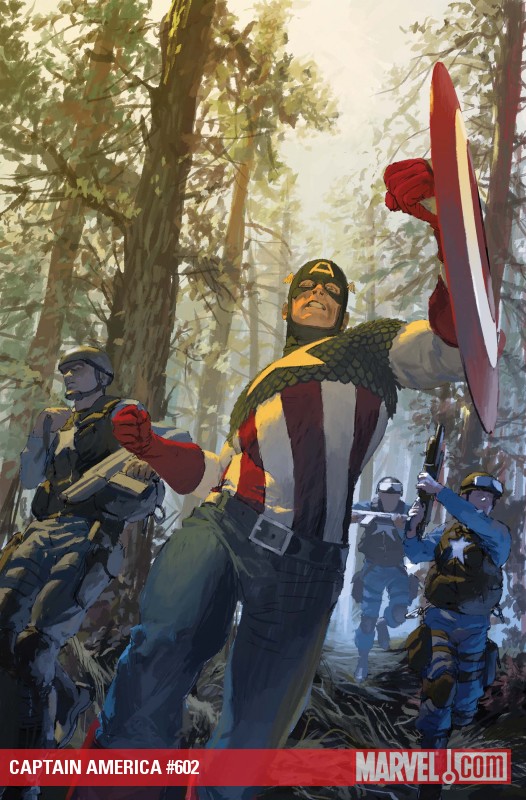
You can tell why I'm excited, right? With issue #602, CAPTAIN AMERICA IS BACK- and I don't mean Steve Rogers- I mean his comic book. Reborn has come and gone (ok, not really, but it's supposed to be over), so we get to go back to reading the adventures of Captain America. I was pretty happy with the end result of Who Will Wield The Shield?, so seeing Ed Brubaker get back to telling the sort of relatively down to earth Cap stories that I've become so fond of is, well, kind of like a really cool Independence Day present (or something). Anyway, the tale looks to be the best sort of Captain America tale; the kind that's about what it means to wear the Flag, what it means to represent America. This is exactly the kind of story I'm a sucker for- and I'm ready for them to be back.

I'm trying to decide whether or not I want to pony up for Dark Avengers #13. I want to get the full picture of Siege and, while I'm not made of money, buying the books that Bendis is writing (along with those titles I would buy anyway, like Thor) will probably give me the best idea of what he thinks I need to see- it is his story, after all.

With that said, Incredible Hercules #140, Uncanny X-Men #520, Starman #81, Joe the Barbarian #1 and Fables #92 are all definite pick ups. A couple of notes on the last three: 1) I haven't been reading Blackest Night, but it's hard for me to pass up on an issue of Starman, even if I'm not sure it really counts, 2) Grant Morrison is writing Joe the Barbarian, which makes it automatic pick-up (this puts the Scottish Scribe in some very exclusive company) and 3) a Fables story about baseball and murder? What could be bad?