Showing posts with label 'trade waiting'. Show all posts

Wednesday's New Things: Justice Isn't Blind, It's a Seven Foot Tall Green Lawyer!


1. This new She-Hulk comic was announced so long ago that I forgot I was waiting for it! Seeing it on the shelves this week will be very exciting. Written by up-and-comer Charles Soule and drawn by the very talented Javier Pulido, you might call this the Hawkeyeing of Jennifer Walters. The truth is that I'm not sure that this book will have that book's appeal; Soule is much less of a known quality than Matt Fraction, Pulido isn't quite the artist that David Aja is, although presumably he draws more quickly, and the main character didn't just appear in the most successful superhero movie of all time. Hopefully, potential readers will see past all that, and the character's dated branding; between what appears to be an honest attempt at a comic book starring a female character, Soule's ability, as a practicing lawyer, to lend credibility to the writing, and Pulido's always welcome retro style, this all new She-Hulk could be both very good and deeply important. I can't find a lettered preview, but you can take a peek at Pulido's unusually spacious art here

2. I love the idea of The Mercenary Sea. I mean, the solicit, though vague, just drips with potential: "Action and adventure set in 1938—The South Seas. Japan has invaded China. War in Europe is imminent. Ex-bootlegger Jack Harper captains The Venture, a refitted German U-Boat, with a crew of expats, mercenaries and treasure hunters. They do whatever it takes to stay afloat, often running up against pirates, headhunters, spies, and soldiers. They’re always one step away from the greatest score of their lives...or their certain demise." The rub, though, is in the preview: leaving aside the dialogue, which somehow seems both over- and underwritten, the art seems indebted to the style of the excellent FX cartoon spy show Archer. That kind of broad stroke and colorist driven depth works on television much more than it works here; when you're not distracted by the fact that the lines are moving, they just seem stiff and imprecise. Some of the silhouette work on the third page of the preview seems to avoid these problems, but, although those panels are ok on their own, they're a snoozefest when taken together. 

3. Last week in this space, I wrote about the calculations I make when deciding whether or not to trade wait. In general, I tend to wait for miniseries; moreso than traditional serials, which are often themselves confused about whether or not they are better read in individual issues or trade paperbacks, minis, 99 times out of 100, read better when they're collected. In part, this is because the good mini is so rare; I expect that the vast majority are event tie in comics. Most everything else gets published as a graphic novel, with a few exceptions (Phongram, the initial publishing strategy of Fatale, Casanova, etc). This one, though, ties into to both the fact that CAPTAIN AMERICA: THE WINTER SOLDIER hits movie screens in early April and to a storyline currently being set up in Rick Remender's Captain America. By and large, Remender has attempted to stay out of Ed Brubaker's long shadow by avoiding espionage as a theme; unfortunately for him, that's the great genre of the Marvel comic book from the last ten years. It's also the only context in which a Winter Soldier solo comic book really makes any sense. With the movie imminent, Remender is stuck. Given how hit and miss his writing always is, it doesn't really make sense to trade wait this comic book; I want to read it now, I doubt I'll want to return to it later. I don't know what's up with Marvel and unlettered preview, but check out Roland Boschi's serviceable, if not great, art here.

Coming Soon To A Spinner Rack Near You: Sandman Overture


My resolve to trade wait Sandman: Overture is eroding quickly. 

The Transmogrification of The Indie Comic-Book into The Indie Graphic Novel (Series)

Jason Lutes' "Berlin" has been coming out since 1996 in a slim 30-page saddle-stitched format (that's just fancy talk for: it's a comic-book). But things have changed since 1996. Are "Berlin" and Adrian Tomine's "Optic Nerve" the last of the great indie comic-books?

Chris Ware's "Acme Novelty Library" became a hardcover graphic novel series when Ware began self-publishing the title at issue #16. Los Bros Hernandez' "Love and Rockets" became an annual paperback graphic novel with restarted numbering under the title "New Stories" in 2oo8. Finally, Seth's "Palookaville" jumped ship this year: with "Palookaville" issue #20, the series is now 'hardcover graphic novel volume' #20.

"Acme Novelty Library" changed formats like most people change their clothes but "Palookaville" now exists as nineteen comic-books and one graphic novel-ish thing. Seth is to be congratulated in at least one way: "Palookaville" Vol. 20 is a pretty gorgeous book object but doubts linger in the forefront of my mind.
"The expansion into hardcover from pamphlet is a parallel that illustrates Seth's growth ... into a book designer, hobbyist, editor, essayist, and installation artist."
~ "Palookaville" #20 (marketing writing on the book-band)
A slightly different tune from Seth himself (a slog of text yes, but worth it):

"It's not like I wasn't aware that the comic book format was coming to an end. A shift had occurred (this last decade) in the sales of comic books and people simply weren't buying 'alternative' comic books any longer-- they were waiting for the book collections instead. Books were the current 'healthy business model.' ... I was torn. I have a deep and abiding love of the old pamphlet form of comics. I grew up with them, and it is the most simple, austere and unpretentious format you could invent. ...

all the great alternative comics were gone ... Hate, Yummy Fur, Eightball, Yahoo, Dirty Plotte, Peepshow, Jim/Frank... they'd all vanished. Even Love and Rockets had turned into a large squarebound book. Only Optic Nerve seemed to be strongly carrying on. I hadn't truly realized how much of a dying breed we were. Was I leaving now too? It seemed a minor betrayal of something to quit the format. ...

It's difficult to do a long story all at once and putting it out a bit at a time was a method that worked for me. There was an era when the comics reader was more willing to go along with this approach ... Then they'd buy the book collection as well. I appreciated that too. I guess that day is done. ...

In fact, the less constrained page count would actually allow me to present larger chunks of the long story as well. ... I suspect that this format change itself will influence how my next long story is told. ... So, goodbye, comic book format. It was good to know you. I leave you with no regrets."
~ Seth from "Palookaville" #20: Introduction

So where does the 'comic-book' end and the 'graphic novel' begin? Well, somewhere in the middle of the 'graphic novella' I guess? At over 100 pages? Other than that I'll be damned if I know anymore.

Alan Moore and Melinda Gebbie's "Lost Girls" was an indie comic-book slowly released over several years. The series was canceled and eventually finished when published as a bound book set and then a single volume "graphic novel". If the only way to get the entire story is to buy the trade, does that lend credence to the concept of a serialized graphic novel?

"I suspect that this format change itself will influence how my next long story is told." Of course it will. If I gave anyone alive one page a day to write something, the writing would be different than if I gave them 100 pages at once. Artists, like all humans, are adaptable. They expand or truncate to fit the space they're given. This affects the way these stories are told and if ALL indie creators switch over like this I fear we will begin to see an English-language paper-marketplace with very similar comics. I am working on a review of "Berlin" #17. Will my review of "Berlin" #18 (in 2o13 or whenever) be of a hardcover book? In which case, webcomics-in-print may become the new go-to source for a variety for voices who wish to do something in short formats without a superhero in it (not that there's anything wrong if there is) at a comics shop or box chain bookstore. Truth is: webcomics already rival the indie comics in that regard. Turn on your computer, type "recommended webcomics" into Google and you may be amazed at what you find.

But should not the talented creators of limited financial means be also given credit for surmountting the problem Seth clearly stated: "It's difficult to do a long story all at once"? As a creator of limited financial means (who believes himself to be talented) I myself know that to be true. Time, food, money. These are troubling obstacles to sitting at a computer/typewriter/drawing board/lightbox all day long. I believe those who do so, indie or otherwise, without immediate recompense and publish their hard-fought work all at once, are creators who deserve the term graphic novel.

In the end, I have little doubt that just as digital comics will take off, people will find a use for paper comics; so too, as the ongoing graphic novel series becomes more common, people will find a use (most likely an entirely original and unexpected one) for the comic-book.

Here's looking forward to whatever that may be.

~@JonGorga

Digital Comics Part 3: Threat or Menace?

Okay. So I've talked about comics made FOR the internet put on the internet, i.e. webcomics, and the creativity they display in Part 1.

I've talked about comics made for print delivered THROUGH the internet by official channels: Digital Comics Unlimited, Wowio, Eagle Media and so on as well as the aesthetics of their presentation in Part 2.

But let's talk about pirates. (Arrr.) Then we'll talk about the positive implications of all this.

For quite a few years, people all over the world have been spending some of their free time scanning printed comics page-by-page into their computers with an optical scanner and then combining those image files into one 'zipped' file which merely retains the images and their correct reading order. Those files can in turn be read by specially designed programs that present two images at a time to imitate the recto-verso page-turn of printed comic-books and graphic novels. If you access any large P2P sharing network with one of the programs designed to do so like DC++ or Shakespeer and do a search for any popular comic-book series by name, you will most likely find a surprising number of these files. Then if you download one of the programs designed to read them like ComicBookLover or CDisplay all you've got to do is drag one of those zipped CBR files into one of these reader programs and you are bada-bing reading what is probably an illegally scanned-and-uploaded print comic for free. Nothing about the program is illegal, it functions just like iTunes used to (i.e. with no internet-ready iTunes Store function).

There is also a legal source of scanned print comics files. Marvel Comics and a few other companies (including Archie Comics!) released CD-ROM and DVD-ROM packages with a company called Graphic Imaging Technology INC. with tons and tons of scanned comics in PDF format. (Wikipedia has a list of these CD-ROMs.)

The most exciting of those, to me, were the ones which collected all the comics in a particular crossover 'event'. If you've read my old rant about the way these stories are collected, you'd understand. Marvel produced a "House of M" The Complete Collection Collector's Edition CD-ROM as well as "Civil War" The Complete Collection DVD-ROM. I'd try these out if they weren't so bloody expensive. Especially since Marvel unveiled Digital Comics Unlimited and discontinued these sets in 2007. This might actually be the best way to experience these highly splintered stories. Buying something in the neighborhood of 100+ comics to fully understand one big story is a pain in the neck!

This is why we most need an 'iTunes for comics.' I did receive one of these type of sets as a Christmas present. I'd like to be able to read those files on whatever I'm reading my comics on.

(The question that leaves is: Where the hell is DC Comics in all of this? Archie Comics can be bought digitally in two formats and DC/Warner Bros. does nothing? Perhaps the company that brought us the first comic-book with new material, the first superhero, and the first corporate webcomics site is biding its time to wait for the right solution to the entire digital conundrum and slap all the competition upside the head. Who knows?)

Of course like I said in Part 2, Marvel doesn't put out its brand new comics in digital form either in their old boxed DVD-ROM sets or on Marvel Digital Comics Unlimited or on Panelfly/the Marvel Comics app. They seem to have an unwritten six-months-or-older-only rule. They're protecting their interests. But that will only last as long as there is a sizable interest to protect. And the digital pirates get an entire new-comics-Wednesday's material worth of comics on the net for illegal download in a matter of hours anyway. Anyone in the world can read pretty nearly every single comic ever published for free. Illegally.

So will digital comics replace print comics?

The short answer is: Yes they will, but not anytime soon.

It was pointed out that I wasn't very specific in Part 2 of this article series. I should have written: as academics and creators, we should be prepared because comics will be largely digital within our lifetimes. As artforms move into the digital format, the relationship of dependence between the art-concept and the art-object (vinyl/plastic, paper/vellum) changes. A huge amount of music is available for download on iTunes. Prose of all kinds is available on the Kindle. And newspapers are moving digital, of course they really, really should as there's very little about their product that is dependent on visuals and even less that is dependent on layout. But a newspaper has images and a layout. A comic is images and layout. It may be a 'book layout' instead of a 'page layout', but it's still about organizing visuals into a sequence.

Comics = Sequential Art
Sequential Art = Art + Sequence
Comics = Images + Layout

You take away either of those elements? You no longer have comics. Moving comics into digital files is very problematic for this reason, among others. But these are formal concerns and not financial ones.

Let's talk about money.

Clare's father K. J. pointed this out to me: consider music. Only sixty years ago music first became available for affordable mass-consumption on Long Playing records, i.e. LPs. Forty years ago music became available on 8-Track. Wasn't a disaster, but didn't last. Lower quality and slightly higher convenience. Twenty years ago came the Compact Disc, i.e. CDs. Lower quality (compared to LP), but higher convenience. Ten years ago music became illegally available on Napster and the Recording Industry had a conniption in their general direction. Today music is available for download from various sources legally. Again at lower quality (when compared to LP), but with extreme convenience. Now iTunes is the #1 source of music, but CDs are slipping from the #2 spot. Vinyl outsells CDs in some markets, collectors and audiophiles want them more than ever. It's a niche market. I buy very, very little music: but I pretty much buy only vinyl. There are many collector edition LPs. There is an annual Record Store Day. Convenience and quality, right?

I can see a world that wouldn't be so horrible:
My comic arrives in my digital device. Maybe it is a 'comic-book' with multiple 'pages'. Maybe it is a 'comic-strip' with a single 'page' that I scroll smoothly through for a good hour. I read it on the same device I used to buy it with a credit card number, on which I can buy comics made by people from all over the world. I review and discuss it online when I'm done. I have a digital 'subscription' with a list of preferences which can be changed instantaneously. ('Would you like to subscribe to the new upcoming superhero crossover event: only the main title, all the tie-ins, or continue with your subscriptions as they are, sir?' 'Would you like to be alerted about new comics by this artist, sir?') I can read old files. Maybe I have pre-sets as to how I want to see panels, pages, splash-pages, balloons and in what order. Maybe if I really, really loved seven random issues, I follow a few links and pay again to buy a nicely printed trade-paperback collection to MY specifications. Maybe if I really liked a mini-series I wait a few months and then shell out big-bucks for the glossy hardcover at a bi-annual 'Comic-Book Store Day' where I meet some real people and have a nice time.

There is, in fact, already an annual Free Comic Book Day to be held this very Saturday May 1st! Its main goal is to drive people into comic-book stores. Go take advantage of the fact that many, many publishers will be putting out a free non-digital old-school print comic on Saturday!

There will still be people who will buy books and comic-books and vinyl for a long, long time. People will probably buy the things they want to keep forever in physical form. In the words of my friend Aaron LeBow: "a book can't get a virus". But we as a culture read/hear/watch a huge amount of stuff every day! In a complimenting sort of counter-point my friend David Bustlin is planning to go digital with his comics as soon as possible for very practical reasons: freeing-up closet space and reducing paper waste.

If we combine the physical promotion of Free Comic Book Day with: ComicBookLover
(Which is like iTunes, the program. Easy, flexible, and compatible with all kinds of image files.)

and with: Panelfly
(Which is like iTunes, the online store. Simple, inexpensive, and compatible with all kinds of publishers.)

Get it on ALL your digital devices, make it CUSTOMIZABLE...
And maybe we've really got something exciting there.

There is only one thing that can be said with definitiveness: Print comics will continue to be made as long as publishers continue to perceive it as a solvent business and as long as individuals continue to find comics challenging and exciting to work in. And digital comics (of all kinds) will continue to be produced/made available as long as publishers continue to percieve it as a solvent business and as long as individuals continue to find comics challenging and exciting to work in.

Like J. Jonah Jameson, the long-time persecutor of Spider-Man, you can choose to frame the question as: "Threat or Menace?" or you can choose to ask: "What can digital comics do for me?"

Simple as that.

UPDATE 5/7/2o1o: Apparently the days of the comics scanning pirate may one day come to a close: A press release can be read here about the recent joint effort of the F.B.I., a law firm specializing in intellectual property, the U.S. Department of Justice, and a coalition of comics publishers including Marvel Comics, DC Comics, Dark Horse Comics, Bongo Comics, Archie Comics, Conan Properties LLC, and Mirage Studios Inc. in the seizure of the servers propping up htmlcomics.com, one of the websites hosting scanned-and-uploaded comics.

Be wary pirates. Be wary.

UPDATE 5/8/2o1o: Marvel publicized here a long while ago about the various formats and devices its comics were becoming available on. The problem is all three of these devices use separate formats meaning none of these programs can swap files. Not very convenient.

Why I Trade Wait (Sometimes)

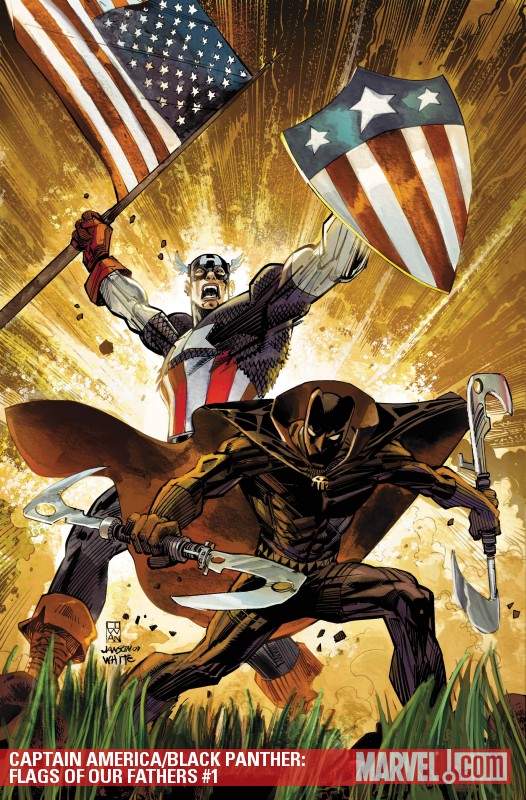
This looks AWESOME.

I dig the title (Flags of our Fathers), I like the writing in the preview, I like the Denys Cowan art in the preview, and I'm a sucker for World War II stories... particularly those featuring Captain America and The Howling Commandos.

This is a comic book that I want.

But... 22 pages of story for $3.99 is a tough sell and this is why some people, myself included, have a tendency to trade wait for books like this.

The series is four issues long, so that's sixteen dollars for 88 pages (which, ratios being what they are, is the same 5.5 page/dollar ratio as the book). Now, it's possible that they'll release it as an even more expensive hardcover first, but if I'm waiting I can wait for the trade and here's why:

If I wait for the trade, the most it'll cost me is $15 dollars- and, because the page count is so low, I expect it will be less, even cheaper if I track it down on Amazon. The ratio continues to get lower and lower if I'm willing to wait a couple of months.

This is why people trade wait- because comics are expensive, and trades are, quite simply, a lot cheaper. Contra Jon's objections (and, for the most part, I agree with them, which is why I buy most of my books on a monthly basis), trades allow for comic book readers to consume many more panels for a much, much lower price. This is also true of most $3 dollar books, like the first volume of Chew, for instance (which includes the series' first five issues and costs $9.99, which is hella savings), or, as is more common, like the first volume of Thor ($14.99 for six issues, and much cheaper on Amazon). Even in the latter case, waiting for the trade is the price of a comic book. If I'm willing to wait for some series I want to read (Chew, for instance) I save myself several books worth of money. If the move to $4 books continues, I think I'm going to trade wait more and more.

Again, this is not to say I disagree with Jon; in fact I think most of the comic-buying audience continues to prefer the single-issues, except in cases when they come to a series, writer or artist late in the game (which, I suspect, was the original purpose of the collections). This is, I suspect, because there's something compelling about a pamphlet, something beautiful and something worth keeping. There's a tension, though, because saving money (and, in particular saving money in such a way that it helps me buy more comics) is also compelling. The future of the comics industry is going to be in finding the balance, if we haven't already found it.

"Luke Cage Noir" was really, really good.

"Luke Cage Noir" #4 from Marvel Comics

So...

I know this is very strange, but I'm going to do it: I'm not going to tell you anything specific about the last issue of this mini-series. Honestly, I feel that in my past posts I have already said too much. The twists in this last issue are very, very good and to describe why I loved this issue would be to ruin it for all of you.

I have had my copies of "Luke Cage Noir" #1, 2, 3, and 4 on the desk for a few weeks now, pondering the best way to do a retrospective post about the mini-series. The problem is that I've already written so much in my reviews of issue #2 and issue #3 that heaping on more would ruin the surprises that made this series wonderful. I considered doing a historical analysis of portrayals of black superheroes or something but that's really not the point of a review and I already wrote a paper that covered that when I was still in high school. (Plus "Luke Cage Noir"-artist Shawn Martinbrough is talking all over the net about an exhibit at the Studio Museum Harlem about the different incarnations of Luke Cage. It may or may not have already been held... There's nothing about it on their website.)

THE LONG AND SHORTBOX OF IT?
The last issue contains one awful moment of absurd, over-the-top, bloody hyper-violence.
Just to let you know.
BUT:
The last issue has several fantastic twists.
The last issue has many wonderful emotional moments.
The last issue is as good as, if not better than, the others.

The series is entirely wrapped up and thus would probably read equally well as a mini or as a trade. Of course, you can find the individual issues right now and the trade isn't supposed to be out 'till March...

Go. Go buy them.


UPDATE:

The exhibit I mentioned above eventually did occur and I covered it for the blog here.

A "Testament" to Art in the Face of Death

A few years ago, after the sudden lunge Marvel Comics made to capitalize on the upcoming Fox Studios X-Men movie "X-Men: Last Stand" and their soon to be announced prequels "X-Men Origins: Magneto" and "X-Men Origins: Wolverine" (one of which got made and one of which didn't) a very special project was started.

It wasn't "Wolverine Origins" and it wasn't "X-Men: First Class" and it wasn't "X-Men: Origins". It was a five issue mini-series about one of their most central villain's origins.

I'll give you a few hints:

It was about the villain who appeared in the very first X-Men comic. (Pictured to the right.)

A character who never got his movie probably because Fox didn't want to do a movie about the Holocaust. Hitler's Final Solution. The genocide of six-million people. Whether Fox Studios (or Marvel Studios) may still someday make a film out of the shell of this project is yet to be determined.

It was written by Greg Pak, drawn by Italian comics artist Carmine Di Giandomenico, and edited by Marvel editor Warren Simons.

It was, of course, "X-Men: Magneto- Testament".

In 2008, almost as an aside from all those aforementioned "Origins" projects, both the comics and the films, Warren Simons began talking about the idea of a historical fiction project detailing the harrowing childhood of the character of Magneto before he became 'Magneto', even before he began calling himself Erik Lehnsherr. Greg Pak signed on as writer; he said: 'I knew from the start this was a project I had to do'. It seems that we should all be glad he did, since the book has earned a great deal of praise since its release.

I have, shamefully, yet to read all of "X-Men: Magneto- Testament". It was one of the rare occasions I chose to 'wait for the trade' and because I rarely pay attention to those releases, I never bought it. I now know a great deal about it because The Simon Wiesenthal Center (an organization devoted to keeping Holocaust studies alive) held a great event on December 8th at The Center For Tolerance here in NYC titled: "An Evening with the Author and Editor of X-Men: Magneto Testament". It was a fascinating presentation of the thought process, historical research, blood, sweat, ink, and tears, that went into the writing and production of "Magneto: Testament".

It was one of those really strange nights in which you just lean back and marvel at how two completely different spheres of interest can come together so perfectly. I didn't realize how little I knew about the Holocaust and about the character of Erik Magnus' involvement in it. I took World History II in high school and read Art Speigelman's "Maus" but it didn't cover the sonderkommando, prisoners drafted into helping the extermination process in return for better treatment for themselves and their families, or the deceptive signs convincing soon to be executed prisoners that they were about to take a shower. I'd read "X-Men" #1 and seen the X-Men films but I didn't know that Magneto had a child who died at a young age between his survival of the concentration camp at Auschwitz and the birth of his living twin children Wanda and Pietro or that it had been established years and years ago that the future supervillain was one of those sonderkommando at Auschwitz. Magneto (a.k.a. Magnus, a.k.a. Erik Lehnsherr, a.k.a. Xorn?) is revealed in "Testament" to have began life as Max Eisenhardt. The new name was chosen because it was discovered by way of their historical consultant with the Simon Wiesenthal Center that neither of the names Magneto had gone under until that point were truly Jewish, nor were they popular names for boys in Germany at that time.

Probably the most remarkable moment of the presentation came during the question and answer session at the end, when an older woman who hailed originally from Pak's native Texas told us that when she moved to New York City after high school (possibly it was even after college, I can't remember) she had never been told about the Holocaust at all. She personally thanked the writer and editor for creating a work of art that tells the story of what the average Jewish person underwent during WWII in a visual medium that often grabs the attention of children. To this Pak responded that it has been proven that different people learn best through different media and that is why it is worthwhile and important 'to tell these stories again and again'.

So these are some of the things I learned last week. Warren Simons (the editor; pictured to the left), Greg Pak (the writer; pictured to the right), and Mark Weitzman (the historical consultant; not pictured) gave us a wonderful conversation about the careful balancing act that had to be played between aggravating old-school Magneto fans and accidentally feeding the fires of the Holocaust deniers with any inaccuracies. The nightmare of scheduling something with subject matter requiring this delicate accuracy on a printing schedule for a major comic-book publisher sounds as if it would have tried the nerves of anybody. According to the two men, it was artist di Giandomenico (unfortunately not present at the talk) who most kept them on track, in the words of Simons: 'He never missed a day'.

December 8th was an eye-opening and fascinating evening and I wouldn't be surprised if the Wiesenthal Center's other programming is equally interesting.

P.S. ~
There is, by the way, an excellent essay available online here detailing Magneto's life as seen in the comics published up to that time and classifying him as a sufferer of Bipolar Disorder and Post Traumatic Stress Disorder. Think about that.

P.P.S. ~
I was told about the event at the Wiesenthal Center by my good friend and fellow member of the blogosphere (and consummate Jew!) Matt Rosza. (He blogs about things that cross his brain at: Risking Hemlock. Although comics are not the driving force of his interests, they do intersect with the world of history/politics in surprising ways, like in this post about the photoshopped image super-imposing the scars and make-up from "The Dark Knight" version of the Joker over the face of Barack Obama. Check the blog out.)

Gorga's Looking Forward to Wednesday 12/16/2oo9

I'ma lookin' forward tah:

"Amazing Spider-Man" #615 (definitely)
Well... someday I'll read this series instead of just buy them and plan to read them. I still need to read #602.

"Ex Machina" #47 (definitely)
I'm not going to NOT read this. The last issues of this series (we're leading up to the final one, #50) have to go out with a bang.

"Cowboy Ninja Viking" #3 (probably)
Jeez read that solicit. How can I not buy this? It is my intention to re-read the first issue with the understanding that it is a comedy and then review it for this site. Then buy and read #2.

Huh.

"X-Factor" #200 (maybe)
THIS looks interesting.

"Cable" #21 (maybe)
I must admit the idea that Marvel is doing an X-Men crossover event named "Second Coming" about the red-haired baby-girl who was the first mutant born since the events of the "House of M" crossover returning to the present after escaping to the future and becoming a fully-grown lady is... remarkable. For many reasons.

Hey, I'm a sucker for alternate past world stories. Read the preview pages. See what I mean. So cool!

NOTE: The collected paperback edition of "The Life and Times of Savior 28" is solicited to come out this week (earlier than we'd gotten word previously). Although I almost certainly won't be buying this since I have all five issues of the mini-series, I highly recommend the series to all fans of superhero comics. If you 'waited for trade' on this one, you really, really should stick to your guns now.

Well, that's all he wrote.... for now! Be sure to check back in this space to see what I buy!


UPDATE: 12/20/2oo9

Once AGAIN this week some comics could simply not be located: "Chimichanga" #1 and "Cowboy Ninja Viking" #3 are either delayed or got lost in a shipment or something.

Cap Reborn #4 didn't look very good. The preview pages are kind of misleading and... dammit, I don't care about this series anymore. We'll have to see how the last issue is.

"X-Factor" #200 turned out to be an expensive book with a lot of reprints in the back. Short story, bunch of pages of reprints, 5 bucks. Does not compute.

Seeing "The Brave and the Bold" #30 on Josh's pull-list made me curious and when I flipped though it I decided it looked awesome and so I picked it up. It is wonderful.

"Cable" #21 was surprisingly good and you will probably see a review of it from me in the coming weeks.

You will definitely see a review of "Ex Machina" #47 from me soon.

And I picked up Amazing Spidey #615. No surprise there.

Earth One... For the First Time All Over Again?

DC is going to be up to some crazy tricks next year.

DC announced their new "Earth One" project this morning.


So: Who wants to see a new comic about Batman becoming Batman? Again.
I'm not sure I do.

But: Who wants to see new stories about established superhero characters in the full-length graphic novel format?
That I'm pretty sure I do.

Apparently the first of these graphic novels (fittingly featuring the first superhero character) will be "Superman: Earth One" and will be written by the excellent J. Michael Straczynski and drawn by Shane Davis (whom I've never heard of but, if this Superman image is any real indication of his work, he'll be welcome in my brain) and will soon be followed by "Batman: Earth One" by drum rolllllll... Geoff Johns and Gary Frank!

(from DC: The Source blog, via the "Comics Books" program wall)


I have been saying for years now that the future of superhero comics could be in graphic novels.

Sci-Fi books and films gained huge readership and slowly got established as a part of the cultural canon where Sci-Fi television never did.
Superhero films have pretty insane box office clout these days where superhero comics are being ignored by comparison.
Graphic novels are becoming the darling of 'literary' types where comic-books are left by the way-side (most obscenely in the occasions where the story was serialized as a comic-book before it was a collected trade-paperback).

See, people are doing this silly thing called 'trade waiting'. We'll hear more about this later, but basically it's the comics equivalent of 'Who has time for television? I'll wait for the DVD season set.' (Which, by the way, I do. Television is much harder to follow for me than monthly comics.) They don't pick up the monthly individual issues of an ongoing comic-book, they instead wait six months or more for the paperback collection. People like the feeling that they've gotten their money's worth, that they can hold a meaty consumer item, something that looks nice on a shelf. I'm as guilty of that as anyone. Although I have rarely, rarely, rarely waited for the trade on an ongoing series, I certainly feel the pull. I did twice decide to wait for a trade of a mini-series and I have bought paperbacks of stories I already owned entirely in single issues. Some series are built for it and some aren't.

I do believe there is a certain weight, a certain power, to complete 'full-length' works of art.

I think the film "Citizen Kane", the novel "Invisible Man", and the graphic novel "Arkham Asylum: A Serious House on Serious Earth" attest to this.

Do I think they're actually categorically BETTER than short-form serial fiction? No. Do I think it's right to squish a random chunk of short-form serial fiction together and pretend it's a complete single work? HELL NO. I think that's a mess. I've written to that effect elsewhere on this site.

This is not the first effort to do graphic novels with established superhero characters. The excellent "Arkham Asylum: A Serious House on Serious Earth" stands as proof. What the "Earth One" graphic novel project might signify is a shift toward graphic novel series, i.e. long-form serial fiction. Something more like the James Bond films. Okay. Maybe that's a bad example?

When Straczynski was asked in this interview on Ain't It Cool News conducted by columnist "Ambush Bug" with both writers Straczynski and Johns what he thinks of this possibility, his answer is wonderful:

BUG: The graphic novel format has been a preferred reading experience for a growing number of fans. Trade-waiting is a pretty common term I hear thrown around these days. What do you think; does the release of such a high profile product in a graphic novel format signify the end of the monthly single issues?

JMS Not at all. It's like saying that the production of movies signifies the end of dramatic series TV. Each serves a different need, and fills a different niche. If there's anything that is signified by trade-waiting, it's that we need to write better stories. If a reader can wait until it's all done to buy it, then we're not doing our jobs right. We should be writing stories that the reader can't wait to buy as soon as the next installment hits the stands, and then at the end, wants to gather together for ease of re-reading. If a reader can wait it out, then we as creators need to re-evaluate our work. Seriously.

And here's the more optimistic side of the coin from Johns:

BUG: Apart from event books and maybe the occasional guest appearance or team book appearance, this is the first time I recall you doing a Bat book. What was it about this project that finally attracted you to Gotham?

GJ: Three words: “Gary Frank” and “freedom.” Obviously, I love long form storytelling. ... BATMAN: EARTH ONE allows Gary and I to break the restraints of any continuity and focus on two things: character and story. Add to that the idea of working on a line of graphic novels instead of being limited to twenty-two pages, it’s a challenge and I love a challenge.

Sounds good to me.

The Life and Times (and Death) of a Savior

I bought "The Life and Times of Savior 28" #5 (from IDW Comics) two months back and, as I'd gotten used to over the previous issues of this mini-series, I got something much more than the average smart superhero story.

I got something beautiful.


This review of "The Life and Times of Savior 28" #5 is long overdue, yes. But J.M. DeMatteis' and Mike Cavallaro's remarkable mini-series deserves more praise and a more critical exploration than I have seen it receive.

Alan Moore has stated that when he was writing the "Watchmen" mini-series, he really felt like it was going to be the end of the superhero genre. He thought that as far as he was concerned once he'd shown that the ultimate expression of Superman had to be either detached from humanity or devoted to destroying the few to save the many and the ultimate expression of Batman would either be a non-functioning psycho or an all-too human man-child the superhero genre would be dead. "Watchmen" was to be its tombstone. How naive of him.

The truth, as things turned out, is that people loved "Watchmen" so much (and indeed loved the psychopathic Rorschach most of all) that the genre was rejuvenated as a place where characters could be seen somewhat realistically destroying each other mentally and physically on a monthly basis. Superhero comics are still for children... except they also have to be violent enough that adults will take them seriously. Superhero comics have to be lighthearted enough that children will find them exciting and hopeful... except again they also have to be grounded enough that adults take them seriously. Paul Levitz, the until-just-recently Publisher of DC Comics, said in the 2003 documentary "Comic Book Superheroes Unmasked": "We point out, with some passion and energy, that comics not only aren't only for kids, they're not mostly for kids today." And, on the subject of "Watchmen", "Most of the guys in comics live within about fifty miles of here, so we were all at the same poker-games and the same parties. And it was just: 'Wow, how the hell did he [Moore] do that?' and you went home and you ripped up whatever you had done that week and just said 'No, dammit. There's more I can do.' " As well as the glorious general statement: "Comic-book writers and artists are doing the same thing the storytellers did drawing pictures on the caves at Lascaux. We're using story to create context for life. On a very, very good day (and we don't have enough of them) that becomes art, on an ordinary day it becomes escape. It's always magic."

(Yeah. If you haven't watched that documentary yet, you should.)

So the superhero fiction writer of today must ask himself this archetypal question: To continue the fight month after month or try to do something more?

The main character of "The Life and Times of Savior 28" is cracking under this exact pressure. Savior 28 a.k.a. James Smith (the most fantastically everyman secret I.D. name I'VE ever heard) is a character who doesn't know who he is anymore in the wake of the September 11th attacks. Like many Americans. Like the superhero genre itself.

I don't think any of us truly appreciate our superheroes. Despite the millions they rake in at the box office, they still seem to be a cultural joke in most people's eyes. That's the beauty of "Watchmen", it didn't take its characters for granted. And that's the main reason I can't stop thinking of "The Life and Times of Savior 28" as the new "Watchmen", because it doesn't either. And you, also, will no longer be able to take your superheroes for granted after you read the end of the first issue of "Savior 28". Because to watch a superhuman character lose the woman he'd loved, and drown the pain in alcohol, only to wake up on September 12th, 2oo1 and see the epitome of failure in his eyes? That's pain. Anguish, even. For James Smith and for the reader. What does James Smith do? The invulnerable super-powered flying man of the title?

He opens another bottle of scotch.

His next reaction? Suicide attempts.

Plural, of course. He's superhuman.

Mike Cavallaro's art is key to the evocation of pain in these scenes. James Smith's face changes in each panel into a new mask of horror. (Really. Click on this image, make it as big as you can get it and look at each panel. Distinctive expression of pain on each face in each image.) His smooth, almost cartoony line allows the character to fool our senses for a moment every time he appears in one of many too-horrible-for-words moments.

This is actually the first page of "The Life and Times of Savior 28" art I ever saw. It's the first page of the second issue. It sold me on buying the issue pretty much immediately. The following 21 pages sold me on the whole series.

Even though that was my introduction to the series, I don't think I'd recommend you read it that way. The series' writer and concept originator J.M. DeMatteis had something in mind in the structure of the mini-series. Is it as structured as "Watchmen"'s plot? No. Each issue doesn't have a unique arc and structure, but they do have their own themes: #1 and #2 are about the history of the superhero and the history of the 'real world', respectively. That's why the first issue is titled "A Kind of Eulogy". The third issue is about the superhero as celebrity/political figure. The media and political pundits of the 'real world' are featured. Hence, "The Whole World Is Watching". The fourth focuses on the Oedipal Complex exhibited by most superhero characters (albeit with a role reversal) and the fifth (titled "In Pace Requiescat") is about the superhero as (finally!) savior. The main thematic elements of superhero narratives are on display here: history (mainly, their own), social/political relevancy, Freudian/Oedipal tension, and religion.

Is this a definite and clear structure? Hell no. There are bits of every theme in each issue. Plus I just made half of that stuff up! I'm an academic folks, what can I say? But, this is part of my point. "The Life and Times of Savior 28" is not 'the "Watchmen" of our generation'. Such a title would be pretty damn meaningless anyway. It feels in a few ways, to this reviewer at least, like a kind of anti-"Watchmen". An antidote to ultra-realistic, ultra-violent, ultra-structured superhero comics. A silky-smooth-line-drawn, tastefully intense, organic superhero comic that examines and comments on superhero comics.

The final issue does not disappoint. The entire mini-series is framed as the memoir of Savior 28's former sidekick, Dennis McNulty, and the story reaches an emotional and absolutely fitting conclusion for both Savior 28 and his 'biographer'. I couldn't stop myself from reading this as soon as it was in my possession. The story hit home emotionally as I read it standing in a falafel shop. It is finally, at the end, so sad. Cavallaro's smart splash-page storytelling techniques are in full force here. But the real crescendo of the piece is a single page of twelve small panels in which almost the entirety of the series is silently summarized and as we see Savior 28's and Dennis McNulty's lives meet and intertwine and separate and end all on one page... it hurts. Everything that Paul Levitz said about comics is reflected in that one page, as well as in the last issue, as well as in the entirety of the series.

"The Life and Times of Savior 28" is a particularly smart and particularly beautiful exegesis of superhero narratives because it makes it clear that our superheroes can be saviors if, just like REAL people, they choose to sacrifice something REAL. Is it child-appropriate? Not really, no. As evidenced by the nine panel-grid page above and the splash-page at left. (If you want a great kid-appropriate comic, you must check out Clare's editorial here.)

I believe the mini-series "The Life and Times of Savior 28" reconciles much of the problems facing most superhero comics (and their writers...) coming out today.

Read it. A trade paperback collection has been solicited for January. For my money, you want to read the five 22-page issues to really get a feeling for their individual themes and rising energy. But I'm crazy. Just read it.

More Twenties Action North of 125th Street!

"Luke Cage: Noir" #3 of 4 from Marvel Comics

This issue re-kindled and re-affirmed my love for this series. The 'villains' (such as they are) took a quick backseat to the character-driven story elements. As it should be. (Indeed, the two have been merged as we now see in flashback that all three of the introduced villains were present at the defining moment of Luke's life.) Martinbrough's art continues to be gorgeous, while built on clear and subtle story-telling. And it's badass.

I have been saying for years (and I'm sure I'm not alone; nor am I original in this, goes back to Aristotle I think) that a good work of art should be made up of good parts, a balance between each of those having autonomy and each being merely parts of the whole. A good movie should have scenes that should fly by themselves as good short films and a good comic should have pages that should fly by themselves as good one-pagers. This issue was full of them.

(Check out this great scene in which Luke sets a trap for his childhood-friend turned greedy mob boss out to kill him. Stryker is too late to stop his henchman from striking a match after he sees the literal 'writing on the wall' and the gas-lamp.)

It's also been a great deal of fun for me as a recently minted New Yorker to see all the references to New York City locales and borders. So "downtown" to a black man in the Nineteen-Twenties would of course be "south of 125th street", i.e. below the lowest street in Harlem. The land of the "offay", the white man.

But maybe the best part? The flashbacks are coming together fairly well! Finally! We can now see a chronology of the story. And it's awesome. We now see that the populace of Harlem's belief in Luke Cage's invulnerability may be greatly mistaken... or is it? We still have yet to see Luke take a bullet straight on. (Excepting the first issue's exciting cover, an image not strictly part of the story.)

If you're a Marvel fan, you know what the answer to that question is probably going to be based on the superpowers of the main 616 continuity version of the character running around since 1972, but I'm not sure that in this new NOIR version of the Marvel universe, Mike Benson and Adam Glass might not be going for something different. The fourth issue will tell, I'm sure, and I can't wait! I'm really enjoying this.

The end left a bit to be desired. It looks like we're taking another bit of a left turn, but I thought that about the end of the first issue and enjoyed the second one nonetheless.

THE LONG AND SHORTBOX OF IT?
This series is going from great to excellent before my eyes! Although, I'm saddened at the realization that this may read better as a 'serialized graphic novel' than a mini-series. A minor distinction, yes. But basically it means I may not be able to stop myself from buying it again in hardcover... And the mini-series is a dying breed.

Still, it's worth your money.

Already Tired of, uh, Monday....

I know I'm way early this week, but I'm procrastinating on a paper, and this seemed like a perfect way to do it. Also, there's a lot of really great stuff coming out this week, stuff I'm really excited for.

First, and foremost (perhaps even foremost of any comic being released this year) is the grand finale of one of the greatest comic stories of all time- Planetary. The long awaited issue #27 of the Warren Ellis penned and John Cassaday illustrated series comes out this week and I'm really, really excited. If you haven't already checked out the preview pages Jon posted about earlier in the week, well, you should. They're pretty fantastic, as is the rest of the series.

And that's just the start of the barrage of the comics on the imprint front this week. From Vertigo we get the second issue of Jeff Lemire's fantastic Sweet Tooth and the Bill Willingham penned Fables novel Peter and Max (although I'm hoping to win a copy through this contest over at Graphic Content). What's really exciting me this week, though, is an imprint release from Icon: Criminal: The Sinners #1. The dynamic duo of Ed Brubaker (who, lets be honest, turns whatever he touches into gold) and Sean Phillips (who, aside from David Aja, might be my favorite illustrator in all of comics) proved themselves once again with the conclusion to Incognito, and I'm ready to return to the tale of Tracy Lawless- and this one sounds like a killer. Brubaker's crime stories are the best in all of comics, which is why I was sad to see him leave Daredevil...

But the new writer, Andy Diggle, seems to be planning some cool stuff- after buying the Daredevil Dark Reign one-shot, I'm convinced that Matt's life is about to get really difficult- and that makes for great Daredevil comics, so I'm pumped for #501 to come out this week. I'm also pumped for the X-Men vs. Agents of Atlas mini to get started- although I was disappointed by the last issue of the AoA ongoing a couple of weeks ago, I think the manic energy that Jeff Parker brings to his work is perfect for a short series like this and I'm curious to see which X-Men he's going to use (hopefully Nightcrawler is going to be one of them; the blue elf has been criminally underused by Matt Fraction in Uncanny). Strange Tales #2 comes out this week too, as does the new issue of The Torch, but I'm not sure if I'll be picking up the latter- I think I might trade-wait it. As for the former, well, I think Jon and I are going to take another shot at reviewing it jointly and seeing what happens. And then, of course, add Batman and Robin #5 to the list and, well, I've got a huge week to make up for last week's tiny little one.

It's going to be a good Wednesday.

Jon's Looking Forward to... Wednesday 9/23/2oo9

(The standard Spideys:)

"the Amazing Spider-Man" #606

"New Avengers" #57
Bendis has, as usual, left us with quite a cliffhanger from last issue. Spidey, the new Cap, Luke Cage and pals are temporarily without their powers and staring down an army of supervillains while Norman Osborn is dealing with a power-play from the relative unknown Dr. Jonas Harrow. Where in the hell is this going and is it going to be wrapped up in this issue like I think it is?

(In the take-a-peeks:)

"Dark X-Men: The Confession"
It looks emotionally brutal. I read Clare's copy of "Exodus" and I was impressed. Made me wish I had read the entire crossover.

"Ms. Marvel" #45
My curiosity will get the better of me it will. If you've read my review of issue #43, you know I'm not crazy about this book. Maybe the final part of "War of the Marvels" will convince me otherwise... Maybe Spidey will appear.

"Superman: Secret Origin" #1
Oo! Oo! Hunh! Geoff Johns! Gary Frank! The Origin of Superman! Cool!

(A cautionary tale:)

DC Comics Classics Library: "Batman: A Death in the Family" hardcover
This was one of the stories that made me a comic-book reader. If this collected edition is nice enough... I don't know. Might be tempting. But in light of my recent editorial about comics collections, well, I think you know how I feel about hardcover comics collections. So to that point: What the deuce is "A Lonely Place of Dying" and what is it doing in a collection titled "A Death in the Family"? I've got a bad feeling they're attempting to squeeze-in the creation of the third Robin to give a more up-beat ending to the death of the second Robin. That's TWO incomplete stories instead of ONE complete one. Nobody listens to me.

UPDATE
Yeah, quick Amazon.com research corroborates my theory. Sheesh!

Well, other than that hardcover, check back in a few days to see what I review!

The Beginning of a Political Fall

"Ex Machina" #45 from Wildstorm (an imprint of DC Comics)

(I haven't read more than a random smattering of issues of this series and the previous one, #44.)

This is the first issue of the last story-arc of Brian K. Vaughan's "Ex Machina". The series that presented a superhero stopping one of the planes that struck the Twin Towers on September 11th 2001, the series that has an ex-superhero mayor of New York City, the series that showed a fictional mayor choose to legalize same-sex marriage in the five burroughs of NYC, is coming to a close in four months.

How will this beautifully ordered insanity end? Reporter Suzanne Padilla was imbued with the third formerly unknown 'superpower' in the last issue: Mayor Mitchell Hundred the 'superhero' can psychically control machines, Phearson the 'supervillain' could psychically control animals (before his death), and now we have a new wrinkle in the form of Ms. Padilla now being able to control people. Scary.

Honestly, not much happens in this issue. It's mostly set-up and drum-beating. Mayor Hundred and his main aide Dave speak about abortion and whether or not a government has the right to openly support any form of birth control. Tony Harris's art isn't at its best in these pages. His figures look stiff and his scenery blurry. The flashback? An especially brilliant one. 'The Great Machine', Hundred's nom-de-tights from his short time as a crime-fighter, flies out to the Roosevelt Island tram-car stuck over the river and discovers... a woman about to give birth! Trapped on the Roosevelt Island tram, how will the Great Machine get out of this one? As always the flashback story could be a great story all by itself, but is made relevant when tied-in with the main storyline. The art is also really solid in these pages.

In the middle, a conversation between Mayor Hundred and the Police Commissioner of NYC about the (very, VERY) unusual activity of last issue. Read my review to get a better idea.

Suzanne Padilla then shows herself and when asked: "The Mayor. You're... you're gonna kill him, aren't you?" she replies "Don't be ridiculous. I'm going to kill everyone on the planet."

Then we see the title of this final arc of the series: "Pro-Life" Part One. Is Brian K. Vaughan a smart wanker or what? Just look at his smug little smile. He knows it. In the physical comic, this statement is immediately followed by the preview pages for Wildtorm's upcoming "Planetary" #27, that series' final issue. What more could you want?

(Brian K. Vaughan and his little smile.)

Well, a bit more story to begin with. I never realized until reading this how badly Vaughan is guilty of 'writing for the trade' as they call it. I have no doubt that by the end of this arc everything will be wrapped up pretty well. But as someone coming off of the crazy action conclusion of an arc and to find myself thrown into the slow-moving nothingness of a beginning of an arc... You have to understand. I HAD TO DIG JUST TO HAVE SPECIFIC EVENTS TO WRITE ABOUT FOR MY REVIEW. Last month I could barely contain all the information I had to give you. This is a problem in my mind. If you want to tell 150-page-sized stories. Do that. Write a series of small "Ex Machina" graphic novels. GO STRAIGHT TO THE 'TRADE'! I'll read them if they're good! Don't split a big story into little parts with a huge imbalance of story elements. Judd Winick does this too, only worse. An issue of meat- followed by an issue of fluff- followed by an issue of meat. An issue of character work- followed by an issue of action- followed by an issue of character work. Is it so hard to build your plot with multiple spikes of rising action? Jeez.

And Harris needs to be more careful. His style leans toward stiffness in the way the characters stand. They need to have a flowing dynamic pose (like he usually does) to look alive.

THE LONG AND SHORTBOX OF IT? This is pretty good, slightly uneven material. I hope BKV has the plan to carry this out smart and exciting and Harris's work will be fluid and striking, like most of "Ex Machina" has been! I'll be reading and reviewing the last four issues here.

UPDATE: 9/20/2oo9

I bought a copy of "Ex Machina" #34 on the street the other day and read it on the train. It is an excellently constructed issue giving us a quick version of the life story of the very interesting character, Commissioner Amy Angotti. And I only paid a buck for it! That is perhaps the single best thing about living in New York. Comic-books sold on the sidewalk. Amazing.

Oh, more importantly, it gives great illumination to me about the scene in which Hundred talks with her. I now see that some long-term threads were added to there, and I enjoyed it more. It made the whole issue feel less... empty.

So my ignorance shouldn't account for the quality of this issue. This is the final story-arc of a four or five year-old series. Not everything is going to make perfect sense to me since I haven't read every issue of the series. I revise my statement to "very good, if slightly uneven material".

That is all.

Hardcover Hell!

This is a bit of a rant. Forgive me.

Okay. Flashback time. It's Fall 2005. Jon Gorga has just begun his senior year of high school. He knows that the current Marvel event is "House of M", but he believes it to be an X-Men thing which qualifies it generally under the 'stay away-too complicated' category, even though the New Avengers are in it. But it's not the 'real main-continuity' Avengers, isn't it? It's the 'House of M' world Avengers. Mutants are the majority instead of a minority, Peter Parker married to Gwen Stacy and living like a celebrity and stuff like that. Case closed. I didn't need to own it. Not the story of the life of the Spider-Man I was following. Skippable! How smug I was.

Flashforward. It's late Summer 2007. And Jon Gorga finally deigns to read the first issue of House of M and discovers: "Oh, yeah it's still Spider-Man it's just that the world is different. Their memories are altered so that all this different bullshit seems normal to them. Well, I still don't know if I need to own that. It's one damn step away from an alternate Spidey." Then in "House of M" #4 immediately after it becomes clear that these are THE Avengers, a remarkably tender scene occurs between Wolverine and the young Layla Miller:

"Who are you?" "L-Layla." "Like the song?" "No." "Where'd you come from?"
...
"I mean I woke up and everything was all-- I thought I was crazy. My parents were the same but everything else was--I mean, what's going on? Am I crazy or not?" "You're not crazy." "You sure?" "If you are-- then we both are."

Tears. Something about this scene never fails to leave me on the verge of tears. EVERY TIME. I don't know how it happens. I don't know if it's the gorgeous art by Olivier Coipel or the simple manner in which Layla Miller expresses herself or the fact that after 48 hours of running around like he's going insane Wolverine, the big bad-ass, finds his answer in a thirteen-year-old girl. A thirteen-year-old girl who's been going through pretty much just what he has for the past two days. Probably it's the combination. It's beautiful somehow. So now a sophisticated college boy Jon Gorga says: "I NEED to own this. This is GOOD."

And that's only one of many amazing scenes that follow. In #5 Spider-Man gets the memories of his original life back. And promptly FREAKS OUT. He's looking at a dead woman he loves and the child he can't possibly have had with her, he feels the life he always wanted wiped out in an instant. He physically doubles over on a car's hood in psychic/emotional pain.

And the twist in #7? Forget it, I couldn't ruin that for you. You have to read it yourself. But that moment when Bendis pulls out the big emotional rug from under you, that was when I said: "I need to own this in hardcover. This is an amazing eight-issues-of-comics worth story. This is a great Spider-Man story, a great X-Men story, a great sci-fi story. This is a great story. Period. It deserves a nice hardcover position on my shelf." Which brings me to my point:

Hardcover comics reprint collections are the most frustrating/wonderful/stupid thing the comics industry produces.

A hardcover edition of the "House of M" mini-series was due out in January of the next year (2008), but January is too late for Christmas, so I've had a jones to own this hardcover for a long time. I thought: "It's a story I'D like to read over and over. It's a story I could put in anyone's hands and..." Oh wait. Not quite.

Most people probably don't know or care who the Scarlet Witch is. (I barely did before I read "House of M") And as she's the force that alters the world, she's pretty important. Furthermore no one will understand what's happening on the first few pages without an understanding of who she is. Then I reread the last few pages of the mini-series. They are pretty much just a set-up for another story. It wouldn't make a ton of sense. So I scrapped it. Really. I figured $30 is too much to pay for something I can read in a certain illegal format on my computer any time I want and which I am going to purchase partially in individual comics. Why have two and a half versions of something?

I then noticed that there was a collection of "New Avengers" issues that would form a perfect long epilogue to the "House of M" story. New Avengers: The Collective is the story set-up in the last pages of "House of M". So there's another thing I could buy in hardcover and have a really nice kind of a set. But still not quite worth it. Then I discovered the gorgeous "Avengers Disassembled" hardcover. This collection tells the fucking awesome story of the end of the Avengers as we knew them and is a great introduction to the Scarlet Witch and leads pretty directly into "House of M". So: Buy "Avengers: Disassembled" and "House of M" and "New Avengers: The Collective" and it will all make sense. I was beginning to have a beautiful vision of all the big Marvel events together on my shelf in hardcover. Oh wait...

Except the 'New' Avengers formed in the meantime between "Disassembled" and "House of M" and Spider-Man gets a temporary costume between "House of M" and "New Avengers: The Collective". So someone who knows nothing will say: "What? I thought The Avengers were gone. Who are the New Avengers?" AND "Why is Spider-Man wearing that thing? Is it metal?" See what I mean? When I buy individual super-hero comics I expect an incomplete story. Anything else would be impossible because Spider-Man has been published since 1962! So why not buy five thousand little nuggets of the story that add up to one mega-story. That works for me. Maybe it's just me being a control freak, but by buying these stories in 22-page installments I can make sense of them: Spider-Man shows up here, then he shows up here, then he gets a new costume and everywhere he shows up for a while afterward he's wearing the new costume. Simple.

But if Marvel and DC are going to tell stretched-out stories AND they're going to publish hardcover collections, they need to start doing it smarter. Because the way it is now, it's IMPOSSIBLE to actually read these stories in order. You've got to make goddamn flowcharts to try to make their collections work in order. Honestly, for me? It's come down to this: I don't want them. And I'm not the only one, people come into the store all the time asking for a story they can understand and fully appreciate. And they are in short order. The problem is only exacerbated by Marvel's insistence at not keeping their collections in print for more than a month.

I WANT:
+A "HOUSE OF M" hardcover with "Son of M" #1-6 and "New Avengers" #26 as an epilogue.
+A "ROAD TO CIVIL WAR" hardcover with everything that was a part of the lead up to "Civil War": "Amazing Spider-Man" #529-531, "New Avengers: Illuminati" #1, and so on.
+A "CIVIL WAR" hardcover with the "Civil War: Frontline" issues, (maybe just the important ones, i.e. #1, #4, and #11), the "Iron Man" tie-in issues, some of the "New Avengers" tie-in issues, the "Amazing Spider-Man" issues, and "Civil War: Casualties of War" mixed in and more importantly "Captain America" #25 and "Civil War: The Confession" as an epilogue. That one is a no brainer, guys.
+A "SECRET INVASION" hardcover with "New Avengers" #31, "New Avengers: Illuminati" #5 first and "New Avengers" #41 and #43 mixed in.

Or simply produce the "Civil War Chronicles" and "Secret Invasion Chronicles" series as paperbacks and hardcovers. I just want things to be published in order. IMPOSSIBLE you say? Yes and no. It IS impossible because Marvel and DC are corporate entities and some of these collections I'm talking about would be massive, but no it ISN'T impossible because Marvel produces those godawful beasts called Omnibuses and the story is laid out for them already, all they would need to do is go back and pick out the parts required to tell the damn story right. They've already done it once: "Secret Wars II" Omnibus Edition is exactly what I'm talking about, except apparently the order of the material is wrong in some places and most of us don't want to read that story anyway. I say play ball fair or go home. Give us a hardcover that tells the whole story or don't do it at all. If you can't enhance what you've already done, leave it alone.


UPDATE: 9/15/2oo9

I spent a far longer time than is sensible staring at the "House of M", "Avengers: Disassembled", and "Secret Wars" hardcover editions at a store today. Le sigh. They are all the same height and depth. Perfect for a shelf. They are so pretty. Damn I want them.

UPDATE: 9/24/2oo9

I own a copy of the "House of M" hardcover. It is so beautiful. It keeps me warm at night. To quote Tom Waits' song "Step Right Up": "It finds you a job. It is a job. ... It disinfects. It sanitizes for your protection. It gives you an erection! It wins the election!" I know it ain't 100% right. But like a good friend who's just a little off, I love it anyway.

Just the story of a certain cat with steel-hard skin and the skirt he lost when he went in the clink on a bum rap.

"Luke Cage Noir" #2 from Marvel Comics

Re-telling the origin of Marvel characters in the new setting of the Depression Era is a fairly novel idea that Marvel is milking for all it's worth. Still, issue #1 of this series impressed me, so I came back for more. It's Harlem in the 1920s, a topic that already interests me because my, perhaps, favorite prose novel of all time is Ralph Ellison's "Invisible Man", a brilliant piece of work that takes place in Harlem of the 1950s. There are echoes here of Ellison's essential concept of African-American man as 'invisible' in a social sense.

(Cover of "Luke Cage Noir" #1)

I'm not sure what bloody right Tombstone had appearing in the cliffhanger ending of the first issue and then fairly heavily in this issue as he has nothing to with Luke Cage. But noticing that Tombstone is an albino African-American (a fact often over-looked) and noting that both he and Luke Cage have nearly identical abilities (impenetrable skin, super-strength) I'm almost tempted to say that his inclusion here is inspired. But it isn't.

Actually, I think that giving this 1920s version of Luke Cage a super-villain is the weakest element of this mini-series so far. Everything else, however? I LOVE IT.

The 1920s dialogue by Adam Glass and Mike Benson is delightful and for the most part sits just below the place where it would be over the top and ridiculous. As a result it feels fun while still giving a sense of a real time and place. Shawn Martinbrough's art is atmospheric. Great panels of Luke Cage in an urban environment, every image in the rain is damn gorgeous. The facial expressions show a nearly true range of human emotion. Although I wish the artist and the colorist had been in closer conversation about the flashbacks. Both issues have various flashbacks and both issues have some panels with sepia-tone coloring to make this clear and some panels without. It makes for frustrating reading at times. "What is this? When does this take place? 10 years ago, before Luke Cage was in jail or tomorrow?" Frustrating.

The cliffhanger ending from last month involving Luke Cage, an empty grave, and the mobster Tombstone with a pair of tommy guns as well as a pair of rottweilers didn't really interest me as much as the story of a regular joe in remarkable circumstances who wants to find the girl he loves. Thankfully, that story hasn't been entirely derailed, but it has been a bit submerged. Speaking of submerged... Spilling a rooftop water tank onto bad guys is funny no matter what medium, genre, or decade you do it in. Awesome!

And THIS issue's cliffhanger brings the plot about Luke's dear Josephine back to the fore!

THE LONG AND SHORTBOX OF IT? This is a damn good series with a great character re-placed into a logical location for his origin story to take place. Despite minor problems, this mini-series is fun and cool and will probably make a damn good collection in a few months. You can bet I will be picking up #3 and the final issue, #4!

+++++++++++++++++++++++++++++++++++++++++++++++
So here's my review of a Marvel book. Josh just reviewed Jeff Lemire's "Sweet Tooth", an imprint book, so if it isn't clear yet we're giving you a special point-of-view this week in honor of "Strange Tales" #1! The Marvel Guy goes indie and the Independent Guy takes a look into the Marvel Multiverse and then both of us will together, give you, in the next few days, our thoughts on this unusual moment in which Marvel invites some "Strange" bedfellows into the House of Ideas!