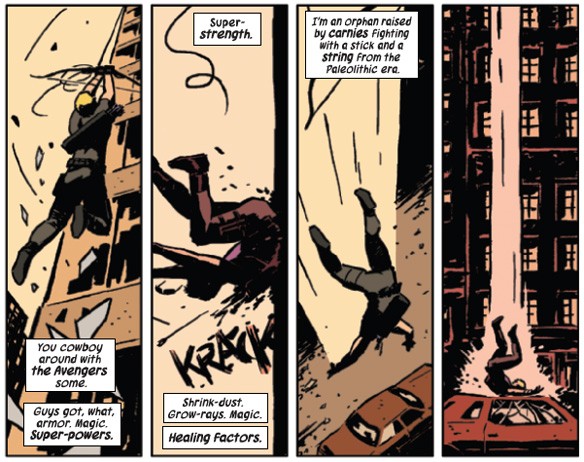
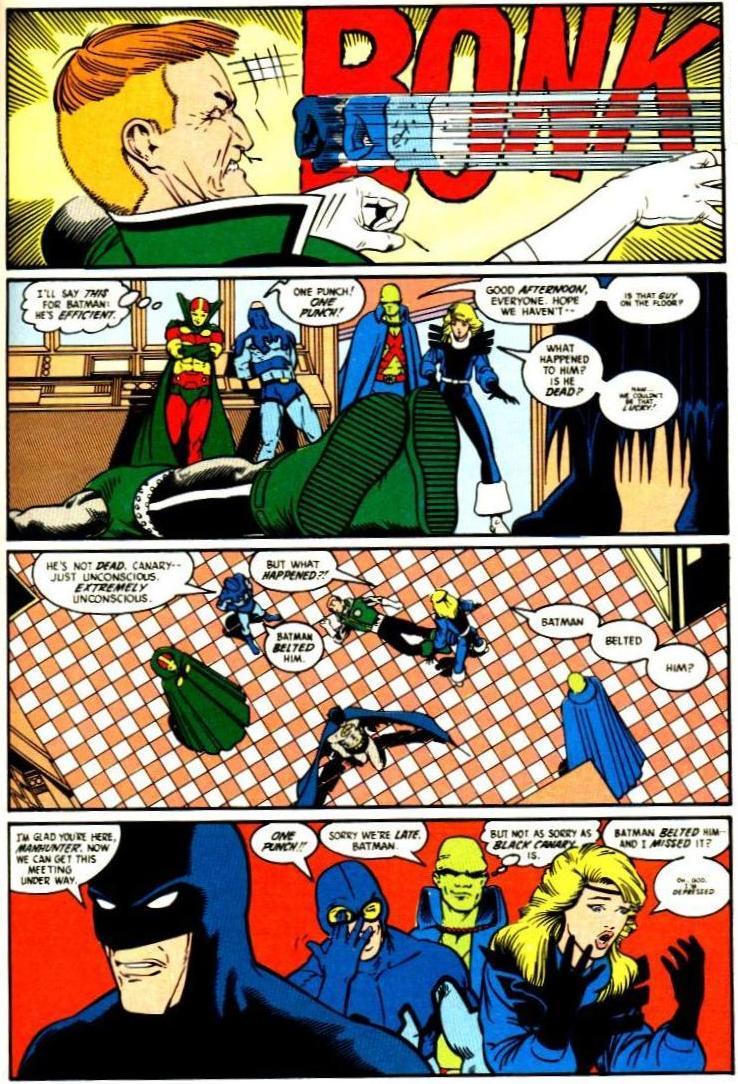
Heart of Ice


Yesterday, we got our first glimpse of Alan Moore and Kevin O'Neill's first post League of Extraordinary Gentleman: Century collaboration, which stars Captain Nemo's daughter, Janni. You can read the full synopsis on the Gosh Comics site.

This project, which must be set between the first and second Century volumes, is in particular interesting because both its length and its solicitation text seem to suggest that it is going to be much simpler than that recently concluded arc, which was so thick with reference and allusion that it often seemed a parody of Moore's original project. Here, we get a short work, only 48 pages, and only two explicit references to the tradition in literature in English, Poe and Lovecraft, Americans both (no matter how much H.P wished he'd been born across the pond). Invoking those two suggests that Heart of Ice is going to dark and horrifying as well as lithe, a prospect that has my pulse up, if only a little. Of course, the quality of the project is going to be directly related to whether Moore can control impulses towards excess-- if he can, this may very well be the best League adventure since the band got back together.

A Note On Ed Brubaker's Move From Marvel

So long, Ed! (source)
I want to take a moment to talk about last week's news that Ed Brubaker is leaving Marvel in January, when he entrusts his Winter Soldier scripting duties to Jason Latour's very capable pen.

Since the announcement of Brubaker's imminent departure from Captain America, I've been been thinking about doing a rather extensive annotation of his run with the character. Such a project would be both massively enjoyable and massively time consuming, and I'm not sure if I have the wherewithal or, more importantly, the knowledge base, to do it properly. Now that I know that Brubaker's time with the House of Ideas is coming to an end, my impulse is to expand the scope of my annotations, which would, of course, mean both more time and more research. Even if I decide not to undertake such a sprawling project, watch this space for a couple of retrospective essays, which will deal with his Captain America work and his writing for and influence on the company in general.

Right now, though, I think its important to talk about what, exactly, is ending when the man who brought back Bucky Barnes walks away from Marvel to concentrate both on his creator owned comics and on ventures in other media. Much more than any other superhero comic book writer in the last fifteen years or so, I think that Brubaker understood that, when he was dealing with Steve Rogers and Bucky Barnes, or even when he was dealing with Iron Fist or Daredevil, he was dealing with the stuff of legend, and so he always approached the material in its own terms, with gravity and without anything resembling irony. Given the generally accepted absurdity of comic book superheroes, it would be very easy to laugh off Brubaker's seriousness as a kind of misreading of the state of mainstream comics, but I think to see him in this way fundamentally misses the point.

Indeed, I've always gotten the sense that Brubaker believes in superhero comics, that he believes in what they're capable of, and that he believes that they can affect the culture at large even if they don't often reach beyond an, unfairly stereotyped, niche market. That he is ambitious in this way is evident, of course, in his politically resonant work on both Captain America and Winter Soldier, but I think it can also be seen in his incredibly well respected Daredevil issues and the Gotham Central series he wrote at DC with Greg Rucka, and in his flawed X-Men work, and in his abortive run on Secret Avengers. His attraction to the big idea, to the conspiracy that takes years to unravel, to the story that takes dozens of issues to unfold, is clear in all of his work, but his ability to use the combination of medium and the genre as a certain kind of more- or less- subtle allegory is what sets him apart from even from the talented writers, writers like Matt Fraction, Jonathan Hickman and Jason Aaron, that are guiding Marvel's bold new direction. What Ed Brubaker gifted to us, more than almost a decade of excellent stories, was a renewed sense that not only could mainstream superhero comics be culturally important, but that they could also be literary, particularly if their readership was willing treat them as such.

Not all of his allegories are played out, yet, and the real shame here is that, for the next few years, even if new writers pull at the threads that Brubaker left behind, the work will probably lack that double ambition, that driving desire to tell stories that matter to everyone and that are also great. Everyone who is going to have to pick up from where Brubaker left off is going to have to deal with this, and I think that, rather than try, most are simply going to give up the gun; Andy Diggle's Daredevil run is the cautionary tale here. There is an obvious exception to this in Winter Soldier, but I wonder if, even with a talented writer like Latour and a movie with that title on the way, the book has any long term prospects without its creator at the pen. On the other hand, Captain America has, in the last year and a half, certainly begun to feel less essential, even as the month-to-month quality of the book hasn't dropped in any significant way, and so I'm not sure that Brubaker is pulling as hard as he used to, not even at his own big ideas. Still, if Rick Remender's high action Steve Rogers as John Carter of Mars new direction for the character is any measure, we're not going to get a chance to see superhero comics done quite as well, or quite as seriously, as Brubaker did them, at least not for a long time.

While this turn is lamentable, it is certainly not disastrous. Its important for those of us in or on the edge of fan communities to remember that nothing lasts forever, and doubly so in this case, since to act like it should, to assume that it would, betrays the high quality and literary aspects of Brubaker's work. Rather than mourn the end of something I love, something I think is important in way that superhero comics tend not to be important, I would much rather celebrate it. There are, after all, volumes of Captain America on my shelf, just waiting to be annotated.

Moloch Whose Comics Are Judgement!

I have to say that, of all these silly Before Watchmen books, the surprise solicited J. Michael Straczynski and Eduardo Risso Moloch is the second most tempting, after that one that I already bought an issue of.

Moral issues and problems with the premise aside, its always good to see Eduardo Risso's name on a comic book, particularly since Spaceman, which had some high quality issues, seems to have fallen off of my pull list for one reason or another. His drawing, when he takes his pen to characters that are not his own, has a revealing, almost transgressive, quality, one that I think is perfect for the Before Watchmen project. And to apply it, of all the Alan Moore creations that have been so far violated in this manner, to Moloch? Moloch, who was more of a cancer-ridden plot device than a real character? Moloch, who, even under Dave Gibbons's steady hand, already looks like something from Risso's sketchbook? This new mini is suddenly the most interesting of the lot of them.

Of course, that doesn't make the Moloch book interesting or in any real way necessary, and it certainly doesn't make the project any less toxic. Although it's hard to look at the preview art and not be tempted to deal with the demon, Alan Ginsberg seems apropos:

What sphinx of cement and aluminum bashed open
      their skulls and ate up their brains and imagi-
      nation?
Moloch! Solitude! Filth! Ugliness! Ashcans and unob
       tainable dollars! Children screaming under the
       stairways! Boys sobbing in armies! Old men
       weeping in the parks!

Barton. Clint Barton.

I've been waiting for this book for a long time. Or, more precisely, I've been waiting for the successor to this book for a long time-- four years too long. Those first sixteen issues of The Immortal Iron Fist, those issues that Matt Fraction and Ed Brubaker wrote, those issues that David Aja drew, are certainly among the best superhero comics of our young century, and may very well be the best superhero comics produced in that century's first decade. But then Brubaker, after a little more than a year on the title, went back to concentrating on Steve Rogers for a living. Soon after, Fraction and Aja wrapped up the run, with the writer becoming Marvel's golden boy and Aja retreating, for the most part, back to Spain, doing an issue here and an issue there, dropping a few covers when he could.

I return to The Immortal Iron Fist on a pretty regular basis, out of nostalgia as much as awe, and, last April, it was good to hear that two thirds of the band was coming home for a series featuring the newly famous purple archer. Although Jeremy Renner's Hawkeye was the least developed and least seen presence in Joss Whedon's movie, the character still represented newly fertile ground for a decidedly West Coast Avenger-- if Fraction and Aja could drag Iron Fist back into the spotlight, after Brian Bendis, through sheer force of well, had done the same with Luke Cage, surely they could do the same for the Archering Avenger, right? Even though his last crack at an ongoing series was a massive, relationship ending, flop?*

Well, it turns out, they could. Hawkeye #1 is so close to a perfect 32-pages-with-advertising comic that pointing out its one flaw-- there's a panel that needs to be flipped in order for the characters' movement to make sense--seems like nitpicking. Fraction's writing is a joy, dense and clear, like, but not quite as much of a workout as, the best of his Casanova work. That book is probably the closest analogue to what he's trying to do here, not only because Hawkeye doesn't really resemble anything that either Marvel or DC is putting out right now, reading much more like one of those brilliant new Image books, but also because Fraction is very clearly pointing to the fact that he's going to be writing a certain kind of espionage story. The James Bond nods, one an explicit reference and the other a kind of easter egg, are a dead giveaway, but the subtler clues, the just this side of too clever references to Hawkeye's relative obscurity as a character ("...are you, like, Iron Fist or something?"), the way he passes unnoticed in his neighborhood, despite a conspicuous amount of purple in his wardrobe, suggest that this is a sort of anti-Avengers book, an attempt to figure out the hero that Barton is when no one is watching.

Given that, the closest cousin that Hawkeye does have amongst the current cohort of Marvel or DC series is Ed Brubaker's Winter Soldier, another superb spy project starring a less than well known character. But Brubaker writes a different sort of cloak and dagger than Fraction, more serious and less self aware, straight up espionage, really, while Fraction and Aja are just sort of winking and nodding at its conventions, and not those conventions alone. The duo mix their Ian Fleming references with homages to famous panels and reflections on the absurdity of an archer's presence on a team made up mostly of gods and supermortals, that is, the simple fact that a man who shoots a weapon from the paleolithic period is out of place on a team featuring Thor and a man with a reactor where his heart should be. In emphasizing these things, Fraction and Aja are reaching beyond Clint Barton and trying to say something about superheroes, or, more precisely, superhero comics, in general.
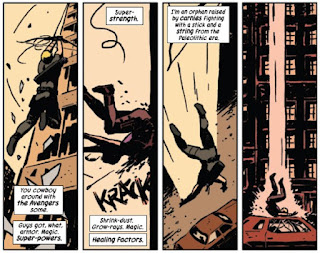

The punchline, it seems to me, goes back to how inconspicuous Fraction makes Barton, the fact that someone only recognizes him once in a while. Partially, that line is clever because it reads as a joke on how many times Hawkeye's costume has changed, but, truthfully, it moves beyond clever and into something resembling scholarly. Consider this: all comics, superhero or otherwise, work because of iconography, and not just obvious Captain America or Batman men-in-tights-with-their-own-homemade-logo iconography. We know that the talking mouse with the cigarette is Art Spiegelman the same way we know that the character with that one Curt Swan curl on his forehead is both Clark Kent and Superman. Icons are what makes comics intelligible, what makes them possible. But they're also what makes superheroes memorable-- this is why such characters found their natural home in the funny books-- and, without his bow, there's absolutely nothing iconographic about Clint Barton; as Fraction has himself has suggested, there's a much more famous character in American popular culture with that nickname:

I'd totally read a Fraction and Aja M*A*S*H comic. 
I would even go so far as to say that Barton's bow isn't iconographic the same way that, say, Spiderman's chest-spider is. The weapon represents Hawkeye, for sure, but it could just as easily represent a character at a rival comics company who is, with the exception of a slightly greener color scheme, essentially the same, or it could present him as an an American Indian stereotype or an Olympian. The bow, as a symbol, simply isn't specific enough to be powerful. Peter Parker's spider symbol, however, only really means one thing-- your friendly neighborhood Spiderman. This is why the Clone Saga, despite its poor execution, could have been terrific: the plot exploited a formal quality as the crux of the story. Fraction and Aja seem to have realized that his lack of significant or interesting iconography is Clint Barton's great flaw, the reason that he's never been successful except as a part of a group of much more immediately recognizable characters, and are making that flaw work for them rather than attempting to overcome it. 

That recognition, perhaps aided by the character's relatively limited presence in The Avengers, is why people, primarily people like me, have responded so well to the first issue of Hawkeye: Fraction is writing Clint Barton as the schmuck he's always been, he's just doing it with the mask off. It just turns out that Barton is much more interesting as himself, when someone is being honest about the fact that he lacks the heavy duty icons necessary for stardom, than he is as the purple archering Avenger.

--------------
*That's not entirely fair-- it just turns out that people were about as interested in Hawkeye and Mockingbird together, again, as they were about either alone.

Quote for the Week: Bart Beaty

Comics scholars receive very little condemnation when we teach Crumb, Spiegelman and Ware (and Satrapi and Bechdel and…). When we do receive raised eyebrows is when we teach  Archie and other works that are “not serious” or “not sophisticated”. The route that the comics world might have taken would have been to fundamentally challenge that ideology. To reject those sorts of claims altogether. If you look at the type of work that we’ve published as scholars and taught as teachers though, we’ve largely failed to do that. And I include myself in that group even as I recognize that this might have been the more productive direction to go.

- Bart Beaty, talking about his new book Comics versus Art, on the marvelous unrealized promise of academic comics studies.